Sunday, June 11, 2023

Monday, December 19, 2022
Saturday, July 30, 2022
Wednesday, June 1, 2022
060122 Young Bluebirds Make a Big Hit With Everyone

052722 Juvenile Eastern Bluebird

Adult Male Eastern Bluebird
The proud father attending to his three juvenile birds. Two winters ago, there was a freeze that lasted for quite some time that was responsible for the deaths of both bluebirds and Carolina Wrens. The bluebirds have taken it upon themselves to increase their numbers, but the Carolina Wrens are few and far between. There are other nesting wrens in several neighborhood locations.

053122 Juvenile Eastern Bluebird
In a more shaded area, this juvenile bluebird can be seen sporting its spots and its lack of the adult plumage. Isn't it beautiful?

060122 Male Northern Cardinal
This lovely cardinal was actually within the tangled trees and brush of Heron Cove. Who thinks that there could easily be a nest in there? One of the nest locations disappeared, as cleanup efforts were undertaken by the city and some valuable habitat was removed. However, there is still plenty of habitat here and many birds are nesting this this wonderful area, including the Brown Thrasher, Warbling Vireo, Red-winged Blackbird, Mourning Dove, Green Heron, grackles, Eastern Kingbird, and plenty of others.
Saturday, February 5, 2022
Saturday, January 15, 2022
Saturday, January 1, 2022
Saturday, December 25, 2021
Monday, July 6, 2020
Sunday, June 14, 2020
Monday, April 6, 2020
040620 Spring Migrants and More at Boomer Lake

032920 Abatement Team
I had seen small orange flags on metal wires in the ground at Goose Island over the years, but never knew that it was for egg addling by licensed abatement teams. Having observed what appeared to be biologists banding Canada Geese, I never gave it a second thought, as there were usual several large families of Canada Geese in some instances. This is how we keep birds from getting too overpopulated, since these geese are residents. Canada Geese are known as pest birds in many communities, and there are federally licensed abatement teams that perform this service. The geese are uninjured, while their eggs are no longer fertile. The geese try to hatch dead eggs and nobody is killed.

033020 Ruddy Ducks
The lead bird is a beautifully fully plumaged duck. Note his bright coloration and bright blue bill. This animal is a show stopper in breeding plumage. The rest of the birds are female. They should be heading north to breed soon.

040220 Lesser Scaup
The Lesser Scaup winters in the southern part of the country as well as in the west. Some of them are already in their way to the boreal forest and northern parts of the US to breed. This is a lovely example of the adult male. The species favors fresh water and smaller lakes, and is a common and widespread duck.

Ditto, View 2

040520 Baird's Sandpiper
This High Boreal breeder has long, tapered wings making it well adapted for lengthy flights. They usually complete their migration from Tierra del Fuego to the High Arctic in as little as five weeks! Known as the "grasspiper," they forage in drier, more vegetated habitats than most other sandpipers.

Lesser Yellowlegs
This thin, long-legged shorebird is unable to hide those bright legs, which is its namesake. It will run after prey on land, usually found walking in shallow water picking up food either at or just below the surface.

040620 American Avocets in Flight
One of the most beautiful of birds, the American Avocet is sometimes involved as a brood parasite, laying their eggs even in the nests of other species. Other shorebirds will sometimes to the same to the avocet. They often place their nests on the ground with nothing to provide shade. However, they will dip the bellies in water in water during incubation.

American Avocet, View 2

American Avocet, Detail

Northern Cardinal
Isn't she lovely?
Sunday, March 8, 2020
Sunday, September 29, 2019
Friday, May 17, 2019
Secret Lives of Birds and the Mulberry Bush

Scissor-tailed Flycatcher

Canada Gosling

Cedar Waxwing
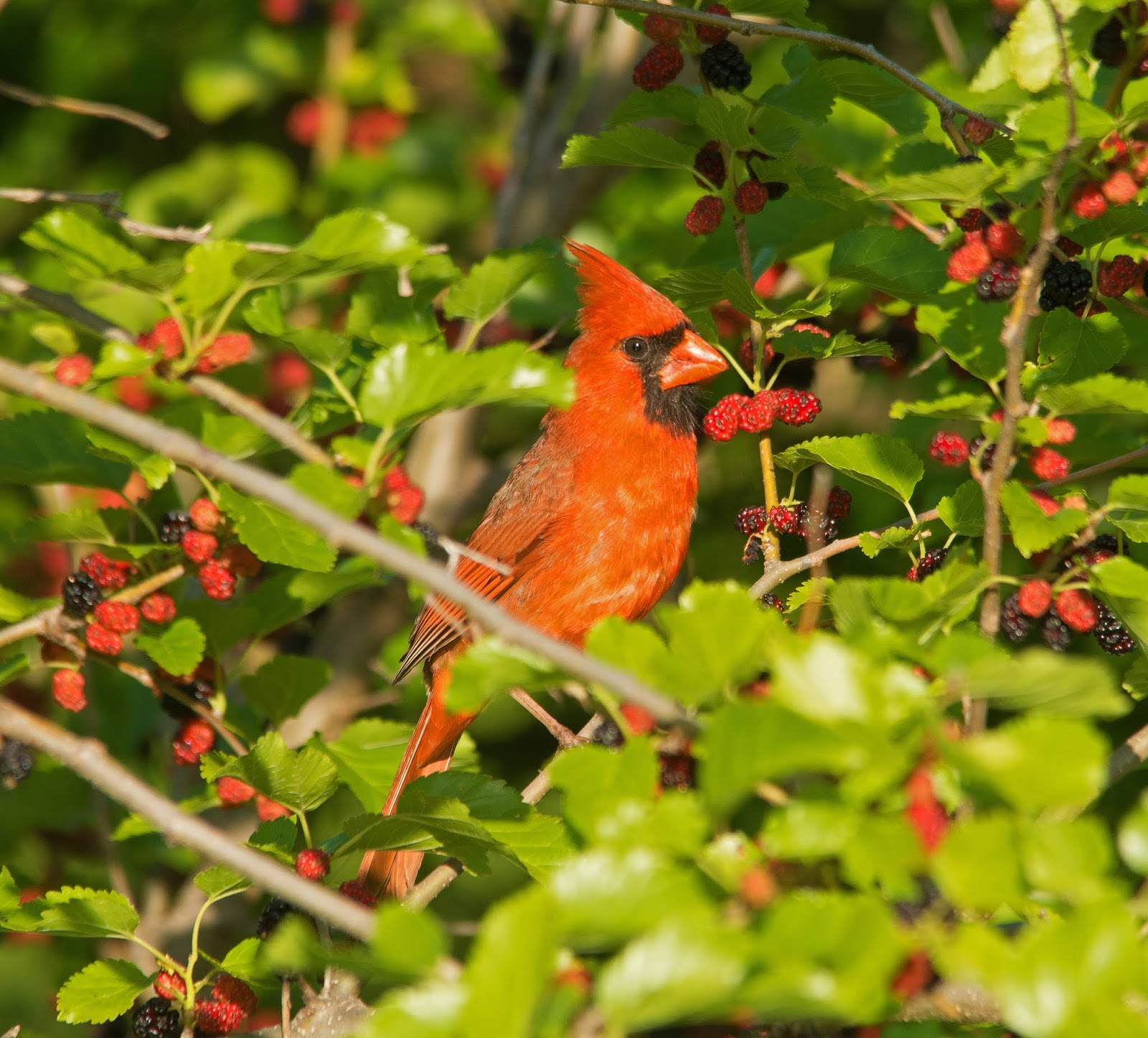
Northern Cardinal

Swainson's Thrush

American Robin
Week of 051319
Another seven days of productive migratory and resident bird views. As can be observed, the mulberry bush drew in a lot of birds, even during nesting season. However, young birds like nestlings, fledglings and juveniles require protein, not the adults. The young need food to help them rapidly grow, so they can migrate, if necessary.
However, the mulberry allowed many adults to capitalize on sweet treats while they were working hard to feed young.
Sunday, January 6, 2019
Sunday, July 15, 2018
Saturday, February 24, 2018
Sunday, June 4, 2017
Gratuitous Findings at Boomer Lake For All

Green Heron

Great-tailed Grackle #1

Great-tailed Grackle #2

Barn Swallow

Diamond-backedNorth Watersnake

Male Northern Cardinal

Mallard with Ducklings

Green Heron in Nest

Ruddy Shelduck

Ditto

Canada Goslings
05-29 - 06-04-17
This week gave us a little bit of everything for the season, but the Ruddy Shelduck was a
bonus, who I actually saw arrive at 1110 hrs. on 06-03. This was the original bird that
came to stay with us for about a week. It then left the area, and I was told by a resident that it
had spent time at The Links, also for nearly a week.
Our Green Heron has been on her nest on and off, again for what seems to be an extended
period of time.
Young birds are in abundance on the lake and many birds have been and are with young. There are three sets of Mallard ducklings that I know about, and an easy dozen families of Canada Geese.
This male Cardinal's female refused a photograph, as she is presently molting, but he appears to be
in a fresh set of feathers.
It has been more than a challenge to find the Cliff Swallows at rest, but another Barn Swallow managed to accommodate. When they were here, the Rough-winged Swallows sat en masse upon
a snag.
We experienced a little rough patch of weather, but it wasn't much of a deterrent for the birds. Let's see what next week holds.
Sunday, April 23, 2017
Green Herons Have Returned and Are Now Nest Building

Green Heron

Yellow-rumped Warbler

American Robin

Mallard
Blue-winged Teal
Female in Front

Neotropic Cormorant

Barn Swallow

Northern Cardinal

Barn Swallow

Barn Swallows
04-16 to 04-22-17
This was a good week, too. Perhaps it wasn't as much as last week for migratory action, but photo ops were still excellent, even though we did have rain and a couple of cloudy days. It is to be expected.
The biggest news is that our Green Herons have moved back in at Heron Cove AND I noticed today that nest building is going on. I actually photographed the nest this morning, as it can be seen being
built. It is right over the water and high, which makes it perfect from where I stand to observe it on the berm. The birds that returned are the elder birds, and there is at least one more in residence, but in another tree. Isn't that exciting? We could well have an early crop of Green Herons if conditions are right, so keep your fingers crossed!
Three Spotted Sandpipers were seen on Tuesday, once the fog cleared, of course.
A Sedge Wren has made an appearance at the lake, which only happened once before, but this year I heard the bird for two days now and actually got a glimpse of it this morning. Perhaps it will stay long enough for me to have a photo.
Also today, there were four Clay-colored Sparrows at our beloved Boomer, three of whom are in the same area. They breed in the northern states above us, as well as in the southern part of the Canadian provinces. They are all recognized by their buzzing trills, which sound more insect-like, but they are heard easily enough, if not seen. They don't try to stay concealed like our Sedge Wren, though.
My good fortune was also in the cards yesterday, when a couple of the Barn Swallows stopped to land. They don't do this too often, which is why I was able to get some photos of them to show you what they look like standing still. There were Cliff Swallows in the mix, but they were not as accommodating. There was also a Tree Swallow, but that picture didn't turn out well with the cloud cover that kept interrupting.
There are still plenty of Yellow-rumped Warblers coming in from the south, and before we know it, our group will be leaving here for all points north in order to breed. I think the best photo that I have of a male Yellow-rumped Warbler is in the above posting, so luckily I was able to do that this spring. When the warblers return in the fall, they are much duller looking, which is one of the hazards of the fall.
Looks like good weather is ahead, so hopefully there will be a few more things for me to show you in the near future.
Wednesday, April 12, 2017
A Peregrine Falcon Makes a Migratory Pitstop

Peregrine Falcon

Yellow-rumped Warbler

Blue-winged Teal

Northern Cardinal

Beaver with Branch

Great-tailed Grackle
04-02 through 04-10-17
Spring gives us a little early action, with the addition of the migratory Peregrine Falcon. These
raptors only pass through Oklahoma. A juvenile bird was observed a couple of days prior to this one, and I never realized what it was until it was too late. Sadly, I could have had a beautiful airborne shot, but I'll settle for this one, even though it was quite a distance away.
A Red-tailed Hawk chased it away with its territorial scream, so I was very fortunate to have been in the right place at the right time.
The Great-tailed and Common Grackles have been around for a couple of weeks now, and I do so
enjoy finding them in the midst of the foliage.
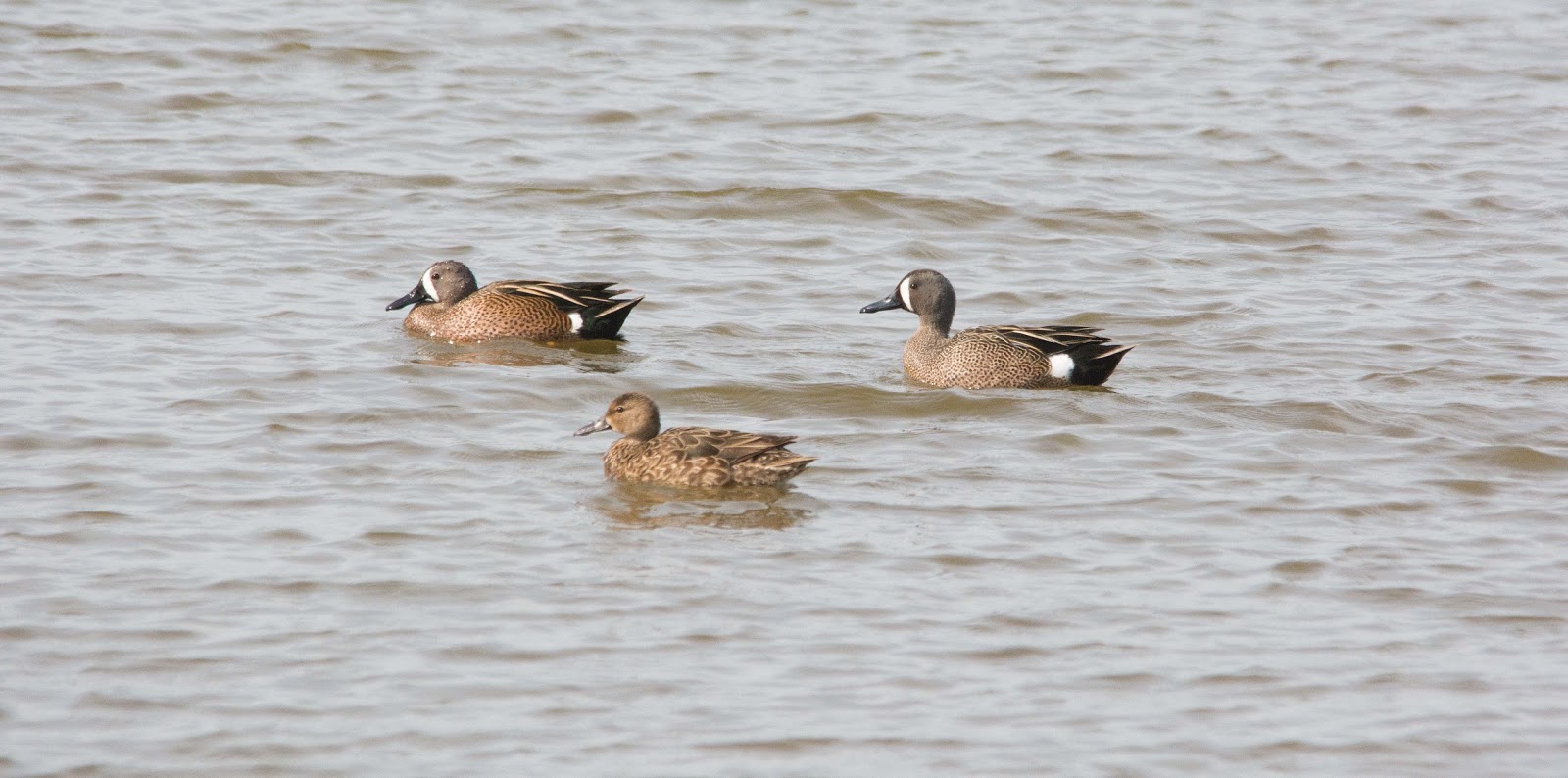
These Blue-winged Teal males were asserting their dominance in the midst of the females.
I had lost track of our beaver and found him on the opposite end of the lake carrying a large branch.
It's no crime to move periodically into better territory.