Showing posts with label Swainson's Hawk. Show all posts
Showing posts with label Swainson's Hawk. Show all posts
Saturday, April 4, 2026

Saturday, September 3, 2022
Sunday, November 22, 2020
Sunday, April 5, 2020
Sunday, March 8, 2020
Sunday, October 20, 2019
Wednesday, May 1, 2019
Birding On a Shoestring: Upper Rio Grande Valley in Texas

Female Lesser Goldfinch

Male Lesser Goldfinch, Breeding Plumage

Grasshopper Sparrow

Jack Rabbit

Swainson's Hawk

Juvenile Northern Mockingbird

Spadefoot Toad
The top two photos were taken at what might be San Felipe Creek, a small riparian area with native plantings. Living space was across the creek, including non-native plants and an orange tree in one back yard. All three kingfishers would travel up and down the creek, which also extended to another area that included both Neotropic and Double-crested Cormorants, assorted doves, kingbirds, a Yellow-crowned Night-Heron and a Spotted Sandpiper.
The Grasshopper Sparrow photos are followed by a Jackrabbit, which was actually a party of three Jackrabbits at one point and a lovely Swainson's Hawk. It threatened rain that entire day, but we missed the brunt of it, which moved off elsewhere.
The juvenile Northern Mockingbird and Spadefoot toad came from a couple of retired ranches that were saved for their intrinsic natural life and native plant and tree growth. Fortunately ranchers are responsible for a lot of native plantings that are reintroduced on their property to make the area better for the land, animals being raised there, and the natural life that it supports through the love of wildlife.
Thanks to all the ranchers that made and continue to make all of this possible by refraining from invasive growth.
Sunday, September 9, 2018
Tuesday, August 21, 2018
Oklahoma Breeding Bird Species Profile: Swainson's Hawk
A lanky hawk of the west, desert, prairie, and farmland, the Swainson's Hawk is one of four buteos with four notched primaries (as opposed to five). They are uncommon and hunt from the air, a perch (still-hunting) or even upon the ground, running after their quarry. They generally feed on reptiles or small mammals in summer, then resort to grasshoppers, locusts, and other invertebrates for the remainder of the year.
Known as the locust or grasshopper hawk, this handsome bird was named after William Swainson, a British naturalist. Swainson felt like many of us do when it comes to living things. They were an inherent passion.
Suspected to have a migration range of 14,000 miles, this raptor is likely the longest traveler in the family of hawks. Wintering in Argentina or Southern Brazil, immature Swainson's Hawks can see their way to southern Canada by late March and their migration can peak from mid-April forward.
Having diverse and somewhat unusual eating habits, this hawk will take Mallards, fledged Lark Buntings, incapacitated Sage Grouse, toads, salamanders, whip snakes, the American Kestrel, young Short-eared Owls, and several others. They are also known for hunting upon freshly plowed fields for rodents, and are opportunistic feeders, as well.
These birds come in a light, intermediate and dark morph. Oklahoma has the lowest percentage of dark morphs, while California has the highest. They can behave similarly to the Northern Harrier by flying low to the ground at times. Wingbeats are deep and loose, and they will soar with wings in a dihedral angle, or an angle between two intersecting planes. They glide like an Osprey would. These are all tell tale signs of how to spot the bird on a hawk watch.
Last year, while visiting the Oklahoma Panhandle, these were relatively common, perching on telephone poles and fence posts. This photo came from that area, with the sun behind the bird.

Swainson's Hawk
Cimmaron County, OK
Another interesting point, also from last year, was during monarch migration. A notation was made on a butterfly site to go outside and look up, which I did. I saw no monarchs, but observed fifteen Swainson's Hawks heading southbound. It was one of the most remarkable sights ever seen, especially with the way that the light struck the underwings and their breasts in late afternoon, as they simply glowed.
Swainson's will hybridize with Red-tailed and Rough-legged Hawks, but it is questionable if Ferruginous Hawks are in the mix.
Saturday, May 20, 2017
Birding On a Shoestring: Life on the Oklahoma Panhandle
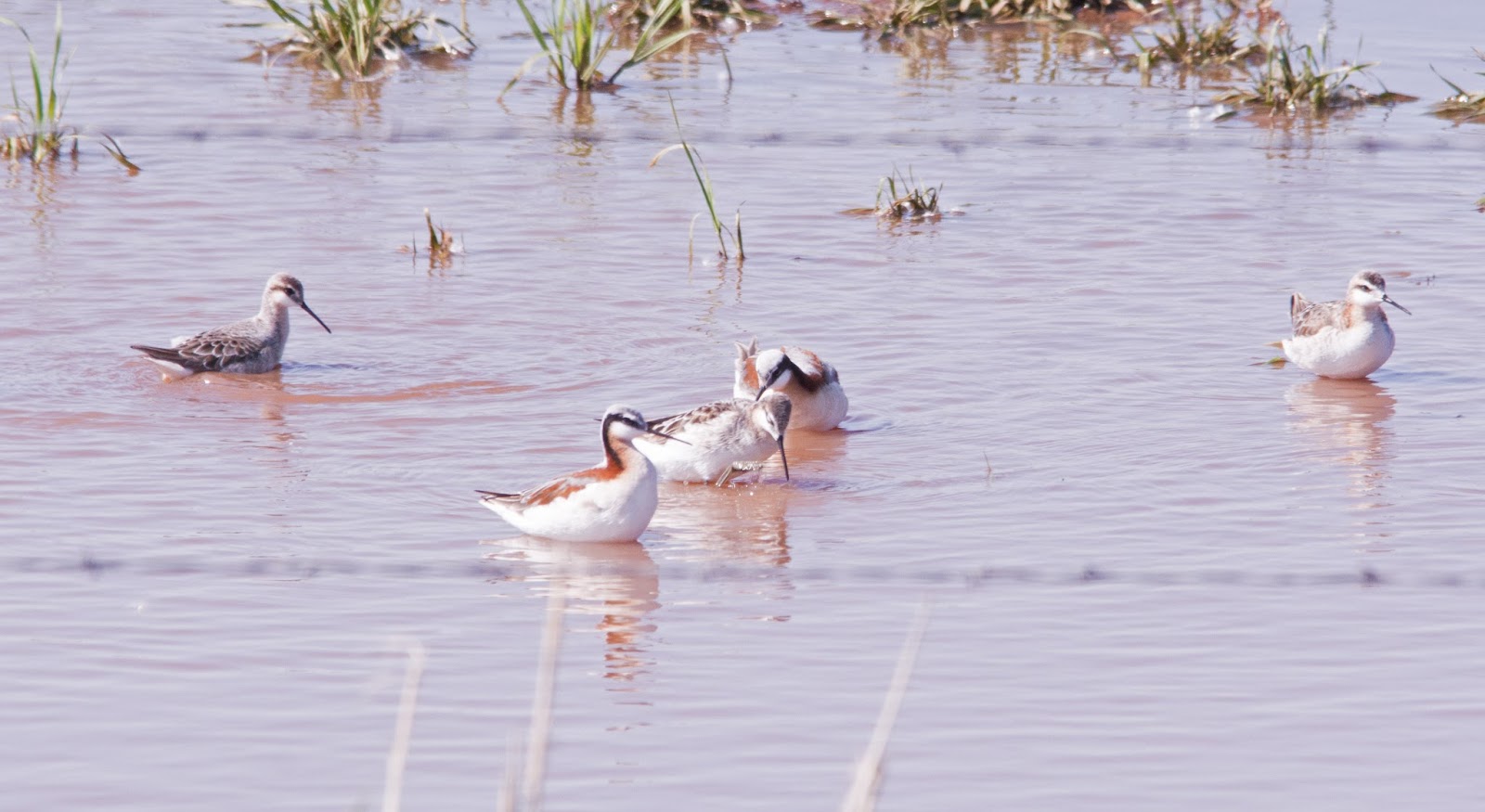
Wilson's Phalarope

Stilt Sandpiper

Wilson's Phalarope

Ditto

American Avocet

Wilson's Phalarope

Lark Bunting

Western Meadowlark

Lark Bunting

Long-billed Curlew

Loggerhead Shrike

Pronghorn Antelope

Swainson's Hawk

House Finch

Juvenile Say's Phoebe


Cassin's Kingbird

Female Bullock's Oriole

Male Orchard Oriole

Chipping Sparrow

White-crowned Sparrow

Male Pronghorn Antelope

Say's Phoebe

Female Black-chinned Hummingbird

Male Black-chinned Hummingbird

Lark Sparrow

White Tailed Deer (Doe)

White Tailed Doe and Fawn (Left)


Ash-throated Flycatcher

Ditto

Canyon Towhee

Cassin's Sparrow

Rock Squirrel

Mule Deer

Black-chinned Hummingbird Nest

Burrowing Owls

Burrowing Owl
Friday, 05-12 through Monday, 05-15-17
This was a trip that I had been wishing for a little over a year, and when the opportunity arose,
my heart was filled with joy. Photos were obtained from the entire panhandle of Oklahoma, which encompasses Beaver, Texas, and Cimarron counties. It holds a wide range of important ecological regions in the state, which makes it an unusual area for western and eastern birds to converge.
We observed long and shortgrass prairie regions, pinyon-juniper habitat, sagebrush wild lands, brushy chaparral, mesa tablelands, Rocky Mountain foothills and rock mesa faces. With these diverse and desert lands came a remarkable and wide range of mammals and birds, most of which I had never encountered before.
Unfortunately, I managed a quick look at one small lizard common to eastern Oklahoma and Texas and met a common garter snake. I had hope for a prairie rattlesnake, but that wasn't in the cards for
this trip.
Many birds were seen but not photographed, like the Common and Chihuahuan Ravens and Prairie Falcon. The Lazuli Bunting and Marsh Wren were heard, along with the Common Poorwill and Western Screech Owl.
As you can see, many beautiful mammals were captured and many birds indigenous to the region, but many more were not. Perhaps this will create a need for a future trip, but it took nearly a day to get
here. The journey was well worth it, and it enriched my first trip to this most important birding area.
These are lands that must be protected at any cost, for our grassland birds are in danger. We have seen great decreases in their presence over the years and the fight for their survival is great, including the Lesser Prairie Chicken. We must make saving their habitat a prime endeavor and you can help by donating to the cause and not buying homes here or destroying this habitat in any fashion. Please help me help THEM.
Perhaps you will enjoy these photos as much as I enjoyed taking them. If you have an interest in this area, which I believe you will after seeing these striking animals, you can help by spending time at Black Mesa State Park and the Black Mesa Bed and Breakfast caters to birders at the Black Mesa Tableland region. Many ranchers raise cattle here and are helping to keep the ecological region alive and well. I tip my hat to these people for this and support their efforts.

Red-headed Woodpecker

Turkey Vulture

Blue-gray Gnatcatcher
Monday, 05-15-17
The grand finale before the return trip home was in Woodward county, just east of the panhandle.
These were all species found at home, so they were just for the fun of it, and one last hurrah. We tried for the Barred Owl, who was not co-operative, but she had young in the nest hole, so it wasn't her fault. Our timing was poor.
Subscribe to:
Posts (Atom)