Showing posts with label Cliff Swallow. Show all posts
Showing posts with label Cliff Swallow. Show all posts
Sunday, June 11, 2023

Thursday, May 26, 2022
052622 Late May Rains Hold Up Some Migrants, But Not Others

051722 Eastern Wood-Pewee
Today the Least Flycatcher was heard, but this character popped out at the end of the trip.


052422 Orchard Oriole
This Orchard Oriole was observed between raindrops on the second rainy day of four.

Great Crested Flycatcher
A pair of these birds were observed looking for protein when the rain held off for a while.

052622 Cliff Swallow
This was the snag that a two Cliff Swallows had an interest in, though many were scouring the area for gnats and other tiny insects. They rarely perch as their feet are somewhat rudimentary since they spend so much time on the wing. Writer also tried for shots yesterday, but it began to rain and that made me more interested in heading home.

Canada Goose
A pair of Canada Geese preferred this quiet wet part of The Lowlands in which to set up a respite. Photo taken to show a little water depth.
Saturday, April 30, 2022
Saturday, September 18, 2021
Saturday, May 1, 2021
Saturday, April 24, 2021
Monday, September 21, 2020
092120 Migratory Gulls, Swallows, Waders, and Shorebirds to the Rescue in Fall

090420 Spotted Sandpiper
This is a non-breeding bird, common for this time of year. Though the Spotted Sandpiper is known for its spots, not all birds will sport them now, especially those molting just before migration into winter plumage.

090920 Blue-winged Teal

090920 Blue-winged Teal
At first appearance, it appeared that these were simply Blue-winged Teal. If one looks a little closer, te green speculum can be seen at the edge of the femoral tract.


091020 Great Blue Heron

Cattle Egret
This loner was among a group of several protective Great Egrets on Shorebird Jetty on this rainy day when many waterbirds were out of the skies.

Pectoral Sandpiper
This was a nice find among the many more common individuals.

The "Silent Sentinel" at its best.


Franklin's Gull

Least Sandpiper
This may be the smallest sandpiper, but it is still beautiful in breeding plumage.

Cliff Swallow
It is rare for these birds to be perched due to rudimentary feet, but it happens on occasion.

One could say "three on a match." Note the red tip on the bill, one of the distinguishing characteristics for this species.
Some of these were before and after the Wyoming adventure, but it is always good to return to familiar grounds, especially in the midst of migration.
Saturday, July 25, 2020
Sunday, June 21, 2020
Wednesday, May 13, 2020
051320 Yesterday's Rain and Clouds Yielded Good Finds


Cliff Swallow

Bell's Vireo
Bright Eastern Subspecies
051220
Birding was done in two segments yesterday, as the weather began as very inclement. It stayed mostly cloudy the entire day, but between 0740-0819 when out the first time, the wind chill was 43 degrees and it was either drizzle or light rain. We began and ended the morning at Heron Cove with four Pied-billed Grebes, one Black Tern, Spotted Sandpipers, Double-crested Cormorant, Great Blue Herons, a southbound Great Egret, a couple of Downy Woodpeckers, Least Flycatcher, Fish Crow, f Purple Martins, a handful of American Robins, Cedar Waxwing, several European Starlings, Baltimore and Orchard Orioles, Red-winged Blackbirds, Great-tailed Grackles, nine Yellow Warblers, and a couple of Northern Cardinals.
23 species were observed in 39 minutes.
The return trip was made shortly after 1400, when the above shots were taken. There were more Black Terns, one of which was shot at Shorebird Jetty. A couple of Forster's Terns were found off the southwest jetty on a snag in the water. There were several Spotted and Least Sandpipers as well as a dozen Cliff Swallows, one perched on a snag north of The Jetty by Finch Corner.
We also located Eurasian Collared-Doves, Mourning Doves, a Red-shouldered Hawk being dive bombed by Great-tailed Grackles, as well as a Gray Catbird, Carolina Wren, and Brown-headed Cowbird.
The Bell's Vireo was found on the west side of Bald Cypress Row, south of Shorebird Jetty, as was the Great Crested Flycatcher.
Further along, we encountered a Western Kingbird, Northern Flicker, more Yellow Warblers, and off the last eastern jetty just prior to Goose Island were thirty Blue-winged Teal, three Northern Shovelers, and two American Coots.
The afternoon trip gave up 43 species in 2 1/2 hours.
Saturday, August 3, 2019
Birding On a Shoestring: Quivira National Wildlife Refuge, Kansas

Black-necked Stilt

Long-billed Dowitcher

Assorted Shorebirds #1

Snowy Plover

White-rumped Sandpiper

Baird's Sandpiper

White-rumped Sandpiper

Assorted Shorebirds #2

Assorted Shorebirds #3

Greater Yellowlegs (Left)
Killdeer (Right)

Greater Yellowlegs (Center)
Baird's Sandpiper (Right)
White-rumped Sandpiper (Left)

Northern Cliff Swallow

Ruddy Duck and Ducklings

Blue-winged Teal (Front)
Immature and Juvenile American Coot (Center and Rear)

American Coot Adult (Left)
Recently Hatched American Coot (Right)

adult male Black-necked Stilt (Rear)
Juvenile Black-necked Stilts ( Center)
adult female possibly on nest (Front)
072719
Taking about five hours, my birding buddy and I arrived at Quivira around 1130ish. Several area residents had informed us at pitstops that there had been plenty of rain this year, so we could expect some wonderful birds. This information was taken to heart, and the more observed, the better it got.
Primed for this adventure, my eyes had been on weather conditions, past and present. It was a given that this adventure was a little too early for both the Red Knot and Buff-breasted Sandpiper, but it was a solid time for the many resident breeding birds and their offspring. There was no disappointment.
The first thing we did was visit the tower area, which had good views of Barn Swallows, Black-necked Stilts in flight that were constantly calling, Great Egret, Great Blue Heron, Spotted Sandpiper, and more.
Eventually making it to Little Salt Marsh, the numbers and species of shorebirds was thrilling, even though many of the most common migrants were there. Just seeing them in their natural state, both on the shore and foraging in the shallow water brought back memories of home in Maine.
Though my hunt for the Bobolink was unsuccessful, a fabulous photo of the Northern Cliff Swallow was unparalleled. There are hopes to return to another part of KS at a later time when the Bobolink and other target birds will be more accessible.
We drove through the Big Salt Marsh area, where were encountered many water birds, which included the above family of Black-necked Stilts, and took a short walking tour at Migrant's Mile Nature Trail. This was a former marsh that had a little water. Sampling my first sand plums, we heard the Common Yellowthroat, and semi-observed a few others.
The prairie grass area also netted the Northern Cliff Swallow. Many other grassland birds, like the meadowlark and Dickcissels were heard there.
Juvenile American Coots, Blue-winged Teal, Black-necked Stilts, and Ruddy Ducks were somewhat unexpected and most welcome. Never had I observed the young of these species.
Once we arrived, we never left until it was time to resettle round the Cheyenne Bottoms area in Barton County. A short stop was made just prior to the Kansas Wetlands Education Center closing for the day, where we semi-solidified plus for Sunday. Stay tuned for the Cheyenne Bottoms and Cheyenne Bottoms Preserve adventure.
for more on the adventure:
https://debhirt.blogspot.com/2019/08/birding-on-shoestring-cheyenne-bottoms_5.html
https://debhirt.blogspot.com/2019/08/birding-on-shoestring-cheyenne-bottoms.html
Sunday, June 23, 2019
Sunday, June 16, 2019
Day 18 with Young Green Herons and Cliff Swallows

Green Heron #1

Ditto

Green Heron #2

View 2

View 3

Second Youngest

Youngest Green Heron

Youngest (Top)
and Middle Green Heron (Below)

View 2

Middle Green Heron

Two Youngest Green Herons
View 2

Cliff Swallow Fledgling (Center)

Juvenile Cliff Swallows

Juvenile Cliff Swallow

Adult Cliff Swallow
Attending Nestling at Mud Nest
View 2
061119
0700-0837/63-69 F/partly cloudy/SE-6/74-66% RH/30.18 Hg and falling-30.23 Hg and steady
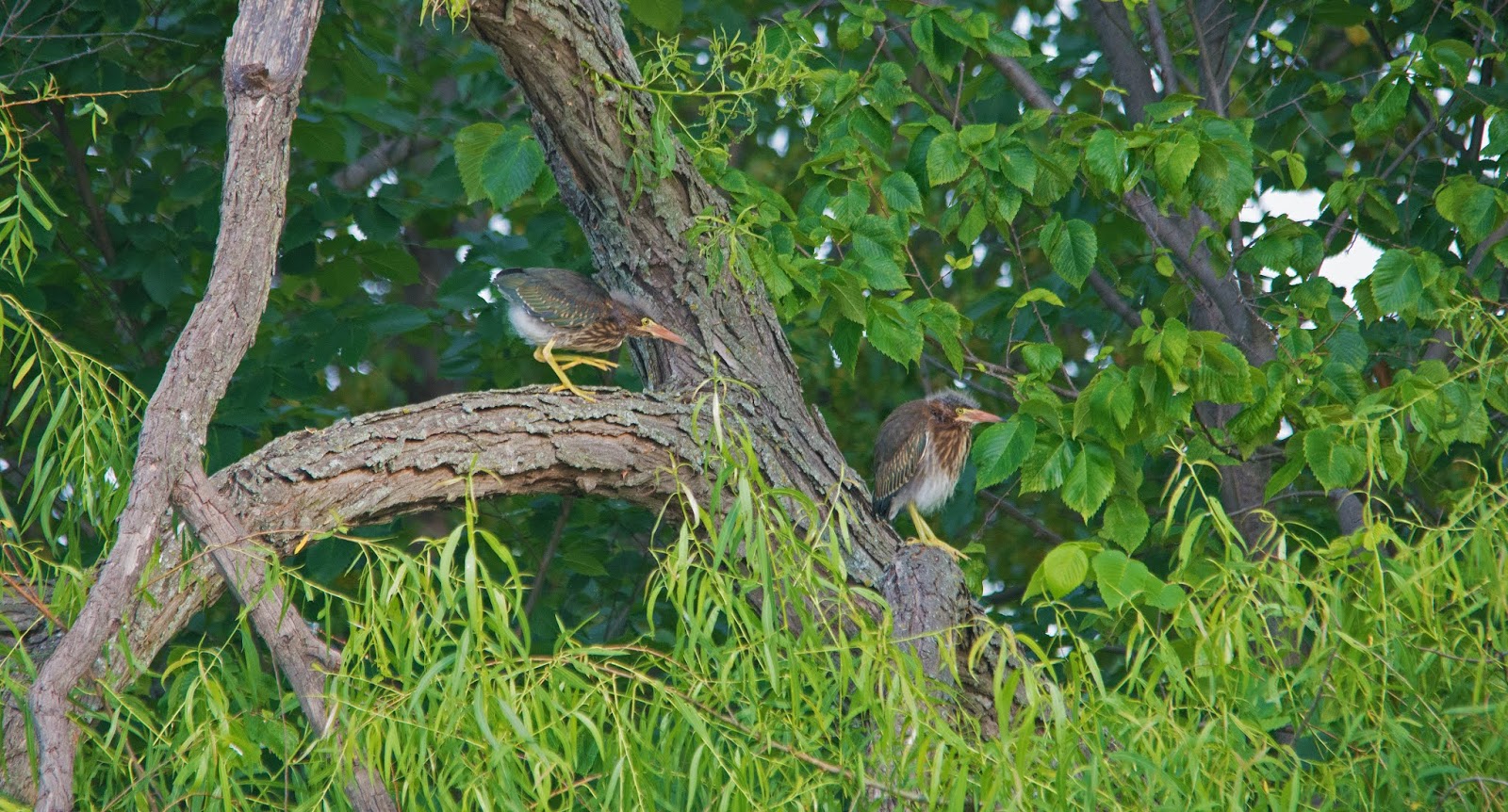
It appeared on this date that the two eldest Green Herons may have fledged, as they could not be located with the others. The helpers were also missing, which tells me that it was getting critical
that these birds begin to fly to start caring for themselves.
The second nest has been attended for a couple of weeks, so it is suspected that there will soon
be more young in the colony that will need exercise/flight attention in ten days to two weeks so another nest can be started.
This was also a good day to hang off the side of the hill at the Lakeview Road Bridge to get more
photos of Cliff Swallows, as more birds are fledging from the nest.
Saturday, June 15, 2019
Green Herons Study and Learn Though Their Surroundings

Barn Swallow

Cliff Swallows
060919
0700-0730/74-75 F/mostly cloudy/NNW-4/77-79% RH/29.99-30. Hg and rising
This was a good day to observe all swallows, as many had finally fledged from their gourd-shaped mud nests along Lakeview Road Bridge. The two swallows that breed regularly in Oklahoma are Cliff, Northern Rough-winged, and Barn Swallows. Cave Swallows have been observed as far south as Manitou in 2015 and photos have been obtained for breeding birds at the Wichita Mountain NWR in 2012 with earlier breeding individuals unproven since 201l. They may have made it as far north as Lake Thunderbird in Norman in 2017. Non-breeders are also seen regularly this year along the Red River, and there could be breeding birds at Red Slough.
No doubt that within the next decade they will be breeding in Stillwater, as well, possibly at Boomer Lake. The higher likelihood could be at Lake Carl Blackwell for Payne County.

Adult Green Heron departs The Cove, as
immature Green Herons await a morsel.

Hopeful Green Herons for slurry

A Parent of Clutch 1

Young Green Herons Explore Home Base

Immature Green Herons Enticed by Other
Species in Flight

Several teen Heron Chicks

Exercise Those Wings

Getting the Right Idea By Watching Others

Rapt Attention On a Passing Great-tailed Grackle

Plenty of Stimulation For Young Minds In Area

Not Missing Anything

Young Green Heron Seeks Flight Instruction

Is Food On the Wing?

Dinner Is Served, But It Won't wait Long

Can You Hear Us Now?

Feeding Frenzy Is About to Begin

Helpers Are Here For Feeding Chores

Moving Around Faster Helps Muscles Grow


Wings and Legs Get Experience


Where's the Fish?


Helpers Make Youngsters Work
For Their Meals

Waiting Nets Nothing

Using Wings For Balance

On the Lookout

Brown Thrasher In Nest

Adults Take a Break

Waiting to Turn Fish to Slurry
061019
0719-0837/64-69 F/clear/N-11/70-64% RH/30.41-30.46 Hg and rising
It's hard work being a Green Heron, unless one is a lazy Green Heron, and like any other bird, survival means work. The young will lollygag for as long as they can, unless they are pushed by family, and sometimes they have to be pushed hard. Observing other species is important and sometimes the basis for flight is learned in that manner, but it must be done quickly in order to survive.
Birds have an accelerated growth rate. They don't live as long as humans and there's a big difference between a two-month-old human and a two month old bird, as they have to migrate during the same year. Hatching in May and heading south on the bird's own power in October is not a lot of time to grow up as a migratory species. This is part of the reason why only half the young make it to their destination for the winter (our winter), and half of those return as helpers the following year.
It is true that the adult males migrate first in many species to set up a territory. The adult female will then follow a couple of weeks later. They then build a nest and get right to business shortly after their arrival in the northern hemisphere to breed. There is no time to waste.
If they arrive when it is too cold, there may be no food in some cases. They may have to wait, and if they arrive too late, some will miss their opportunity for the season. Global warming or climate change waits for no bird.
As time progresses, the cycle may come together for many birds, but there will always be a few that continue to delay, and if that is the case, the species will not survive to prosper. However, birds have been around longer than we have, so they may realize that they must persevere through adjustments.
This will be a learning experience for them and for us. If we choose to negate the data, that is on us, but birds have very real criteria to handle, and their DNA pushes them forward.
Subscribe to:
Posts (Atom)