Showing posts with label Peregrine Falcon. Show all posts
Showing posts with label Peregrine Falcon. Show all posts
Saturday, February 15, 2025

Saturday, July 6, 2024
Saturday, March 16, 2024
Sunday, July 10, 2022
Saturday, February 26, 2022
Saturday, September 25, 2021
Sunday, July 28, 2019
Sunday, September 9, 2018
Friday, September 7, 2018
Oklahoma Migratory Species Profile: Peregrine Falcon
Stooping at a conservative 186 mph, what can possibly escape the clutches of the Peregrine Falcon?
Uncommon in open locales, especially near water, this missile of a bird of prey nests on edges of cliffs as well as within cities upon buildings or bridges. A solitary speed demon such as this to be reckoned with, the peregrine hunts prey such as small or medium sized birds. As seen in the video, it also swiftly dispatches what it considers threats to its young, both real and imagined.
DDT and other equally destructive pesticides nearly eradicated the duck hawk in the mid-twentieth century in the US, but the species managed to rebound with the help of captive breeding.
Falconry has been an avid sport for an easy millennia, and the peregrine was always one of the most coveted of prizes. The only continent devoid of this remarkable species in Antarctica. It also cares nothing for tropical forests or very high mountains, as its talents are squelched in those ecosystems.
It reaches sexual maturity in one year and healthy populations will breed between the ages of two and three. A pair mates for life and they return to the same nesting spot each year. The species is dimorphic, and its markings are unmistakable.
Courtship between a pair is the most acrobatic natural system that one will ever encounter, including dives, spirals, passing food between the two individuals, and the necessity of unparalleled aerial maneuvers to receive the morsel.
Its lineage includes the deadly agility of the Prairie Falcon, where it likely originated in Africa through western Eurasia. Mitochondrial DNA structures tend to surprise the scientific world, for much of its genetics have allowed study and breeding to creat even stronger birds than it originally was made for.

Peregrine Falcon
pen and ink drawing
by Liana Winters Smith
The Perilanner combines hardiness with hunting and similar parenting, and then came the Gyrfalcon to produce large and even more strikingly marked birds. There is even the Perlin, which is a mix with the Merlin.
Peregrines are just as lethal as their own predators, which include the Golden and Bald Eagles. If these birds come too close to the eyases in the nest, they will usually win the encounter, but they usually prefer to keep their distance unless it is warranted.

Peregrine Falcon
Great Salt Plains, 2017
Tuesday, July 24, 2018
Monday, October 2, 2017
September's Stars and Top Quality Hunting Birds

Grasshopper

Bald Eagle

Cattle Egrets

Juvenile Prairie Falcon

Adult Bonelli's Eagle

Ditto

Juvenile Mississippi Kite

Harris's Hawk

Peregrine Falcon

Turkey Vulture

Osprey

Franklin's Gull

Juvenile Little Blue Heron

Ditto

Juvenile Turkey Vulture

Snowy Egret

American White Pelican
Snowy Egret

Juvenile Little Blue Heron

American White Pelican

Ditto, View 2

Peregrine Falcon

Red-tailed Hawk

Female American Kestrel

Great Egret

Green Heron
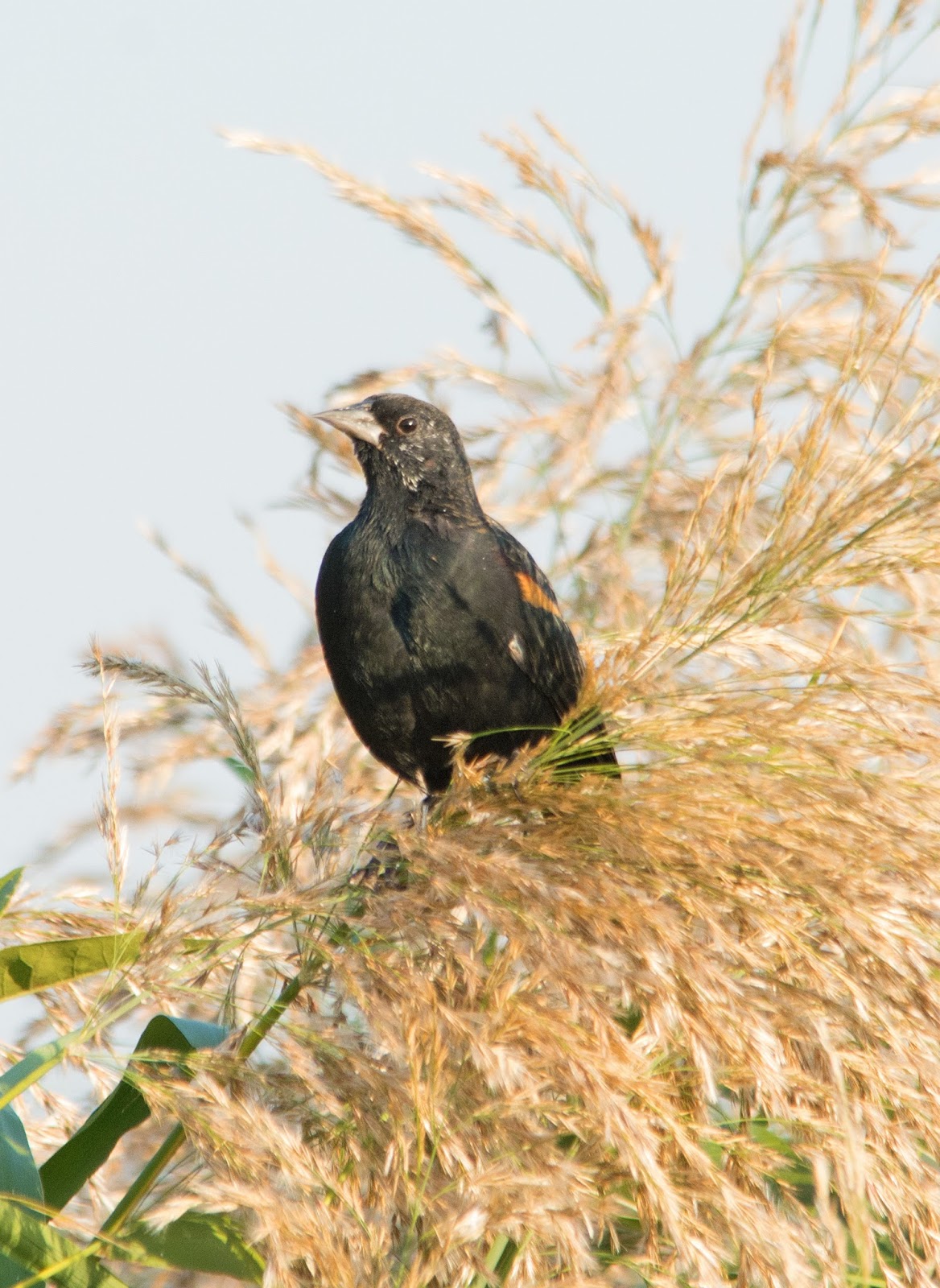
Juvenile Male Red-winged Blackbird

Great Egret (L), Snowy Egret (C), Cattle Egret (R)
September 2017
The summer has been relatively quiet for the numbers of birds that we used to see. By the same token, our numbers for wading birds have increased dramatically, especially migratory Cattle Egrets
and semi-resident Great Egrets.
We have gotten a slight trickle, especially at the end of the month for migratory songbirds, and our Scissor-tailed Flycatchers are still hanging on, perhaps until the end of the month.
We had several late nesting birds, which included woodpeckers and songbirds, but our Green Heron colony lost fledglings, as well as nestlings. That could have been due to a Cooper's Hawk that was found in the area a couple of times, but that is inconclusive.
A couple of unusual birds that normally reside south of here managed to visit southwest Oklahoma. The Groove-billed Ani hasn't been seen in in our fair state since 1979 and it appears that Mexico's Masked Duck spent a couple of weeks in US waters. The ani was around for a much shorter period.
Also photographed above are a number of raptors that we don't get to see at such close range. One of them is the Bonelli's Eagle, which is a raptor from Africa and Eurasia. This beautiful female beat the odds. She was picked up in the Middle East where she was for sale. She was the victim of a shooting, and a terrible disease. It took three solid years of the best care to get her back into the falconry circuit, and I wish to commend the gentleman for the best care that she could have received.
Also, the above young Mississippi Kite was born much later than normal, and he or she was fortunately found by a caring individual shortly after a rain storm. He is being cared for by an area rehabilitator and was taken in on August 15, possibly at the age of 32-35 days. He weighed in at 288 grams and had a setback that dropped his weight to 200 grams. In this photo, he was approximately 69 days of age. There is no question that without human intervention, he would have died.
There are also numerous shots of wading birds from Great Salt Plains in the spillway area. Note the egret with a grasshopper in its mouth. We also noticed large numbers of dead carp there, too.
The rest of the birds pictured above are identified and are some of the best specimens. They are all very healthy birds that got a new lease on life. First and second year raptors have an 85% mortality rate their first two years of life. With proper human intervention, they can be trained to hunt to the best of their ability. Healthy adults will be released into the wild with their new skill set and will make their handlers proud of their newfound keen and confident hunting prowess.
Please enjoy the photos. Keep your eyes on the ground and your head in the clouds. Happy birding!
Wednesday, April 12, 2017
A Peregrine Falcon Makes a Migratory Pitstop

Peregrine Falcon

Yellow-rumped Warbler

Blue-winged Teal

Northern Cardinal

Beaver with Branch

Great-tailed Grackle
04-02 through 04-10-17
Spring gives us a little early action, with the addition of the migratory Peregrine Falcon. These
raptors only pass through Oklahoma. A juvenile bird was observed a couple of days prior to this one, and I never realized what it was until it was too late. Sadly, I could have had a beautiful airborne shot, but I'll settle for this one, even though it was quite a distance away.
A Red-tailed Hawk chased it away with its territorial scream, so I was very fortunate to have been in the right place at the right time.
The Great-tailed and Common Grackles have been around for a couple of weeks now, and I do so
enjoy finding them in the midst of the foliage.
These Blue-winged Teal males were asserting their dominance in the midst of the females.
I had lost track of our beaver and found him on the opposite end of the lake carrying a large branch.
It's no crime to move periodically into better territory.
Subscribe to:
Posts (Atom)