Showing posts with label Long-billed Curlew. Show all posts
Showing posts with label Long-billed Curlew. Show all posts
Sunday, August 23, 2026

Sunday, March 19, 2023
Sunday, November 22, 2020
Sunday, March 8, 2020
Sunday, December 16, 2018
Friday, August 24, 2018
Oklahoma Breeding Bird Species Profile: Long-billed Curlew
Usually solitary, this uncommon denizen of the grasslands uses its long, decurved bill to probe deeply into mud and sand for crabs, and also enjoys shrimp when out of the breeding season. During this period of time, it will also be located in mudflats, wetlands, flooded fields under six inches deep, beaches and tidal estuaries. A rare visitor of the Oklahoma panhandle, the species once was seen in other northwestern counties.
This nesting bird, nicknamed sicklebill or candlestick bird, of the short grass prairie, does not need water nearby and will forage chiefly on grasshoppers, earthworms, and other invertebrates. Breeding habitat can also include combinations of sage and cactus on gentle hills, agricultural lands, or grazed mixed grass prairie.

Long-billed Curlew
Cimarron County, OK
Small flocks will arrive on breeding grounds and foraging and core areas are then established. These are often sandy areas, and flight displays and calls will be given above these locales, which will alert one to a nesting ground. Area meadows are also used to forage within, and flight displays will also be observed here, as well. This extended territory will be defended and unwanted strangers will be removed.
Nest sites are damp hollows or long sloped riparian areas. Curlews will nest in loose colonies and the nests are often by dried cow dung for purposes of concealment. There are four or five eggs in the nest, and they are single brooded. Chicks are precocial, so they can move about on their own power in a short amount of time.
After families are raised, the flock will depart by the first half of August and winter in southern coastal areas from central and western North America.
In flight, the largest shorebird will show rusty wing patches. It struts instead of walks, and the impossibly long decurved bill is an identifying feature. Graceful and with a purpose, it has pale cinnamon underparts.
.
Saturday, May 20, 2017
Birding On a Shoestring: Life on the Oklahoma Panhandle
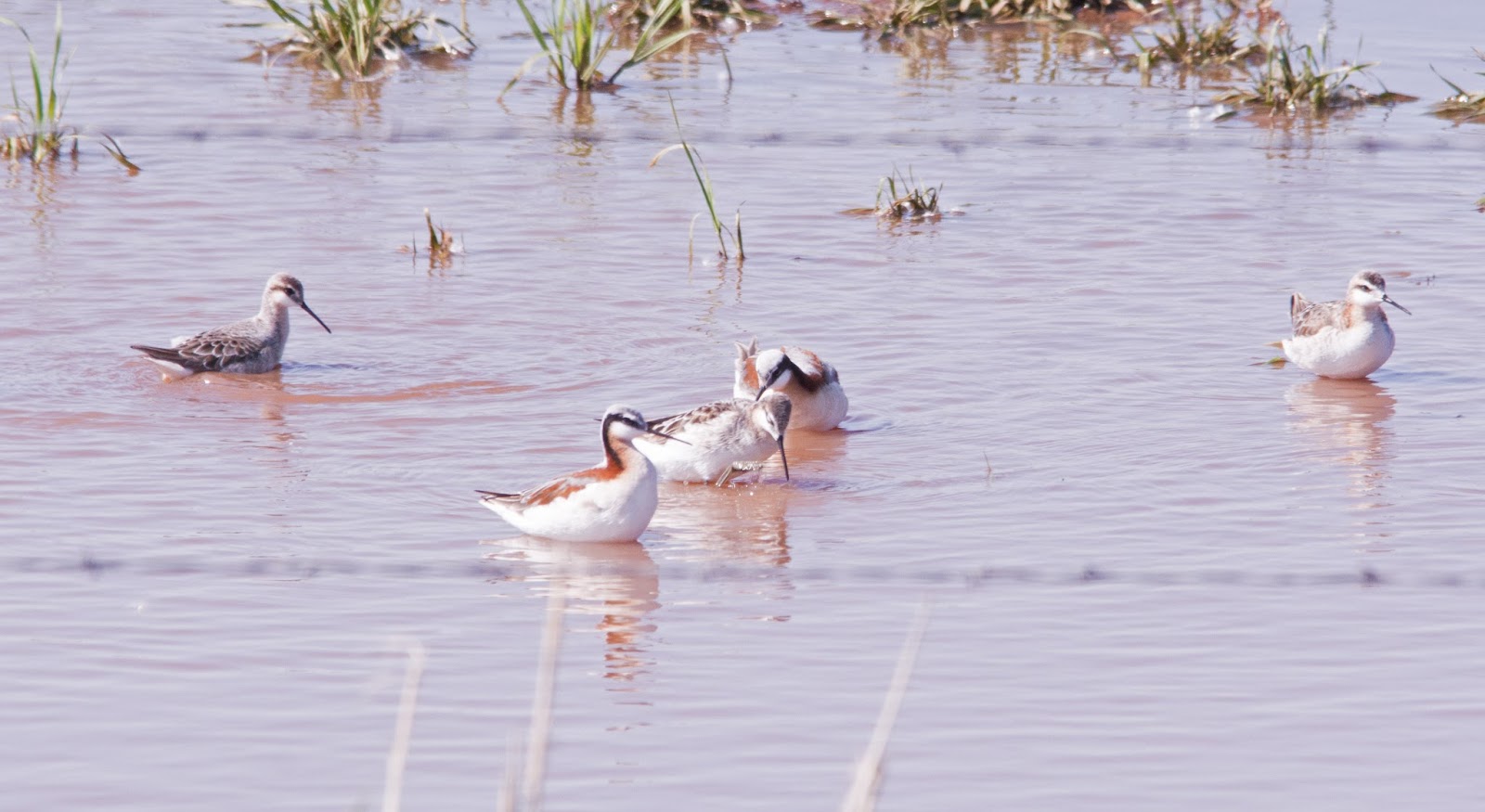
Wilson's Phalarope

Stilt Sandpiper

Wilson's Phalarope

Ditto

American Avocet

Wilson's Phalarope

Lark Bunting

Western Meadowlark

Lark Bunting

Long-billed Curlew

Loggerhead Shrike

Pronghorn Antelope

Swainson's Hawk

House Finch

Juvenile Say's Phoebe


Cassin's Kingbird

Female Bullock's Oriole

Male Orchard Oriole

Chipping Sparrow

White-crowned Sparrow

Male Pronghorn Antelope

Say's Phoebe

Female Black-chinned Hummingbird

Male Black-chinned Hummingbird

Lark Sparrow

White Tailed Deer (Doe)

White Tailed Doe and Fawn (Left)


Ash-throated Flycatcher

Ditto

Canyon Towhee

Cassin's Sparrow

Rock Squirrel

Mule Deer

Black-chinned Hummingbird Nest

Burrowing Owls

Burrowing Owl
Friday, 05-12 through Monday, 05-15-17
This was a trip that I had been wishing for a little over a year, and when the opportunity arose,
my heart was filled with joy. Photos were obtained from the entire panhandle of Oklahoma, which encompasses Beaver, Texas, and Cimarron counties. It holds a wide range of important ecological regions in the state, which makes it an unusual area for western and eastern birds to converge.
We observed long and shortgrass prairie regions, pinyon-juniper habitat, sagebrush wild lands, brushy chaparral, mesa tablelands, Rocky Mountain foothills and rock mesa faces. With these diverse and desert lands came a remarkable and wide range of mammals and birds, most of which I had never encountered before.
Unfortunately, I managed a quick look at one small lizard common to eastern Oklahoma and Texas and met a common garter snake. I had hope for a prairie rattlesnake, but that wasn't in the cards for
this trip.
Many birds were seen but not photographed, like the Common and Chihuahuan Ravens and Prairie Falcon. The Lazuli Bunting and Marsh Wren were heard, along with the Common Poorwill and Western Screech Owl.
As you can see, many beautiful mammals were captured and many birds indigenous to the region, but many more were not. Perhaps this will create a need for a future trip, but it took nearly a day to get
here. The journey was well worth it, and it enriched my first trip to this most important birding area.
These are lands that must be protected at any cost, for our grassland birds are in danger. We have seen great decreases in their presence over the years and the fight for their survival is great, including the Lesser Prairie Chicken. We must make saving their habitat a prime endeavor and you can help by donating to the cause and not buying homes here or destroying this habitat in any fashion. Please help me help THEM.
Perhaps you will enjoy these photos as much as I enjoyed taking them. If you have an interest in this area, which I believe you will after seeing these striking animals, you can help by spending time at Black Mesa State Park and the Black Mesa Bed and Breakfast caters to birders at the Black Mesa Tableland region. Many ranchers raise cattle here and are helping to keep the ecological region alive and well. I tip my hat to these people for this and support their efforts.

Red-headed Woodpecker

Turkey Vulture

Blue-gray Gnatcatcher
Monday, 05-15-17
The grand finale before the return trip home was in Woodward county, just east of the panhandle.
These were all species found at home, so they were just for the fun of it, and one last hurrah. We tried for the Barred Owl, who was not co-operative, but she had young in the nest hole, so it wasn't her fault. Our timing was poor.
Subscribe to:
Posts (Atom)