Showing posts with label brown-headed cowbird. Show all posts
Showing posts with label brown-headed cowbird. Show all posts
Monday, July 6, 2020

Monday, June 29, 2020
Saturday, October 6, 2018
Oklahoma Irruptive Species Profile: Pine Siskin
zhreee-zhreeee-zhreee
The Pine Siskin often associates with the American Goldfinch, and can be a common nomadic winter bird in Oklahoma. But as an occasional compatriot, its presence can vary on a yearly basis. It feeds upon insects, buds, seeds of many conifers, as well as what could be left upon deciduous trees.
Sometimes displaying yellow wingbars, this finch enjoys thistle and will be at your feeder when it is present. Large numbers of this migratory bird can appear sporadically and it is usually due to lack of food in its normal habitat. They have a remarkably high metabolism and will eat constantly. They are generalist feeders, so almost anything will please them. Mineral deposits will also send them to roadways and roadsides in order to eat these sparse flecks from road salt. However, the newer melting agents are made of less worthy chemicals, which could cause them physical angst or worse. They also tend to be run over in the roadways, leading to added mortality.

Pine Siskin
Boomer Lake Park, 2014
During times of breeding in the northern states, mountains, and the Boreal Forest, they are a known Brown-headed Cowbird host. Forest fragmentation has increased this probability, so they tend to have their young survive much better through appropriate forest management, where large swaths are not clear cut and replanted the following spring.
These songbirds are often afflicted with salmonella which can be common at bird feeders, a reminder to keep them very clean, much more than normal during inclement weather. Cats should be keep away from feeding stations, and they are also victims to other predators like raptors, crows, and red squirrels. They will do well in a yard with much cover, especially shrubs and enjoy ornamental conifers. They also enjoy remains from leftover sunflowers, weeds, and thistle plants.
Tuesday, October 2, 2018
Oklahoma Winter Bird Profile: Song Sparrow
One of the most welcome sounds that I hope to hear for winter to bring cheer, is that of the Song Sparrow atop a bush or small tree. Common to brushy areas near water, this ubiquitous sparrow is often found with several of its species in loose groups, as well as with the Dark-eyed Junco.
Several subspecies across the country are known, including the Eastern, which is also the bird of Oklahoma, Aleutian, Southwest, California Coast, and Pacific Northwest, all self-explanatory. Many of these birds are actually intergrades, with a wide latitude on streaking. There is really no audible variation among any of them.
In Oklahoma, most likely the first streaky and robust bird of winter that you see is the Song Sparrow, and memorizing the voice in the above video will seal the deal. The bill is semi-conical with wide breast streaking with a central "stickpin" in the midst of the breast and flesh-toned legs. They will often visit feeders.

Song Sparrow
Boomer Lake Park, March 2015
The Song Sparrow enjoys a number of habitats as a generalist including wet meadows, lakes, thickets, forest edges, bushy marsh margins, parks, roadsides, gardens, salt marshes, etc. It will scratch upon the ground for seeds, and usually flies low to the ground.
Its beautiful song increases with the advent of spring and tends to be variable and quite complex at times, but very familiar. Many birds in the northern section of its range will be migratory, but some will rely upon bird feeders. These insectivores will also eat fruit and seeds all year. They will usually dine upon whatever is available no matter where they are found, insuring the success of the species.
They can be a victim of the Brown-headed Cowbird, but they are quite resilient with an uncanny ability to raise their own as well as that of the obligate brood parasite. The Song Sparrow also has the most numerous subspecies in the US.
Tuesday, September 25, 2018
Oklahoma Migratory Species Profile: Nashville Warbler
A small plain, short-tailed warbler, with complete eyering, the Nashville Warbler is generally uncommon. It breeds in both the northern and western parts of the US, as well as southern Canada. It does not migrate far, still enjoying a small part of the US in California and Texas, as well as Mexico and northern Central America. They do not migrate across the Gulf of Mexico as many warblers do.
This bird was found by ornithologist Alexander Wilson near Nashville, Tennessee in 1881, and was aptly named as a bird of the eastern part of the country at that time. It's climatic range is sending it north.
This common summer resident of the eastern US is closely related to the Orange-crowned Warbler.
Occasionally, one may be so lucky to see the red crown patch in both sexes, but it is even more rarely seen in the female of the species.

Nashville Warbler
Boomer Lake Park, Spring 2017
They will be found in mixed species flocks during migration, as many warblers tend to be observed. During fall migration, they can be found low as opposed to the spring and summer, when they are found higher in hardwood trees. They are insectivores, enjoying caterpillars, beetles, flies, etc.
There are two distinct populations, which include the Western breeding subspecies (or Calaveras Warbler, which is duller colored) that wags its tail, and the Eastern, which does not. The species commonly migrates through Oklahoma in both the spring and fall, including the Panhandle.
They are seldom parasitized by the Brown-headed Cowbird, and are threatened by climate change.
This warbler is a ground nester, found under brushy vegetation or small trees.
Sunday, September 23, 2018
Friday, September 7, 2018
Oklahoma Breeding Bird Species Profile: Gray Catbird
This video on assorted avian mimicked voices was a remarkable rendition by a California Gray Catbird. Never have I heard such accomplished material, for this is what I would expect from an older bird that has seen many breeding seasons. A bird like this could easily have his choice of mates, for a female would easily realize how special he really is for the valuable syrinx that he has.
A uniform gray bird with a black cap, long black tail and rufous undertail coverts, this is a gorgeous and remarkable bird once it opens its mouth.
Common to uncommon in brushy thickets in woods, along forest edges, parks, often in damp shaded areas, as well as generally solitary. However, the exception is when the male sings from an exposed perch to attract a female or protect his territory. This species forages at ground level for berries, insects, and other invertebrates.

Gray Catbird
South Padre Island, TX 2015
Mimic thrushes like this are talented, as well as natural mimics, and one of ten in the Mimidae family. The harsh mew of this bird is especially diagnostic in the field, especially if heard near the ground. Females also sing, though rarely, and not nearly at as much of a volume. Catbirds, like Northern Mockingbirds, often sing at night.
Rather tame, it will respond readily to pishing calls and will come quite near.
Catbirds are late spring migrants, arriving on breeding grounds from May to June, and fall migration is between late August and September. Birds residing on the coast sometimes choose not to migrate.
The Brown-headed Cowbird parasitizes this species, but may not in Oklahoma. In other locations, the female simply ejects cowbird eggs. The territoriality of the Grey Catbird is restricted to the area of the nest site. The female does most of the nest building, though the male will provide the supplies. He will even actually point out possible sites by sitting on branches and moving twigs about as though constructing a nest. Incubation is solely by the female. The male doesn't feed her very much during this time. The species is known to double brood.
Wednesday, August 22, 2018
Oklahoma Breeding Bird Species Profile: Painted Bunting
A sweet, ongoing warble that sounds like graffiti, graffiti, spaghetti for two, and that is the sound of the male (or immature male) Painting Bunting. The male receives his handsome dress no earlier than his second year of life. This uncommon beauty is located along forest edges, wooded ravines, shrubby river bottoms, or in tall trees, and it is very at home along riparian forest. If you have ever heard that song, you will never forget it.
One of the most beautiful and colorful birds, this splash of radiance is found from May through July in the better part of Oklahoma, except the panhandle, which lacks forest and brushy thickets.
Males are very territorial and will battle other interlopers while females are arriving in the area. They have been known to wound or kill other males, and if the female should be caught up within a fracas, she can also risk injury. This species favors invertebrates, and will even remove prey from spider's webs in order to feed. The males are relentless during spring.

Male Painted Bunting
Boomer Creek, 2015
Often parasitized by the Brown-headed Cowbird, this member of the cardinal family is known collectively as a mural or palette of buntings. When males migrate to warmer regions for the winter, they still retain their beautiful plumage and do not molt into drabness.
Due to loss of habitat, the species is declining in both the US and Central America. They may still be trapped as cage birds in the illegal trade south of our country, and have a near threatened conservation status.
If you have had any of these birds in your back yard, they will visit feeders, and you'll be even more fortunate if you have the perfect habitat for a nesting pair.
Sunday, June 17, 2018
Saturday, July 2, 2016
A Green Heron's Work Is Never Done And Boomer Creek Action

Green Heron Adult

Second Green Heron Adult

Juvenile Green Heron, Clutch 2

Third Green Heron Adult

Green Heron Adult 2

Juvenile Green Heron 2, Clutch 2

Green Heron Adult 3

Green Heron Adult 1

Juvenile Mallard Brigade of Eight

Male Bell's Vireo

Brown Thrasher Adult
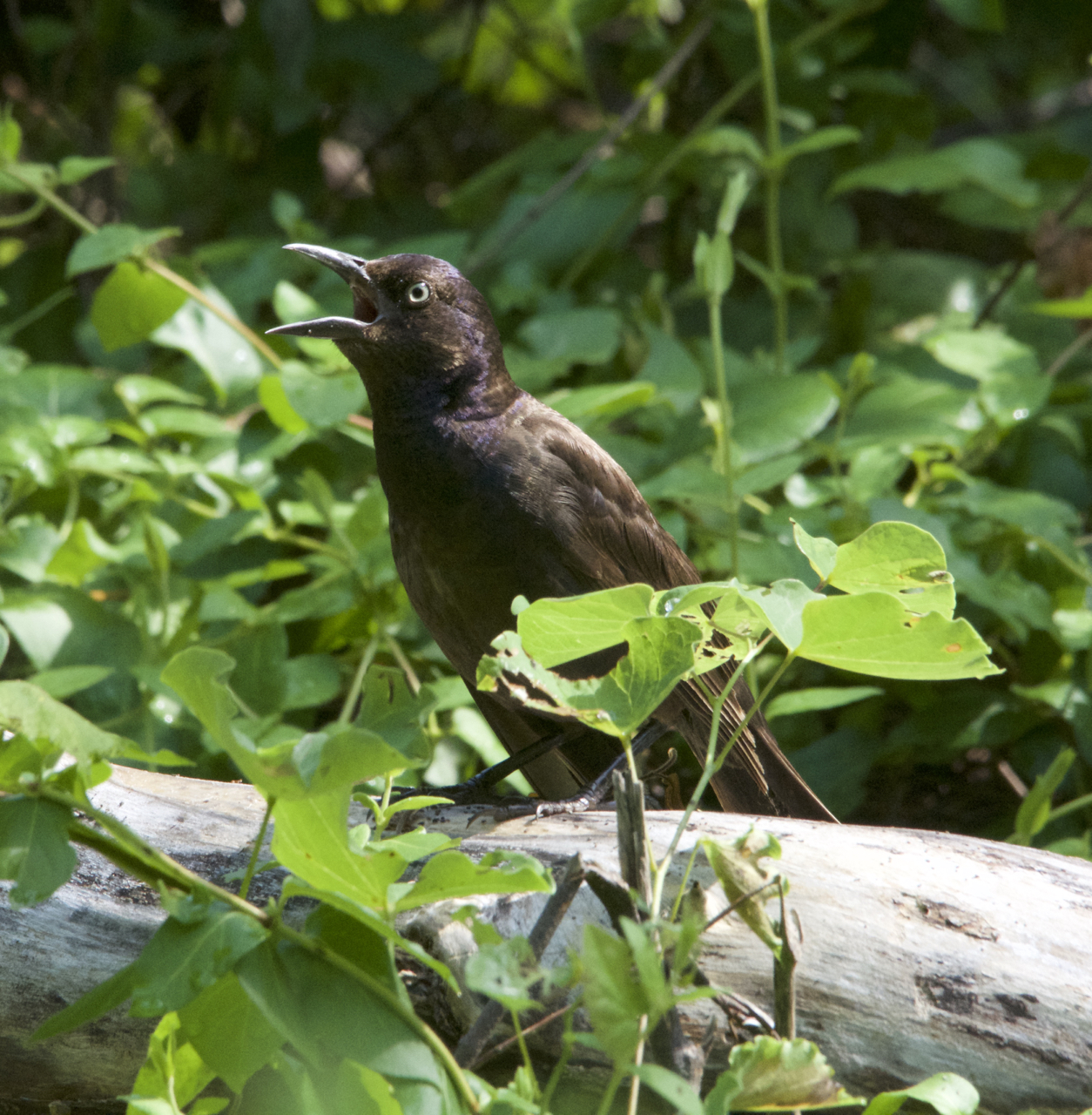
Juvenile Great-tailed Grackle

Five Lined Skink

Male Brown-headed Cowbird
0815-1215 hrs./75-98 degrees F/partly cloudy/12 mph SW winds
The early morning held heavy cloud cover, which finally lifted so I could go out, be it a little
later. However, the wait was worth it, and my Green Herons were mostly all there, save for the
two oldest youths, who were likely out doing preparatory adult activities.
All four adults were at the nesting area, two of which were adding the finishing touches to
site #3. The third and fourth adults were holding back. It is uncertain if they have a nest or
still have not yet started one. One of the second set of adults just saw adulthood, so a nest site
for those two might still be a little premature.
Great Blue Heron attempted to come to the area, but observed that those damn Green herons were
there, and left. This older bird has been dealing with them for the past three years now, and has done
the polite thing this year, by simply backing off. He attempted to share space with the Green Herons in the past, but it was obvious that he was agitated by it.
There were a conservative forty Mallards on the lake proper, approximately fourteen juveniles, and the remainder adults. Some were transitioning into adult male plumage for the first time, and those were quite a forlorn and gangly sight.
The creek had four Turkey Vultures riding thermals, an adult female Mallard with her nearly grown four juveniles, and two juvenile Brown Thrashes, a young Eastern Phoebe, a few juvenile Great-tailed Grackles, and the elusive Yellow-billed Cuckoo with a sighting of the Great Crested Flycatcher's backside. The Red-headed Woodpecker made a couple of brief appearances, and the Black-and-white, as well as thew Prothonotary Warblers were heard going about their daily business.
A recently fledged Warbling Vireo was observed with a parent, and a single Great Blue Heron was on
the water.
Several skinks were found, most likely enjoying the warmth of the day, and the one pictures were in a semi-rotted stump.
The Brown-headed Cowbirds are usually always in the vicinity of cavity nesters, as well as the Bell's Vireo. If they are seen lurking about, chances are excellent that there is at least one active nest of interest.
Tuesday, April 21, 2015
The Bar Gets Raised One Notch

Ross's Goose with Canada Goose Escort

Ross's Goose

Ditto

Blue-winged Teal Pair, Northern Reaches

Ditto

Great Egret, Breeding Plumage

First Year Male Brown-headed Cowbird
Practices Courting Techniques

Male Northern Shoveler

Red-shouldered Hawk

Male Eastern Bluebird

Male Great-tailed Grackle

Female House Sparrow

Male Scissor-tailed Flycatcher

Ditto
These Shots were taken over the past couple of days, and I had to keep dodging raindrops,
as I have been for several days now. Even though, it has been a bit of a challenge from
time-to-time, I believe the shots may speak for themselves. The little Ross's Goose arrived
beside the east side of Goose Island yesterday with a Canada Goose escort. This little goose,
rarely seen on Boomer Lake, preened for about twenty minutes, then climbed up the hill to
the island, where I observed him eat and take a respite. The other geese, even though nesting,
really paid him or her no mind.
I almost forgot. I was at Teal Ridge Wetlands a few days ago, managing to get this shot of the
Yellow-crowned Night-Heron, which is a bird never seen at Boomer Lake, at least not to my knowledge.

One of Two Yellow-crowned Night-Herons

Second Yellow-crowned Night Herons
Note that this second bird is displaying a beautiful yellow plume.
I also visited Couch Park on Sunday, and found this beautiful little Field Sparrow.

Saturday, April 4, 2015
Just Singin' The Blues (and the Whites)

Little Blue Heron

Mallard Drake in Flight

Female Brown-headed Cowbird
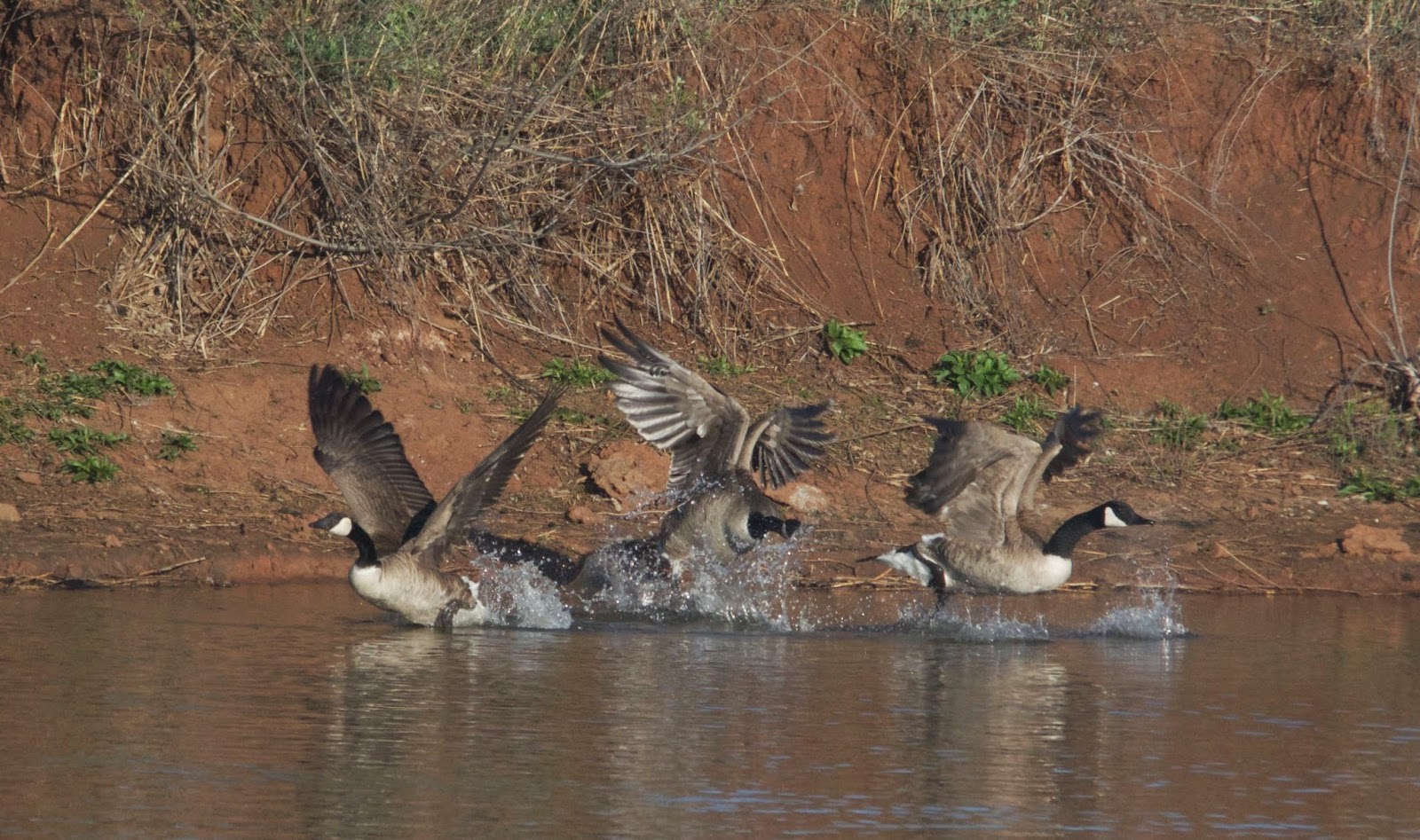
"A Canada Goose Melee"

Male Eastern Bluebird

Male Downy Woodpecker

Great Egret in Breeding Plumage

Ditto

Great Egret in Flight

Song Sparrow
"Just Singin' the Blues"

Female Red-winged Blackbird

European Starling
0730-1110/partly cloudy/37-59 degrees/light and variable winds
There was a chill in the air due to a cold front band going through, but it didn't dissuade some
from making an appearance, like the Little Blue Heron. I have never seen this bird at the lake,
but it is well within its range. Our ducks are still holding over, and a couple of breeding Great Egrets are in the area. There is much more to come, as migration is just beginning. There will be a lot
more to see, so dust off that copy of your birding guide, and get ready to travel in my wake.
Subscribe to:
Posts (Atom)