Showing posts with label American Robin. Show all posts
Showing posts with label American Robin. Show all posts
Saturday, June 20, 2026

Saturday, February 21, 2026
Saturday, July 15, 2023
Saturday, January 28, 2023
Sunday, August 21, 2022
Saturday, July 31, 2021
Sunday, January 31, 2021
Thursday, January 21, 2021
012121 Boomer Lake's Winter Bounty

011321 Harris's Sparrow
I have seen one, but not the second bird that was here last winter. It could even be a different bird and the other two went elsewhere or just are not here yet.


011621 American Robin
This seed came up and was regurgitated before I even realized what was happening when I snapped the shot. Sometimes it pays to take an innocent pose.
Both of these birds were located just matter-of-factly doing what they do best, simply being birds in the cold. Enjoy this odd winter and stay alert for unusual birds that just don't belong here at this time of year, like the Gray Catbird, Red-necked Grebe, and many others out of the county.
There has not been a lot seen during this time of year, but let's keep trying to photograph what we can.
Sunday, January 17, 2021
Sunday, December 13, 2020
Sunday, November 1, 2020
Saturday, October 10, 2020
Saturday, July 25, 2020
Sunday, July 5, 2020
Monday, June 15, 2020
Thursday, June 4, 2020
060420 Different Birds, Different Responsibilities

060320 Northern Flicker
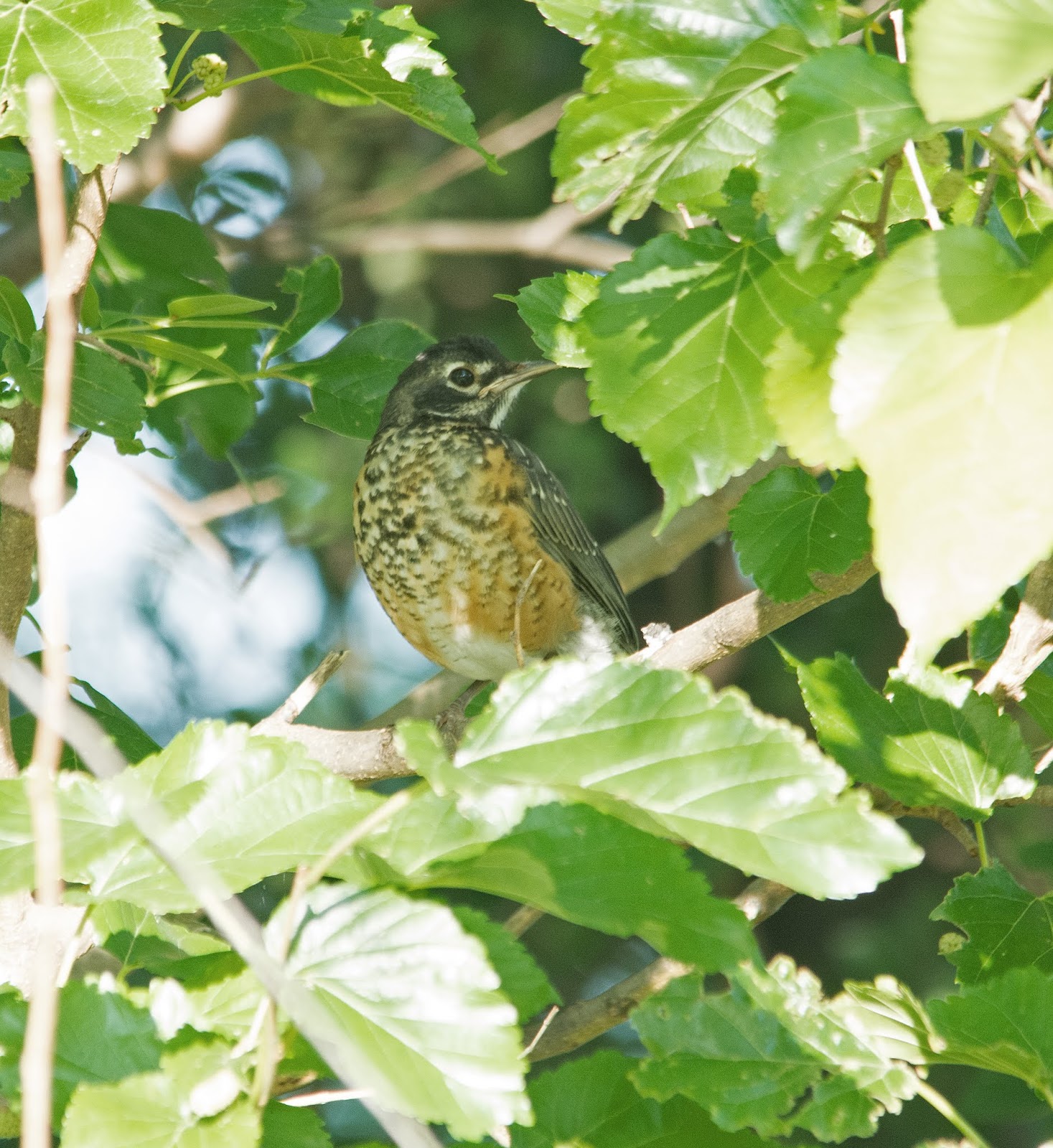
Juvenile American Robin

060420 Great Crested Flycatcher #1

Great Crested Flycatcher #2
Migrants have come and gone for the moment, but raising young is still on the minds of those that are breeding in our presence. It is just as intense to raise as many young birds as possible and the adults are doing everything in their power for them, just like we do.
Many similarities can be noticed, except for the cash outlay, but the investment of any animal is their intense struggle to be successful. Does that sound familiar?
So, writer urges everyone to be just as supportive in their work, as well as backing their needs for habitat, nourishing food and clean water, just like we ask as a basic right.
Tuesday, June 2, 2020
060220 Young Birds Tip the Scale in June

060220 Juvenile Northern Mockingbird

Juvenile American Robin

Baltimore Oriole

American Robin
Plenty of juvenile birds were observed on this outing, however, no additional late migrants were discovered. Before the end of the month, some of the shorebirds should be enroute south, as they are the first breeders of the year. They also have the most distance to travel in general.
Writer always finds new life in the spring the most interesting aspect of nature. This has been the best migration in quite some time.
Friday, May 22, 2020
052220 Post-Rain Comes, More Good Birds

052120 American Robin in Nest
A couple of Ruddy Ducks were seen upon distant water at Boomer Lake in the morning, late birds for the season. We may have seen our last four Spotted Sandpipers. My figure of 145 Cedar Waxwings was conservative, there were likely more. There were chances for an impending storm later in the day, and if that occurs, we can expect good birds on the morrow.

052220 Eastern Meadowlark

Franklin's Gull

Willet

Neotropic Cormorant

Juvenile Hooded Merganser
052220
There was an early morning rain/thunderstorm with wind gusts between 26 and 44 mph between 0553-0753, and we received 0.83" of precipitation. The strongest winds were west and south of Stillwater, which were even worse with straightline storms some of which prompted winds up to 81 mph and wreaked a lot of devastation in several locales.
However, much of Payne county experienced very good birding, as birds are generally down before a storm unless they are within the wrong cell at the wrong time. With this time period and migration waning, we were still going to get a drop before the storm. When the storm was over, most birders were out, writer included.
We noticed more Canada Geese than usual that were either on Boomer Lake or upon the property, along with some downed trees, limbs, and branches. The downed tree that was noticed on the east side was a deciduous tree that came out of the ground at water's edge, due to extreme saturation.
The nests on Heron Cove seemed to be intact and everything was normal, save for the above notation. Females usually spend the night on their nests and are relieved in the morning.
Meridian had a response early and there was a Whimbrel, female Hooded Merganser, Baird's, White-rumped and Spotted Sandpipers, and a Least Tern.
First unusual item noticed on Boomer Lake was a notable Least Tern and a Ruddy Duck, a late bird for the season. Another birder was already at Shorebird Jetty to count several Franklin's Gulls, two Willow Flycatchers, and a Willet. There were no Spotted Sandpipers located, yet only one Cedar Waxwing.
There was also an Eastern Meadowlark, Least Flycatchers, and Yellow Warblers.
Continuing on, Turkey Vultures were riding thermals, as were Mississippi Kites. We also encountered a Yellow-billed Cuckoo, a couple of Great Crested Flycatchers, and a juvenile Hooded Merganser. The merganser came close enough to permit a nice photograph, but the nearby Pied-billed Grebe noticed writer's location, whereas the young merganser did not.
Nothing else was noteworthy at Boomer Lake. Throughout the morning, many other locations were checked throughout the county.
Monday, May 18, 2020
051820 Immature Birds of Boomer and Summer Neotropical Residents

051720 Male Orchard Oriole

Eastern Kingbird
This was an average day with a little over two miles covered, about as far as the rest area. The most noteworthy item was the Bald Eagle. Three Eastern and five Western Kingbirds were counted, as well as the Bell's Vireo around the Cove. Winds were from the NNW at 14 mph and the forty-two Cedar Waxwings were picking mulberries like fiends. There are several more trees and bushes producing fruit this year, feeding more birds than last year. One Green Heron was counted, just passing and eyeballing The Cove with no real time spent trying to find Green Heron nests. One immature American Robin was found in a bald cypress, and all the common birds are nesting.
It was ironic that the Eastern and Western Kingbirds and Scissor-tailed Flycatchers (all flycatchers) were actually not perching far from one another. They are behaving like non-breeders at this point, like they would be on their wintering grounds. If they had eggs and young, they would not be this social!

Immature American Robin

Traill's Flycatcher #1


Traill's Flycatcher #3

Yellow Warbler


Double-crested Cormorant

Female Orchard Oriole

Great Crested Flycatcher

Immature American Robin #2
Today started off very well, a little cooler than the day before, winds from the north at 8 mph with a flat barometer. Expecting to see activity, I was not disappointed. A pair of Eastern Kingbirds were found at Heron Cove, along with a few Yellow Warblers, a couple of Barn Swallows were moving through the area, and there were a handful of Cliff Swallows. Looking at the side of the Lakeview Road Bridge, there were few mud nests, which is unusual. No Green Herons were seen or heard today. On the return trip home, writer even went to the waters edge, but saw none of the Green Herons.
Cedar Waxwings mostly picked all ripe mulberries, but there were a forgotten few that immature American Robins ate. Usually they are on a strict protein diet, but the three that I have seen are well flighted, and at least two birds (one above) are losing their juvenal plumage. This bird is a good five weeks old.
There are still several Least Flycatchers still with us, as well as three Black Terns that were found well before 0700. Four Turkey Vultures were riding early thermals, and both European Starlings and Great-tailed Grackles have young that are successfully making their way in the world foraging for their own food. Five Fish Crows had their morning meeting, splitting into two groups. Both Baltimore and Orchard Orioles have been represented in their new trees. The Baltimore Oriole used to nest in the large oak by the east restrooms, but now it appears that the Orchard Orioles are there now, and one pair of Western Kingbirds are possibly not going to nest on a wooden telephone pole this year.
Today we had four Bell's Vireos! One at Heron Cove, a pair just north of the culvert drainoff to Boomer Lake across from the Kicker offices. These two were performing the chase ritual, and the historic male (who could also be paired, as he is usually the first to be as well as the eldest with the best territory). There is a bit of a story with that. Last year the tall metal power poles were put in, which destroyed some of the original territory. This pair then moved over to west of the Kicker offices. The assumption is that the original pair returned to the main territory, while the young male returned to to his birthplace and just found himself a mate and is now courting her.
Also within this active area today was a traditional Warbling Vireo pair, a pair of Common Yellowthroats with a very active female today, multiple Yellow Warblers, a late Yellow-rumped Warbler, and a Least Flycatcher. I believe there was another flycatcher in the top of the cottonwoods, but he didn't call and my view wasn't good enough to be able to get a halfway decent glance. Therefore, I was unable to count an assumption.
A trip was also made to the wooded area north of Airport Road. No Swainson's Thrushes were found, but a late Eastern Towhee was sounding off, though unseen. There were also Northern Cardinals, Yellow Warblers, Great-tailed Grackles, and European Starlings in the wood, as well as a Mallard Drake. It was pretty quiet out there this morning.
Flycatchers can be so confusing, especially if they don't vocalize. Today there are three photos posted as I wasn't sure which flycatcher I had and it was necessary to get shots from as many angles as possible to try to determine what the bird was. It was either a Willow or an Alder Flycatcher, which are both in this area now. It was last year (I think) that I photographed the willow, which was south of this location at the beginning of this two acre land plot. It made sense. This year, I finally was able to capture the Traill's, which is what both species were once called, until they were renamed Willow and Alder Flycatchers. As of now, I'm still trying to get a photograph of the Alder Flycatcher, which will happen sooner or later. Unless these species vocalize, it is impossible to determine what they are.
On the return trip, there was a nice male Double-crested Cormorant with his crests that was photographed.
Saturday, April 18, 2020
041820 Boomer Lake Migrants and Residents Make the Sky the Limit

Savannah Sparrow
This bird has been living here for a few weeks now. It is usually a lot shyer.

American Robin
More nest material, most likely due to yesterday's windy weather. A bird's work is never done.

Lesser Yellowlegs
This shorebird has been here since yesterday's challenging weather, making several birds batten down the hatches.

Osprey
As can be seen, this individual was somewhat distant. The sun's rays didn't help capturing it, either.

Savannah Sparrow #2
Note differences in coloration.
Today was a far cry from the front that came through yesterday. It was quite a bit warmer and more
songbirds were in the open. We shared time and space with two Common Loons first thing in the morning. Sadly, they left with no goodbyes. Soon discovered were three Blue-winged Teal, two males and a female. Just south of Shorebird Jetty, three Pied-billed Grebes were lazily swimming, three more later discovered by Goose Island near three American Coots. Sleeping in the sun were a pair of Northern Shovelers, the male's coloration being intensified by the lighting. Wafting overhead, an Osprey proved the health of the lake.
Four Franklin's Gulls, three of which rested upon the southern part of the lake, while eight Spotted Sandpipers moved from one location to another in search of sustenance. Three or four Scissor-tailed Flycatchers were heard before they were seen, then four Great Blue Herons flew off with a distinct purpose. The Warbling Vireo called in the distance to remind us that spring is here. One American Crow passed overhead with the sound of three Fish Crows denying its presence. Nearly three dozen Barn and Cliff Swallows rose up near the Lakeview Road Bridge gobbling up insects until their bulging crops refused them more. Harris's Sparrows crept along the ground near the sidewalk until they were flushed by by human presence, who completely ignored them. The male Common Yellowthroat probed the leaf litter and stayed within the brambles near shore, while the Purple Martins remained astute for possible intruders.
There were considerably less shorebirds and ducks that stayed and hunkered down until yesterday's storm system passed. Hopefully they are winging their way near and far to mate and raise families, while we watch the Circle of Life begin once again..
Subscribe to:
Posts (Atom)