Showing posts with label Canada Gosling. Show all posts
Showing posts with label Canada Gosling. Show all posts
Saturday, June 1, 2024

Wednesday, May 26, 2021
052621 Spring Into Spring with Our Green Heron First Family

043021 Carolina Chickadee
This little beauty was out with its mate, checking for a nest cavity. Writer had seen where it was contemplating nesting, though a Downy Woodpecker was trying to usurp the same area even if it was much larger than the chickadee. The Downy's size was much too great for the thin snag.

050821 Red Eared Slider

This lovely was close to shore, but it was easy to stay covered by leaves to get this shot and remain hidden to the subject.


American Avocet


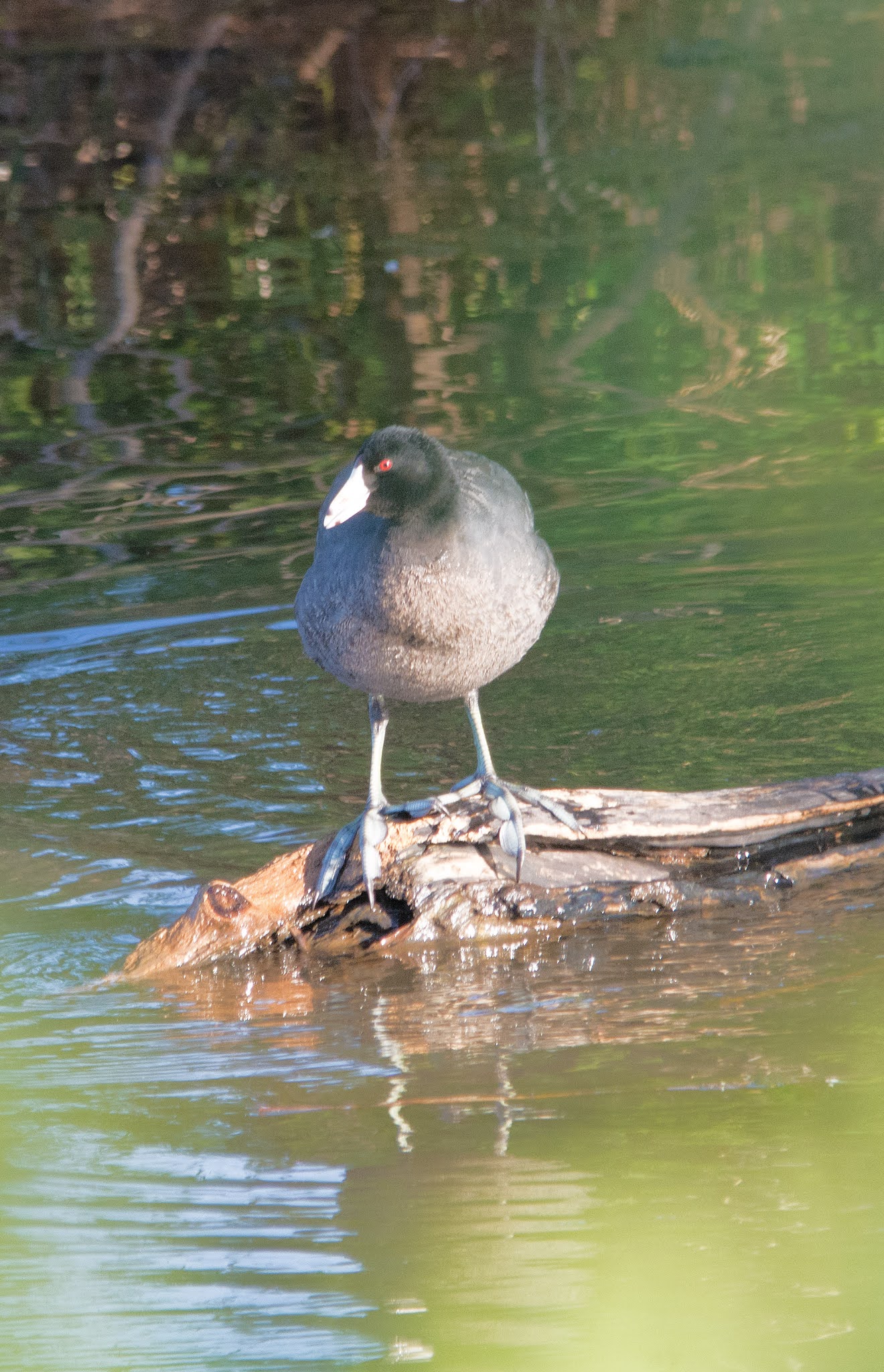
051421 American Coot
Even though morning had been broken, the area coots didn't mind being observed. Look at those unusual lobed toes that are so well adapted to uneven surfaces!

051521 Canada Goose (Gosling)
Knowing a kid's parents will get you right in the front row to photograph the youngster.

Clay Colored Sparrow
This slightly wet all-star was with roughly eight other migrants and this one didn't mind being the center of attention.

There were eight sandpipers wheeling around the lake multiple times, which afforded this nice shot of a bird's-eye-view. How cliche, right?

052521 Least Flycatcher
Least Flycatchers are easy to shoot IF you see one. We were eye to eye.

Green Heron and Nestlings 1
One view of some of the first family of 2021.

Green Heron and Nestlings 2
View two with some of each bird in the photo.

Green Heron and Nestling 3
The other one must have ducked under the parent.
Sunday, April 19, 2020
Wednesday, April 8, 2020
040820. Migrants Continue to Trickle In

040720 Neotropic Cormorant
This small cormorants will breed here, but it is just a matter of time. The species has been coming to the area for five years, and though there are not many, it's more than just a vagrant at this point. Will you get a load of the pose?

040820 Savannah Sparrow
This beauty was a surprise and we're looking at some lovely breeding plumage. This is a northern breeder in the US, as well as the boreal forest. My thanks go to the many species that stop over in our fair state on the way to the north.

American Robin
I had to snap this shot, as this little lady kept coming beside me while I was on the way to check for shorebirds. It's remarkable how she could see to fly with all of this nest material in her area of vision.

Canada Gosling
"I'm Late!"
An area resident told me that she saw a gosling last week, but this was my first sighting. There were four in this clutch. The male knew me, as he gave me the head bob greeting, and the First Family brought them closer and let me take my shots.

Canada Gosling
"Who, Me?"
It really does seem little this little one really DID have that on his mind with this shot.

Least Sandpiper
The smallest of sandpipers, this peep breeds on the tundra. It is common, though declining.
It is believed that the eastern populations on their southbound migration fly from the Gulf of St. Lawrence to wintering ground in northeast South American, which is from 1800 to 2500 miles. Shorebirds are amazing animals.

Lesser Scaup
These birds came from the south and are winging their way to their breeding grounds. Some breeding nearer in the US, and others may make it to Alaska and just below the tundra.

Double-crested Cormorant
If you look hard, you can see the double crests on the dark male on the far right. We can see them as far ahead as the third week of May, and they are steadily increasing the time in the south before they head to their northern breeding grounds.
A Warbling Vireo was heard at Heron Cove this morning, but had no interest in showing itself, also today. It was early. Usually the Baltimore Oriole arrives with the Warbling Vireo mid-April.
Sunday, May 19, 2019
Friday, May 17, 2019
Secret Lives of Birds and the Mulberry Bush

Scissor-tailed Flycatcher

Canada Gosling

Cedar Waxwing
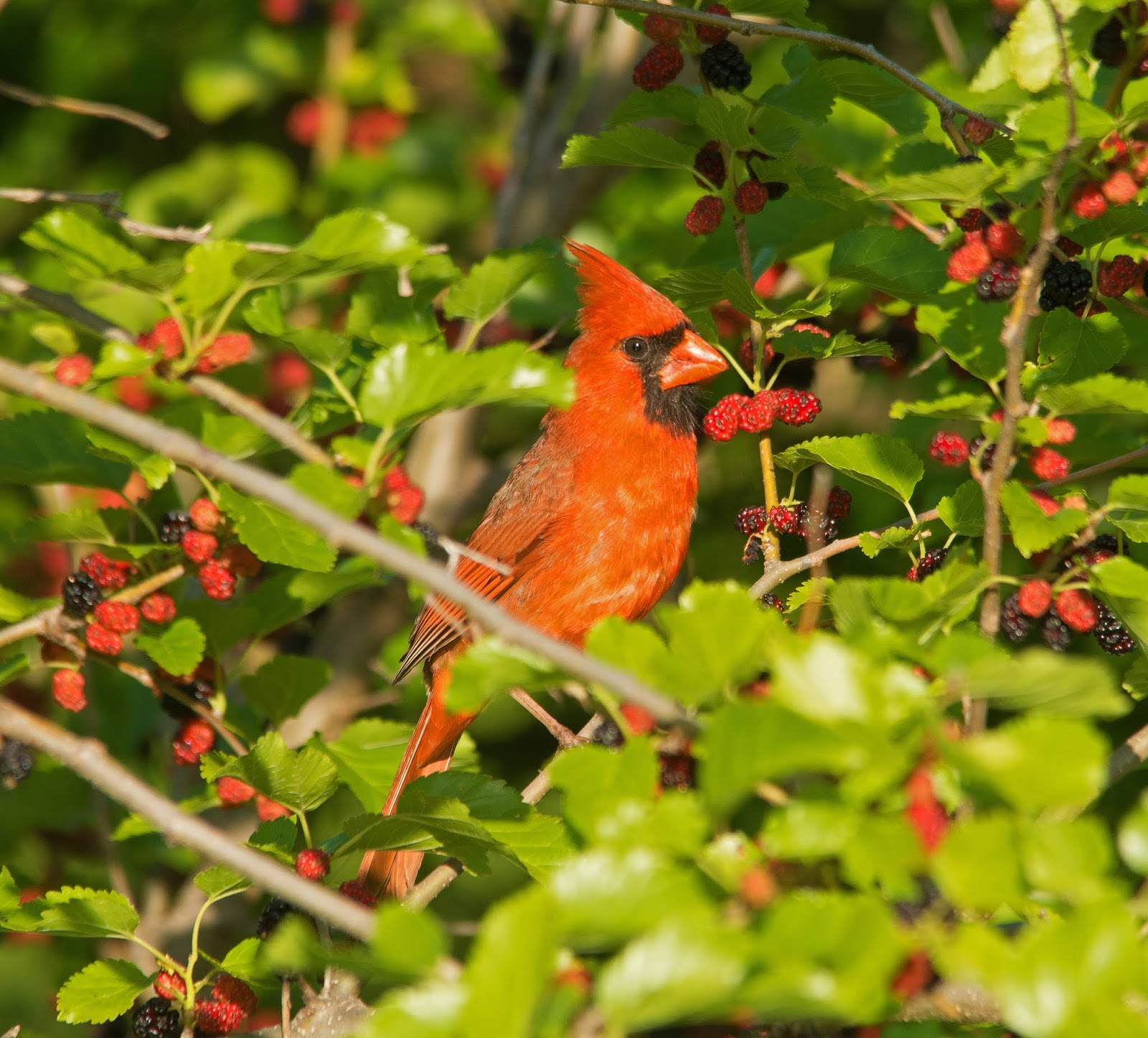
Northern Cardinal

Swainson's Thrush

American Robin
Week of 051319
Another seven days of productive migratory and resident bird views. As can be observed, the mulberry bush drew in a lot of birds, even during nesting season. However, young birds like nestlings, fledglings and juveniles require protein, not the adults. The young need food to help them rapidly grow, so they can migrate, if necessary.
However, the mulberry allowed many adults to capitalize on sweet treats while they were working hard to feed young.
Thursday, June 14, 2018
Latter Half of May 2018 Is Time to Reflect and Count Our Large Bounty of Birds

Scissor-tailed Flycatcher

Adult Green Heron

Mallard Ducklings

Male Orchard Oriole

Mallard Ducklings

Neotropic Cormorant

Two Out of Three Neotropic Cormorants

American Bison

Great-tailed Grackle

Canada Gosling
Last Half of May 2018
We were officially past migration, but as you know, there are always going to be exceptions to the
rule. There are always going to be exceptions and no rules anymore, because with future heat
waves, we'll be see a lot more unusual birds. Winters will be colder and things are going to be changing more and faster than we dreamed possible.
Our Green Herons returned to colonize their Heron Cove and quite frankly, I don't believe that I know any of them. We appear to have a completely new crop, but since they are all breeding age, it could well be the hormones talking, so it would stand to reason that they would be ignoring me.
They were left alone since they arrived in the breeding area a little earlier than usual and they appeared to be anxious, so there was no reason to provide the opportunity to force them to move on, so I stayed as far away as possible. There is no question that we now have a nest, which I believe is occupied. There could even be a second nest, but I only saw twigs going to another spot.
The American Bison was not at Boomer Lake, so don't get your hopes up. This beauty came to us
courtesy of the Wichita Mountains National Wildlife Refuge, and I know that this its the closest that I have ever come to a male bison. He took it all in stride, so I got my shot and returned to the confines of the car.
There are a couple of cute shots of Canada Geese and Mallard ducklings, Neotropic Cormorants, and an unusual shot of our state bird, the Scissor-tailed Flycatcher.
The shot of the Orchard Oriole is more attuned to their wintering grounds in the tropics, as this is a common posture there.
Naturally, it was important to include at least one shot of the colorful Great-tailed Grackle.
Just because I didn't grace this segment with a lot of birds doesn't mean that they weren't here. They certainly are and were, but I was looking for a little more unusual variety this time around.
Sunday, June 4, 2017
Gratuitous Findings at Boomer Lake For All

Green Heron

Great-tailed Grackle #1

Great-tailed Grackle #2

Barn Swallow

Diamond-backedNorth Watersnake

Male Northern Cardinal

Mallard with Ducklings

Green Heron in Nest

Ruddy Shelduck

Ditto

Canada Goslings
05-29 - 06-04-17
This week gave us a little bit of everything for the season, but the Ruddy Shelduck was a
bonus, who I actually saw arrive at 1110 hrs. on 06-03. This was the original bird that
came to stay with us for about a week. It then left the area, and I was told by a resident that it
had spent time at The Links, also for nearly a week.
Our Green Heron has been on her nest on and off, again for what seems to be an extended
period of time.
Young birds are in abundance on the lake and many birds have been and are with young. There are three sets of Mallard ducklings that I know about, and an easy dozen families of Canada Geese.
This male Cardinal's female refused a photograph, as she is presently molting, but he appears to be
in a fresh set of feathers.
It has been more than a challenge to find the Cliff Swallows at rest, but another Barn Swallow managed to accommodate. When they were here, the Rough-winged Swallows sat en masse upon
a snag.
We experienced a little rough patch of weather, but it wasn't much of a deterrent for the birds. Let's see what next week holds.
Saturday, May 27, 2017
There Is Plenty of Light on Boomer Lakefront

Yellow-billed Cuckoo

Green Heron Pair

Green Heron

Female Orchard Oriole
Canada Gosling

Least Flycatcher

Female Orchard Oriole

Ditto

Great-tailed Grackle

Female Red-winged Blackbird

Great Blue Heron

Prothonotary Warbler

Scissor-tailed Flycatchers

Green Heron on Nest

Male Orchard Oriole

Least Flycatcher

Great Blue Heron
05-22 through 05-26-17
This was an impressive workweek, as far as I am concerned. The trumpet vine bush on Boomer
Lake's east side is nearly in full bloom, which invited the Orchard Orioles that nest nearby to partake.
They have nested in the area for years, most likely because this bush exists there, as well as the fact that their site is in the willows by the water, which really attracts a number of good birds to its habitat.
Another wonderful piece of habitat is Heron Cove and the surrounding area, which has native trees, mulberries, and plenty of wetland habitat, which attracts my beautiful Heron colony. Right now, there are two pairs of Green Herons there, which perturbs my Great Blue Heron. He just doesn't have the freedom to come and go as he pleases, but he really does accommodate his Green Heron cousins quite well.
Our usual suspects also enjoy the area, which includes the grackles, blackbirds, warblers, flycatchers, warblers, and when in the area, the catbirds.
Boomer Creek also has dense habitat for those birds that prefer those kinds of areas, like the breeding birds, the shy Yellow-billed Cuckoo, this year's first Least Bittern, and a good group of migratories when they come through.
There are still a few more photos in the camera, which I will save until a later date. These include a few that are a bit on the unusual side, but I'm sure that you'll be pleased.
Until then, enjoy your own private birding areas, and as always, let me know what you are observing.
Subscribe to:
Posts (Atom)