Showing posts with label American Crow. Show all posts
Showing posts with label American Crow. Show all posts
Tuesday, January 2, 2024

Sunday, October 9, 2022
Saturday, September 3, 2022
Monday, April 4, 2022
Sunday, March 20, 2022
Monday, February 21, 2022
Saturday, February 5, 2022
Saturday, January 29, 2022
Wednesday, January 6, 2021
010621 Winter Scenery At a Rain Soaked Boomer Lake

122120 Lesser Canada Goose
This little goose is very easy to notice among its bigger kin, the Canada Goose. The bill is smaller and the breast is paler

122720 Red-Shafted Northern Flicker
These birds appear periodically this far east, but are more common in western Oklahoma, like the Panhandle region. A few years ago, there was an adult in the area, and this bird might be one of the offspring.

Cedar Waxwing
Waxwings are getting more common, no longer as "irruptive" as they once were. They don't mind the fruit of the Bradford pear tree, an invasive tree from China and Viet Nam that is becoming ever popular in the US, is also known as the callery pear. These trees are resistant to disease and readily eaten by birds, which disperse the seeds. The trees can be susceptible to storm, wind, and ice/sno damage, making it a hazard.

122220 Downy Woodpecker
This young lady was picture perfect and didn't mind my company. This shot was captured while the bird was nearly at eye level. She'd climb one tree, then start the same activity on another.

010221 Dark-eyed Junco (cismontanus)
This bird or others like it have been fairly common this winter. I have seen it four times over the past couple of weeks.

This was during the period of several inches of rain and about an inch of snow in The Lowlands. Two American Crows were visiting, each with a pecan. This individual was captured as it went to a lower area for a drink of water, which was also occupied by several Mallards. The water was deep enough to cover their legs while standing.


010421 Mallards
This was an attractive shot that happened to be visible while writer was photographing the crows. They made several passes, so it was not difficult to achieve a good in flight photo.

010621 Sharp-shinned Hawk
This was the third location that this raptor chose to eat what was left of a songbird at Heron Cove, as well as the best photo op. Two Blue Jays led me to it, as they were nearly overhead. While the hawk was in the area, most potential food sources were low to the ground, except two Mourning Doves that were motionless on another tree. After this shot, I politely thanked the subject for its co-operation and retreated so it could dine unimpeded.
Thursday, April 2, 2020
040220 Starring Eared Grebe and American White Pelican Convention
03-21-20

American Crow

Neotropic Cormorant

American White Pelicans
032420

Eastern Meadowlark

Double-crested Cormorant nearly
in full breeding plumage
032520

American Robin
03-26-20

Downy Woodpecker (female)
03-27-20

Eared Grebe nearing
full breeding plumage
Migration is clearly an event with several movements, including our late ducks and breeding plumage waterbirds. The one that I refer to especially in this arrival is the Eared Grebe, one of which I personally have never observed in breeding plumage. It was sleeping among a raft of Ruddy Ducks, including two others that I later spied. This grebe had rudely been awakened by a couple of American Coots that rudely ran noisily in front of it. The Eared Grebe made the attempt to return to sleep, but the ruddies awakened and decided to move. To my good fortune, the group swam closer to me and paraded right across me at a reasonable distance and I managed to get a fairly decent shot. At least it was enough to give a good look, since my observations in the past only included winter birds.
The Neotropic Cormorant has also been a fixture in the spring, having been visiting since at least 2015, when my original shots were obtained. We're hoping that it is breeding somewhere in OK.
The Eastern Meadowlark cannot be overlooked, as it is an iconic prairie bird in the great plains. Even though it has been losing population due to loss of habitat and pesticide use, perhaps we can manage to bring some of the numbers back with proper land management.
As of late, the Fish Crows have been more prevalent than the American Crow, and seem to be expanding their range more than the Black Vulture, which is being sighted in OK, too.
Several days prior to this photo there were nearly two dozen American White Pelicans around the Goose Island area. They stayed about four days, though numbers dropped. At one point, they were observed sleeping on the island. The Canada Geese didn't feel threatened, even with eggs in their ground nests.
Migration is clearly an event with several movements, including our late ducks and breeding plumage waterbirds. The one that I refer to especially in this arrival is the Eared Grebe, one of which I personally have never observed in breeding plumage. It was sleeping among a raft of Ruddy Ducks, including two others that I later spied. This grebe had rudely been awakened by a couple of American Coots that rudely ran noisily in front of it. The Eared Grebe made the attempt to return to sleep, but the ruddies awakened and decided to move. To my good fortune, the group swam closer to me and paraded right across me at a reasonable distance and I managed to get a fairly decent shot. At least it was enough to give a good look, since my observations in the past only included winter birds.
The Neotropic Cormorant has also been a fixture in the spring, having been visiting since at least 2015, when my original shots were obtained. We're hoping that it is breeding somewhere in OK.
The Eastern Meadowlark cannot be overlooked, as it is an iconic prairie bird in the great plains. Even though it has been losing population due to loss of habitat and pesticide use, perhaps we can manage to bring some of the numbers back with proper land management.
As of late, the Fish Crows have been more prevalent than the American Crow, and seem to be expanding their range more than the Black Vulture, which is being sighted in OK, too.
Several days prior to this photo there were nearly two dozen American White Pelicans around the Goose Island area. They stayed about four days, though numbers dropped. At one point, they were observed sleeping on the island. The Canada Geese didn't feel threatened, even with eggs in their ground nests.
Sunday, March 15, 2020
Sunday, October 27, 2019
Sunday, September 2, 2018
Oklahoma Breeding Bird Species Profile: American Crow
One of the most well known birds in the country, the American Crow or common crow, can be a good or bad bird to have in the area, depending upon one's preferences. Groups or singles can be a handful for any raptor to endure, either through the general din or simple harassment. This is known as mobbing behavior. Crows are well known for their intelligence and adaptability, and unless they can get something for their trouble, they are not going to work for it.
Known for their deep caws and croaks, this all black bird is found in all open habitats and will eat anything that isn't protected, which includes the eggs of other birds. They form large roosts during winter where thousands gather in trees. Many of these roosts have been in the same area for a century.

American Crow
Boomer Lake Park, 2015
Nests are stick platforms, preferentially in oaks or conifers, near the trunk, around two feet in diameter. Where there are no trees, telephone poles, shrubs, and the ground are used. Incubation is around eighteen days, and the young stay with their parents or a flock for an indeterminate period after fledging.
They usually avoid deserts and unbroken forest expanses, and are very social birds. They will also form strong relationships with other species, using their powers of flight and foraging and trade this for help with gaining access to a carcass especially during the winter. Even though they have large bills, their structure does not allow them to break through skin.

American Crow
Boomer Lake Park, 2014
The common crow has eaten from outdoor dog dishes, taken fruit from trees, and carried small cups of water to moisten hard food. They have eaten exhausted birds while resting from migration, and several together will provide distraction displays while others will take the food from mammals.
However, even the crow has empathy, and has provided moral support to sick and dying individuals. Either one loves them or despises them, but there is never an in-between. They are even aware that death means no longer existing, and hold funerals for their own species.
These passerines are susceptible to West Nile Virus and will usually pass within a week, even if cared for. Suspicious of humans because of their mistreatment over the centuries, it is unusual for a crow to trust any of them.
For more photos of the American Crow and other birds:
https://debhirt.blogspot.com/2015/01/the-land-of-plenty.html
https://debhirt.blogspot.com/2014/11/the-north-meets-south-long-may-they-fly.html
Friday, January 23, 2015
The Land of Plenty

Canvasbacks in Flight
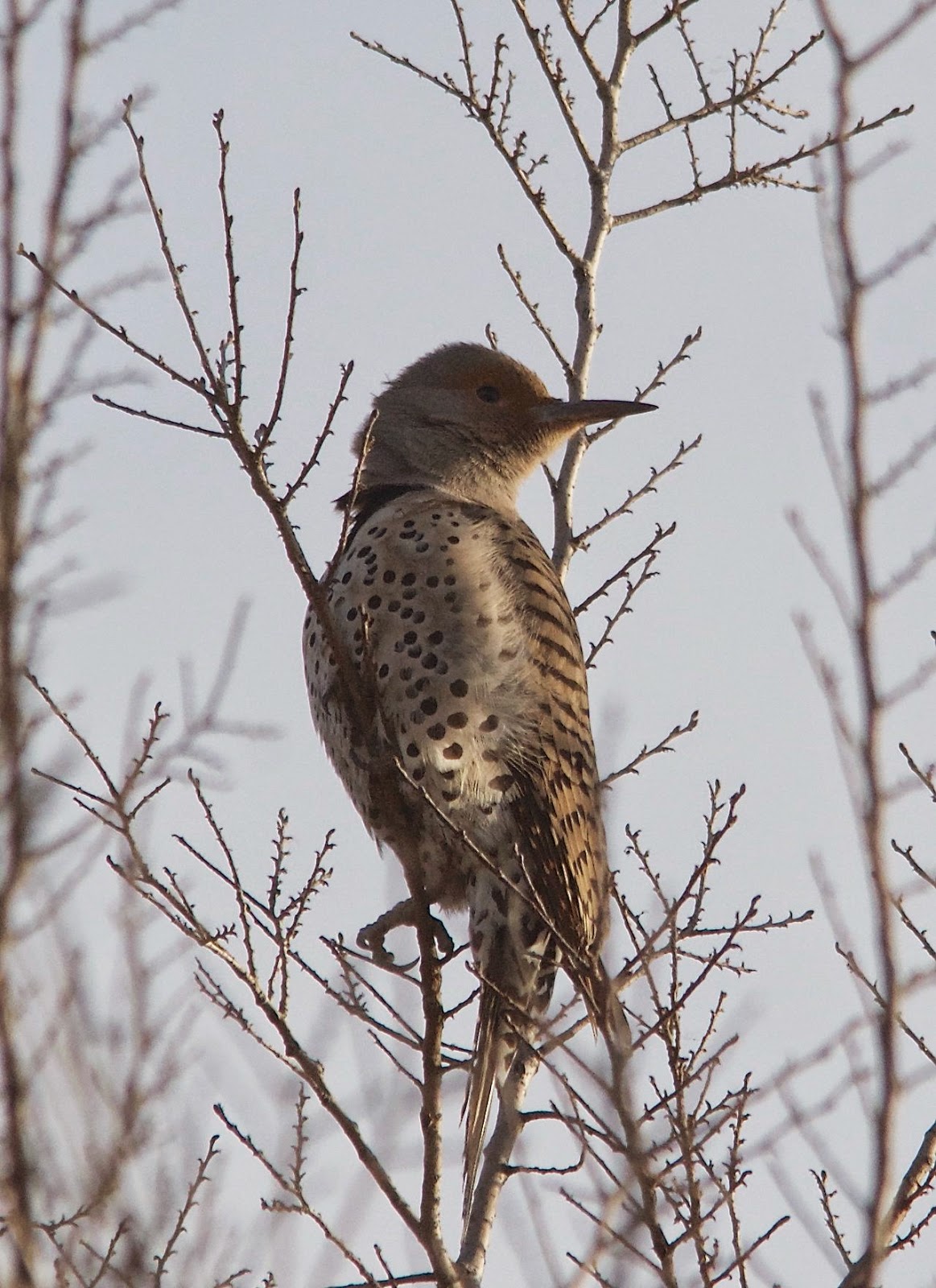
Northern Flicker

Northern Mockingbird

Mourning Dove

American Crow

Ditto

Bufflehead Male

Ditto

American Robin

Great Blue Heron

Ditto

American Crow
0800-0900/partly cloudy/28-29 degrees F/22 degree windchill/no wind
There was a definite chill in the air, but there was plenty of activity on the lake. Many of
our area locals were out, and there was plenty of breathing space for the ducks, even though
a watchful Bald Eagle was west of the Southern Cove. Our friends were gathering and partaking
of what was found in the area. Frost was covering the ground, yet my footsteps were in silence.
In gratitude, my eyes were west, but the eagle disappeared as quickly as it was seen...
Sunday, November 9, 2014
The North Meets the South, Long May They Fly

Great Blue Heron in Flight

Great Blue Heron Fishing

American Goldfinch, Non-Breeding Plumage

Pine Siskin

Northern Mockingbird

American Goldfinch, Non-Breeding Plumage

American Crow

Ring-billed Gull

Double-crested Cormorants

Great Blue Heron
0745-0930/46-51 degrees F/Partly Cloudy/Light and Variable Winds
Look what advanced from the northern states--hordes of American Goldfinches, the Pine Siskin,
more Double-crested Cormorants, and the ducks are inbound, as we speak. There has even been a lone Broad-billed Hummingbird around Stillwater, which is very rare for any hummingbird during this time of year. Watch and wait. See what you might discover...
Subscribe to:
Posts (Atom)