Showing posts with label Wilson's Warbler. Show all posts
Showing posts with label Wilson's Warbler. Show all posts
Saturday, September 5, 2026

Saturday, September 13, 2025
Thursday, May 18, 2023
Sunday, June 5, 2022
Saturday, May 28, 2022
Saturday, April 2, 2022
Saturday, October 9, 2021
Saturday, September 19, 2020
Sunday, October 13, 2019
Sunday, September 29, 2019
Monday, September 23, 2019
Sunday, September 22, 2019
Post Rain Boomer Birding

Yellow Warbler

Female Eastern Downy Woodpecker

Blue-winged Teal
092219
1055-1217/77-78 F/variable to mostly cloudy/SSW-13/87-86% RH/29.88 Hg and steady
After an overnight rain of 2.73", a little activity was observed on Heron Cove. A male Wilson's Warbler was singing, which proves that with adult males, even though they are migrating, summer is not over yet and testosterone is still coursing in their veins. However, Zugunruhe provides migratory restlessness. A photo was not possible due to the rapid movements, even though the male was at eye level. It could have been a good shot.
The Wilson's was in the company of several Yellow Warblers, all having breakfast after a wet night. Insects were on the menu, as migration depletes the body's resources.
A resident female Eastern Downy Woodpecker was also in the area on snags, also in search of protein sustenance. An Eastern Bluebird was heard on the west side of The Cove.
The southeastern low field of Boomer Lake around the pecan trees and mulberry hosted a little over a dozen Canada Geese, 85 migratory Mallards, and a couple dozen juvenile Blue-winged Teal. A couple of Barn Swallows (migrants) and resident Mourning Doves passed overhead.
The remainder of the day remained cloudy and more rain came late afternoon. Perhaps tomorrow will prove fruitful, too.
Thursday, September 19, 2019
Wilson's Warbler Is a Common Fall Migrant in Oklahoma

Wilson's Warbler
091719
0728-0835/75-78 F/partly cloudy/SSE-3/78-76%/29.98-29.97 Hg and steady
After having caught a glimpse of this bird on Saturday, 091419, It was again observed on Monday, 092319, which was a much better look.
It was heard before it was spotted this date, so my intent was to stick for a photo, since the warbler had been used to finding me in the area. The hunch paid off that it would do so, and even though it is a rapid mover, my luck came through. It was observed in a sycamore, and the rest is history.
This was the last day that it was here, apparently continuing on its southern trek. It was last spotted by writer on 091918. Most of these fast moving birds winter in Central America.
Sunday, May 6, 2018
Birding On a Shoestring: The American Southwest via Southeast Arizona part 2

Gambel's Quail

Magnificent (Rivoli's) Hummingbird

Pink Sided Dark-eyed Junco

Gray headed Dark-eyed Junco

Canyon Towhee

Wilson's Warbler

Acorn Woodpecker

Mexican Jay

Plumbeous Vireo

Cactus

Broad-billed Hummingbird

Violet-crowned Hummingbird

Western and Clark's Grebes

Western Grebe

Clark's Grebe

Black Phoebe

Male Lazuli Bunting


Cassin's Kingbird
Many of these were taken in Madera Canyon, as well as in Patagonia, both in Santa Cruz
County, southeast AZ. Most of the western and southwestern subspecies are clearly different,
very noticeably this grayer version of House Wren. The eastern subspecies is clearly more colorful,
but it will blend in better in this ecoregion.
Also observe how the Cassin's Kingbird differs from the Western Kingbird. It just has a white stripe
at the bottom of the tail, unlike the western, which has white on both sides of the tail.
Both the Clark's and the Western Grebes are much bigger than the ones that come from Central OK.
This is a lovely view of the breeding plumage for both. They can even interbreed, and the intergrade shows interesting characteristics, such as the black on the head. One side of the head can look like the western species and the other side can dominate with the headdress of the Clark's species.
There are also different towhees and juncos, all of whom are lumped into the sparrow family. Not all of them can be seen in spring, but there are more species in the winter.
Arizona is also the hummingbird capital of the world, but again, they all cannot be observed at the
same time of year OR the same elevation. For example, the Violet-crowned Hummingbird nests in
a very limited part of the southeast, and it is very rare and local in cottonwoods and sycamores.
As you can see, Gambel's Quail is much different than the Northern Bobwhit , and even less well known are the Montezuma and Scaled Quail, both of which are interested in different ecosystems.
Hopefully, you have enjoyed what some of Arizona has to offer in the winter, spring, and summer
even though it is spring now. Stay tuned for part 3.
Saturday, May 5, 2018
Birding On a Shoestring: The American Southwest Portrayed By Assorted Animals

Wilson's Warbler

Northern Rough-winged Swallow

Cinnamon Teal Pair, Male on L

White-faced Ibis Fishing
One in Front Has a Frog

Great-tailed Grackle

Male Vermilion Flycatcher

Female Vermilion Flycatcher
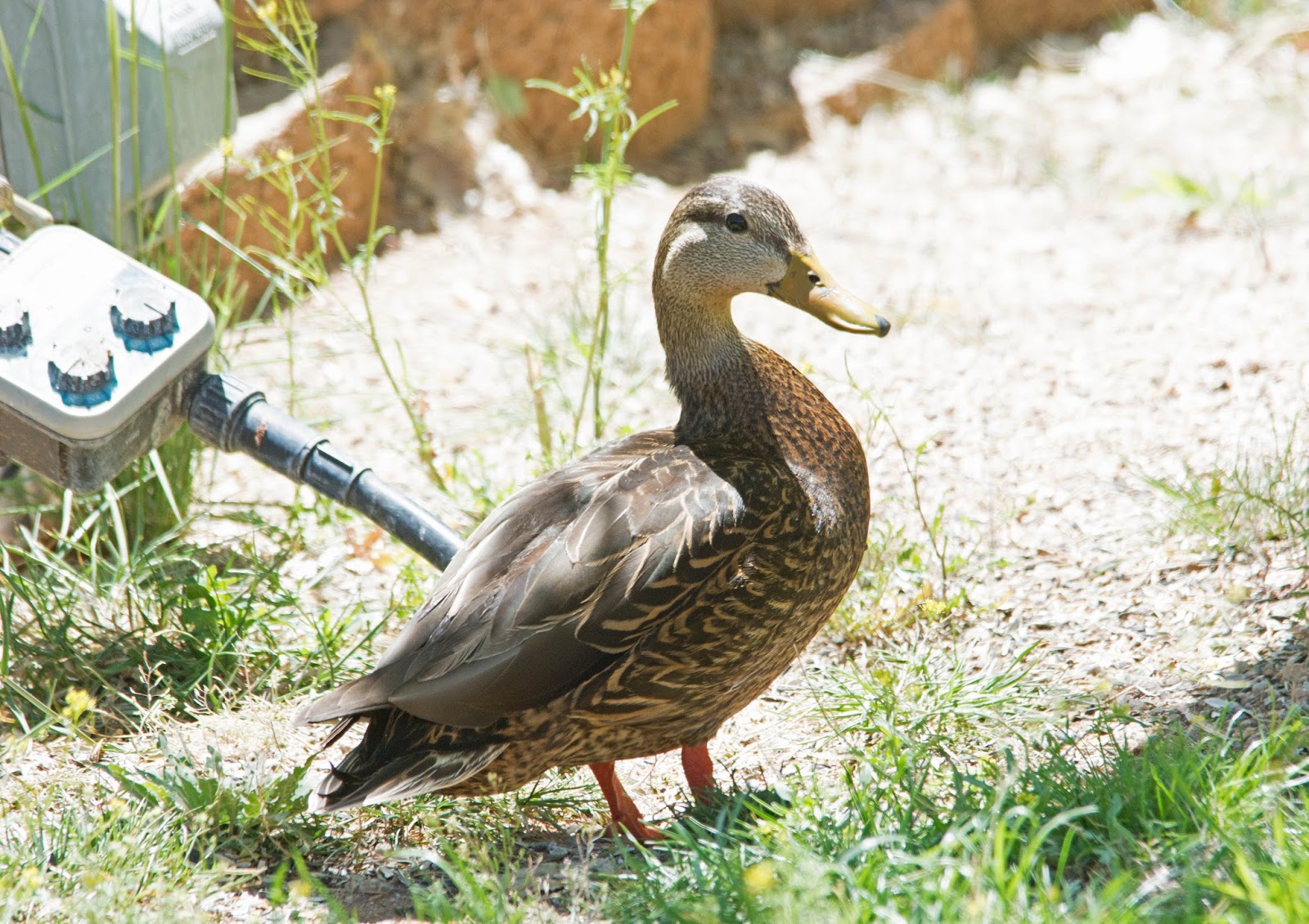
Female Mexican Mallard

Male Gila Woodpecker
Arriving in Tucson, AZ early in the day left a little time for birding, so we managed to
spend an afternoon at the Audubon Mason Center. Unfortunately, I was unable to get the Cactus
Wren there, but that came about a week later, which you'll see soon. This foray from April 19-May
3rd kept us on the run, sometimes rising as early as 0400 to get a jump on travel in order to be an
early birder for the early rising sun, which was at 0600 hrs. AZ does not use daylight saving time, which meant that we were usually awake two hours earlier than normal, and we were on Mountain
Time. Unfortunately, I was still on Oklahoma's daylight savings Central Time the entire trip.
The top photo of the Wilson's Warbler was at the Mason Center and the Gila Woodpecker was also seen there in the cactus scrublands.
The remaining photos were obtained on April 20th, when we drove nearly two hours south to Patagonia, which was in Santa Cruz County, where the remaining shots were taken.
There is much more to come, and I'll work on more photos tomorrow.
Tuesday, September 15, 2015
The Riparian Forest of the Northern Reaches with Migratory Action

Eastern Phoebe

Green Heron

Blue-headed Vireo

Green Heron

Yellow Warbler

Great Egret

Great Blue Heron
66-73 degrees F/0720-0940 hrs./partly cloudy/18 mph winds
The better part of these photos were from Saturday the 13th, some of them within the depths
of The Northern Reaches. There, I saw a friend, the Green Heron perched in the tree, who made
a detour while enrollee elsewhere. He stopped to say hello, and gave several poses. The first
time that I saw that bird, I was trying to photograph a Red-winged Blackbird. He landed right
beside me and croaked for attention. I still have that picture, which I found last night from 2012.
I saw a number of things at The Reaches on Saturday. Due to a recent storm a number of live limbs as well as dead ones peppered the area. I was unable to get through to get to the water when I was forced to stop. This was where I met that beautiful little Blue-headed Vireo. It was but a fleeting
moment, but that was all that I needed for a capture.
I also met a little Orange-crowned Warbler. It is rare that the crown in seen, like the red crown on
the Eastern Kingbird.

Orange-crowned Warbler
And, for the icing on the cake, here is a Wilson's Warbler that was coming through Oklahoma.
It was a brief visit, but it made me smile, as it was my first.

Wilson's Warbler
Good things happen to come at the least expected times, and I must say that I had a productive day.
Subscribe to:
Posts (Atom)