Showing posts with label Red-shouldered Hawk. Show all posts
Showing posts with label Red-shouldered Hawk. Show all posts
Saturday, July 13, 2024

Sunday, August 6, 2023
Saturday, January 21, 2023
Sunday, November 27, 2022
Saturday, September 3, 2022
Saturday, March 26, 2022
Saturday, March 5, 2022
Monday, February 21, 2022
Saturday, January 29, 2022
Monday, January 24, 2022
Friday, January 7, 2022
Monday, April 27, 2020
042720 Migrants of Central Oklahoma and Resident Raptor

Yellow-headed Blackbird, View 2

Yellow-headed Blackbird, View 3

Cackling Goose, View 1

Canada (L) and Cackling Goose (R)

Eastern Kingbird

Red-shouldered Hawk
Saturday, 042520 was another excellent birding day. There is a possibility that there are three Green Herons at The Cove. It is suspected that we're looking at the patriarch male and two females, both to be nesting in different trees. The nest, if there is one or more, hasn't been established yet, as writer wishes to give the birds adequate space this early in the season. One of the usual Northern Flickers was heard just below the berm east of there around the mulberry/Bradford pear tree cluster.
Several Spotted Sandpipers were observed on Shorebird Jetty. South of the jetty, five Lesser Scaups were discovered and a few American Coots closer to the west side of Heron Cove. On the west side of the jetty was a lone Yellow-headed Blackbird with a suspected wing and foot injury. The area rehabilitator was contacted, but it was learned a short time later that the blackbird disappeared. Possibly it was really well enough to fly or a predator took care of the situation, though none was observed while at location. There are still two or three Savannah Sparrows connected to this area.
Two Orchard Orioles are still in the area (males) and one Baltimore Oriole has been in the large oak by the east side restrooms, as well as a pair of Scissor-tailed Flycatchers. The other two Baltimore Orioles had relocated themselves at my residence and the next door neighbor's oak tree. There are still two or three singing Warbling Vireos at Boomer Lake, along with another near writer's location.
A possible Richardson's Cackling x Canada Goose was discovered on Memorial Jetty with what might be its Canada Goose mate. It is possible that this might be the same individual that another birder had seen within the past several days. Looking at the photo, the small bill and smaller stature is seen, but there is clearly a mix of Canada in there.
It has also been noticed that more than one pair of Canada Geese had nests on all three east side jetties. It appears that all eggs are either dead or had been addled. A Mallard may still be brooding eggs, but we did see a trail of eleven ducklings earlier in the week with some that could have easily been adopted. I have not seen the family since that initial finding.
There were two Western Kingbirds across from the Kicker plant, as well as a pair of Mourning Doves and what may be a lone Eurasian Collared-Dove. A pair used to nest in a small tree once near the large oak beside the restrooms, but that area has been cleaned up to allow the storm drain appropriate function. A lone Eastern Kingbird, who has been vascillating around the northeast jetty, along with two more Scissor-tailed Flycatchers whose territory runs to the Kicker field, and two more Savannah Sparrows are temporarily residing there. Many more birds felt comfortable at the marsh grass before the old rotten snag collapsed into several pieces. A male Eastern Bluebird was found on the Boomer Lake side of Kicker this morning. The Orchard Oriole has been patrolling that area as far as the large oak south of there.
We're still finding interesting things around Goose Island, like Northern Shovelers and Blue-winged Teal. Cormorants are still roosting in the tree, mostly by the lilac on The Island.
The wooded area has still been providing many interesting species, including Yellow, Yellow-rumped, and Black-and-White Warblers, as well as Swainson's Thrush, Red and White-eyed Vireos, and even the Pileated Woodpecker stopped by from Boomer Creek for a short time. The Clay-colored Sparrows were also close by with Harris's and Field Sparrows, and Carolina Chickadees. There's likely still more in the area that haven't yet been discovered. It is a nice treasure trove of bustling activity in the midst of migration. A Blue-Gray Gnatcatcher was also heard, as well as an Eastern Phoebe out around the Kicker Field, along with an Eastern Meadowlark and Killdeer.
Since our American Kestrel has been attending to nesting and feeding duties, he has not been on the north end of the Kicker fence on the electrical lines. When the youngster(s) fledge, he will return, possibly with his mate and the young until they are ready to depart for the season.
On the return trip, coming around the stretch bordering Kicker's north and approaching the west gates, a Red-shouldered Hawk blew past me, no more than seven feet away. It was not overhead, it was directly in front of me. It was so close, it could see the red shoulder patch and see the yellow nares, which determined that this was a first year bird. It landed in a cottonwood tree, which was where this photo was made. A nice end to a glorious birding day!
Too bad there was no Bald Eagle nor Osprey today. They were getting to be a great habit. Now I'm looking for their presence. Many times the eagle is atop the new metal electrical poles just surveying its territory. The Osprey was getting to be familiar, too, as it was found three or four days riding the air currents while it was peering into the lake looking for fish. Both of these familiar denizens were missed.
Today gave us a respectable 64 species.
Saturday, April 11, 2020
041120 Spring and Migration Is Feeling More Seasonable

041020 Pied-billed Grebe
This had been a group of ten migrant grebes that was observed from Heron Cove, a group of three a short distance from the rest. Hoping to obtain a better photo, writer began to respond to location. Halfway there, a Bald Eagle flew overhead, not in their direction. Upon arrival the remains of one of these birds had been freshly killed. Knowing that the eagle was not responsible, there was no clue, other than it was not a Cooper's Hawk.

Red-shouldered Hawk
This bird was observed flying in from the south, and the Purple Martins were not happy as it was too close for comfort. They rarely had been in the area in the past, as the house was too close to trees. Ten of them were overhead calling vociferously. This is where the hawk was captured, most likely looking for a meal of coot, which had been found on land a hundred feet east of this location. Someone even sweetly put a daffodil under one of the coot's wings. The unknown suspect had it removed by the next day.
The hawk moved a little further south on the date of this photo, eventually drawing attention to itself. It was soon followed by three Fish Crows to Boomer Creek.

Eastern Phoebe
This little flycatcher was hawking insects in the area and managed to settle here for a a moment.

041120 Least Sandpiper
It appears that the same bird that has been around for about a week is molting. Its feathers appear to be more colorful.

Scissor-tailed Flycatcher
Our State Bird seems to be warming up to the area and being less flighty around people. This was the first early bird of the years, and has since been joined by three others in the area. Two of them tend to travel from the west side of the lake across the water to the east side, and vice versa.
Sunday, January 26, 2020
Sunday, August 4, 2019
Saturday, January 26, 2019
December Melds Into January with New Year's More Recent Bird Trappings
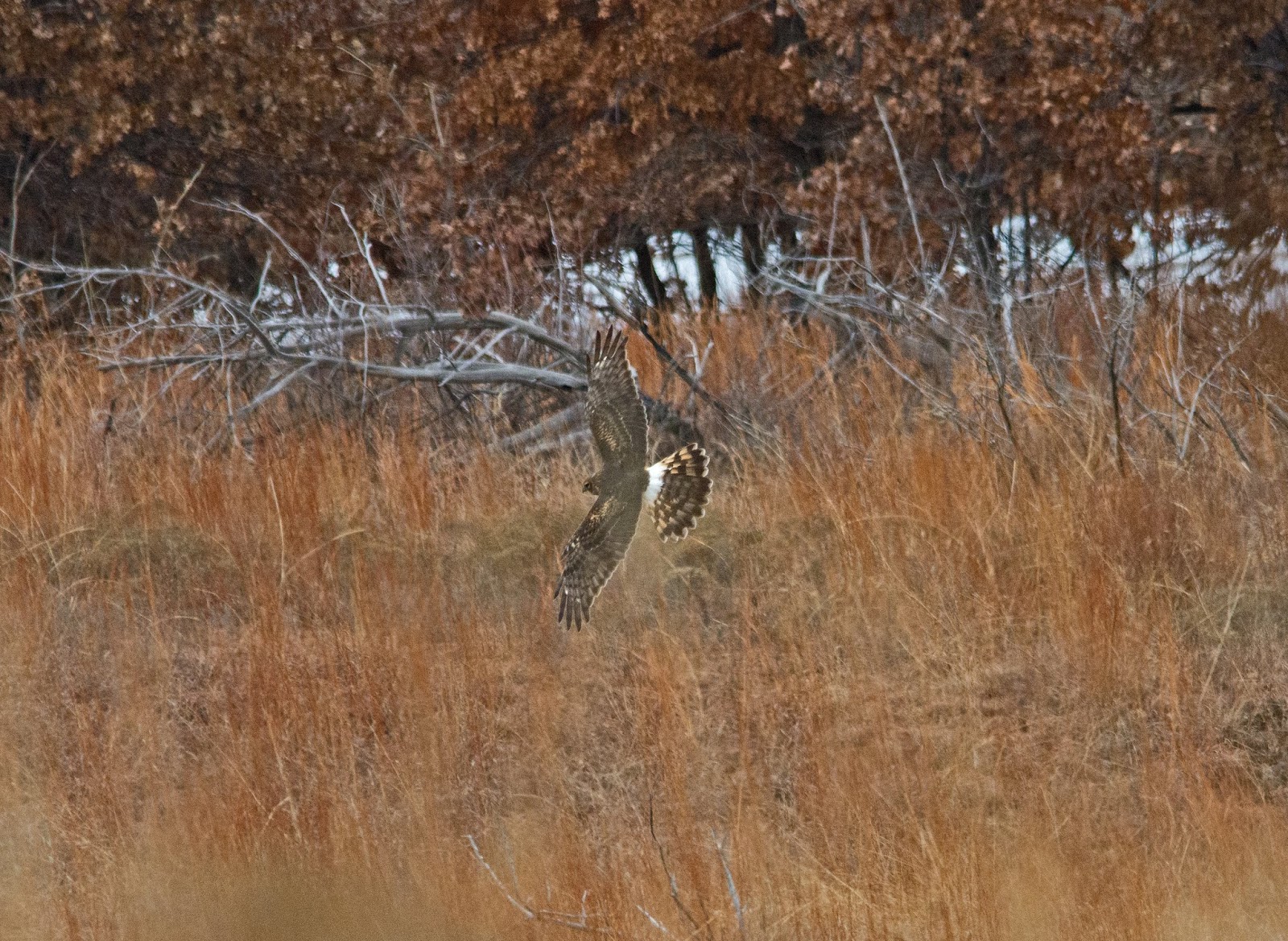
Northern Harrier

Pied-billed Grebes

Ruby-crowned Kinglet

Bonaparte's Gull

Red-shouldered Hawk

Ruddy Ducks

American Goldfinch

Northern Shoveler

Bonaparte's Gull
mid-December 2018 - mid-January 2019
The only photo worth getting at Christmas Bird Count on northwest Payne County was the distant Northern Harrier shot. It beautifully shows the white uppertail coverts so characteristic of the species.
The remainder are all from Boomer Lake Park, some mornings of which were on the colder side for ducks and other water birds.
The Ruby-crowned Kinglet seems to be coming less often, but as can be noted, it was a fairly good photo. These birds constantly tail flick and are on the move, rarely still for any appreciable amount of time.
The Bonaparte's Gulls were on the lake much more frequently this winter. We have had mostly light freezes but those have been few and far between. Today was more of a medium freeze found closer to the edges f the water, but spread out toward the inner part of the lake. Heron Cove was once again iced over.
We seem to be down to one Ruddy Duck now and winter's hawks make an occasional appearance.
The American Goldfinches are steady visitors this winter. Ducks have been visiting more during the cold, and fortunately this Northern Shoveler provided a nice in flight photo op. Pied-billed Grebes vary in numbers, but there is usually at least one most days and up to six have been observed.
Monday, January 21, 2019
Birds of Boomer For December 2018

Red-shouldered Hawk

Juvenile Herring Gulls

Male Hooded Merganser

Juvenile Herring Gull (Rear)

Red-shouldered Hawk

Common Merganser

Glaucous Gull ?


Lesser Black-backed Gull

Carolina Chickadee

Green-winged Teal

Bewick's Wren

Common Merganser

Juvenile Herring Gulls

Common Merganser
12-05 - 12-16-18
Most of December was a very mild month, with very few birds of interest at Boomer Lake.
We had more Herring Gulls than usual, one or two in a couple of hundred Ring-billed Gulls was normal, but we have seen double, sometimes triple those numbers this winter.
The Lesser Black-backed Gull has visited several times, along with a Glaucous Gull that came in once or twice.
Common Mergansers were all over the state more than usual, more than the normal Red-breasted Merganser.
This irruptive year also brought Purple Finches, as well as Red-breasted Nuthatches to mostly the northwest corner of Boomer Lake several times.
Hungry hawks have also been here, but not nearly the numbers that we saw last year--yet. Winter has only been here for a month.
Ducks were very rare in December, too, but there will be a few changes with occasional cooler mornings in January.
Sunday, January 6, 2019
Sunday, December 30, 2018
Subscribe to:
Posts (Atom)