Showing posts with label American Avocet. Show all posts
Showing posts with label American Avocet. Show all posts
Sunday, October 20, 2024

Saturday, June 15, 2024
Monday, November 7, 2022
Saturday, April 23, 2022
Sunday, October 17, 2021
Saturday, July 3, 2021
Wednesday, May 26, 2021
052621 Spring Into Spring with Our Green Heron First Family

043021 Carolina Chickadee
This little beauty was out with its mate, checking for a nest cavity. Writer had seen where it was contemplating nesting, though a Downy Woodpecker was trying to usurp the same area even if it was much larger than the chickadee. The Downy's size was much too great for the thin snag.

050821 Red Eared Slider

This lovely was close to shore, but it was easy to stay covered by leaves to get this shot and remain hidden to the subject.


American Avocet


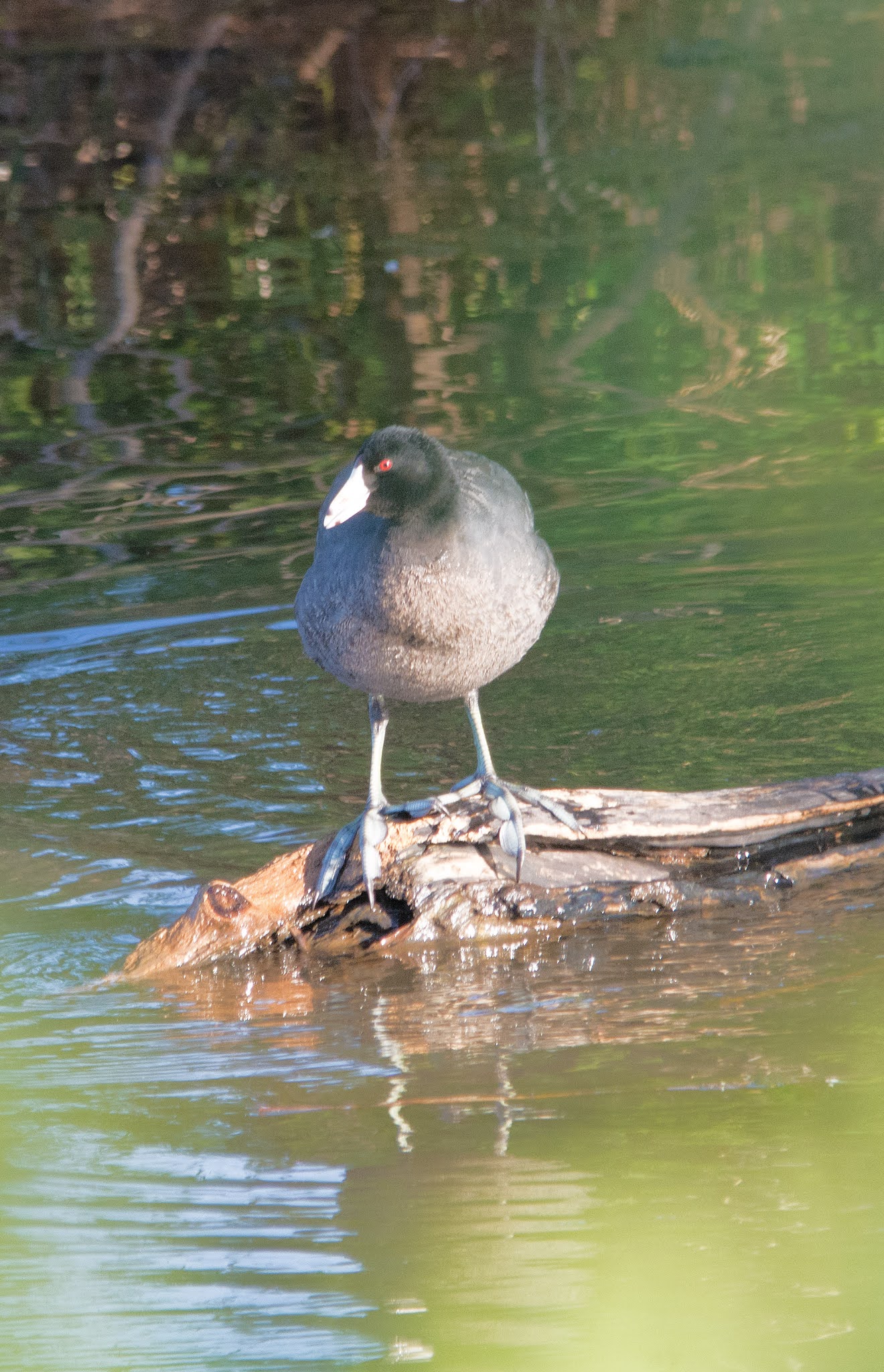
051421 American Coot
Even though morning had been broken, the area coots didn't mind being observed. Look at those unusual lobed toes that are so well adapted to uneven surfaces!

051521 Canada Goose (Gosling)
Knowing a kid's parents will get you right in the front row to photograph the youngster.

Clay Colored Sparrow
This slightly wet all-star was with roughly eight other migrants and this one didn't mind being the center of attention.

There were eight sandpipers wheeling around the lake multiple times, which afforded this nice shot of a bird's-eye-view. How cliche, right?

052521 Least Flycatcher
Least Flycatchers are easy to shoot IF you see one. We were eye to eye.

Green Heron and Nestlings 1
One view of some of the first family of 2021.

Green Heron and Nestlings 2
View two with some of each bird in the photo.

Green Heron and Nestling 3
The other one must have ducked under the parent.
Saturday, May 15, 2021
Saturday, April 24, 2021
Saturday, April 17, 2021
Tuesday, April 21, 2020
042120 Here We Are At Migrant Central

041920 Bonaparte's Gulls

042020 Orchard Oriole
First day at the lake. Baltimore Orioles were right behind, one of which was here near my residence before this oriole.

042120 Blue-winged Teal
There was a total of eleven of these at Boomer this morning.

Savannah Sparrow
There were three on Shorebird Jetty alone. There were five or six spotted.

Least Sandpiper
Two on Shorebird Jetty. Migration is quite active active with a lot to offer today.

Yellow-headed Blackbird
Six were fueling up on Shorebird Jetty, while these three took their time.

Lesser Scaup
Still coming through the area. The scaup were not far off the point of Shorebird Jetty when they took to the air. They preferred settling on the east side of the jetty and were much closer by choice.

American Avocet
This group of 35 arrived shortly before 0800 and as is their habit they made around six passes over the lake. They were flushed a few times, by both a Bald Eagle and an Osprey, which you'll see shortly.

Lesser Scaup
As can be seen, their plumage is very striking. They were only twelve feet from the shore.

Mallard Ducklings
First of the Year
This is the first group that we've observe this year, obviously some were adopted. There were eleven. Mother and father are not far.

Mallard Ducklings
View 2

Grasshopper Sparrow
It was surprising to see this sparrow up in a cottonwood tree near the water, a typical riparian area.
It must have been desperate for a rest and sustenance.

Great Blue Heron (Rear)
Double-crested Cormorants (Front)
Writer considered this a striking pose, something not seen every day. The Great Blue Heron is a second year individual.

Osprey
Pretty close, eh? This raptor was in the area the entire morning. It was spotted on the return trip.

Green Heron
"The Patriarch"
Before we called it a day, it was in order to check The Cove to see if Green Heron was here yet. It was not disappointing. Also made a swing by to see if the Summer Tanager arrived, but not quite yet.
The mulberry bush near here has berries just starting that were pollinated over the past ten days or so.
Overall this was an excellent birding day with 56 species in a four hour day.
Sunday, April 19, 2020
Monday, April 6, 2020
040620 Spring Migrants and More at Boomer Lake

032920 Abatement Team
I had seen small orange flags on metal wires in the ground at Goose Island over the years, but never knew that it was for egg addling by licensed abatement teams. Having observed what appeared to be biologists banding Canada Geese, I never gave it a second thought, as there were usual several large families of Canada Geese in some instances. This is how we keep birds from getting too overpopulated, since these geese are residents. Canada Geese are known as pest birds in many communities, and there are federally licensed abatement teams that perform this service. The geese are uninjured, while their eggs are no longer fertile. The geese try to hatch dead eggs and nobody is killed.

033020 Ruddy Ducks
The lead bird is a beautifully fully plumaged duck. Note his bright coloration and bright blue bill. This animal is a show stopper in breeding plumage. The rest of the birds are female. They should be heading north to breed soon.

040220 Lesser Scaup
The Lesser Scaup winters in the southern part of the country as well as in the west. Some of them are already in their way to the boreal forest and northern parts of the US to breed. This is a lovely example of the adult male. The species favors fresh water and smaller lakes, and is a common and widespread duck.

Ditto, View 2

040520 Baird's Sandpiper
This High Boreal breeder has long, tapered wings making it well adapted for lengthy flights. They usually complete their migration from Tierra del Fuego to the High Arctic in as little as five weeks! Known as the "grasspiper," they forage in drier, more vegetated habitats than most other sandpipers.

Lesser Yellowlegs
This thin, long-legged shorebird is unable to hide those bright legs, which is its namesake. It will run after prey on land, usually found walking in shallow water picking up food either at or just below the surface.

040620 American Avocets in Flight
One of the most beautiful of birds, the American Avocet is sometimes involved as a brood parasite, laying their eggs even in the nests of other species. Other shorebirds will sometimes to the same to the avocet. They often place their nests on the ground with nothing to provide shade. However, they will dip the bellies in water in water during incubation.

American Avocet, View 2

American Avocet, Detail

Northern Cardinal
Isn't she lovely?
Sunday, November 17, 2019
Monday, October 7, 2019
Saturday, September 28, 2019
Migration From Medium to Lower Intensity Over Two Day Period
American Avocet, View 1

American Avocet, View 2
092319
0751-0909/69-72 F/partly cloudy/E-8/84-82% RH/30.01-30.03 Hg and rising
There were still well over four dozen Mallards settled into the low spots at the southeast corner of Boomer Lake. Twenty-Nine Turkey Vultures were riding the thermals over the Boomer Creek area, one Great Egret was at the water's edge wading, two Great Blue Herons were counted as flyovers, an American Coot was in the water, and a Killdeer was heard wailing in the distance.
At The Cove, we had a couple of Mourning Doves on the wing, a yellow-shafted Northern Flicker in the air, an Eastern Phoebe that sat upon a martin house until it tired of the view, a Blue Jay, Carolina Wrens, and a couple of the Northern Cardinal family hiding in the trees on the west side around the sycamores, western soapberry, Bradford pears, and others.
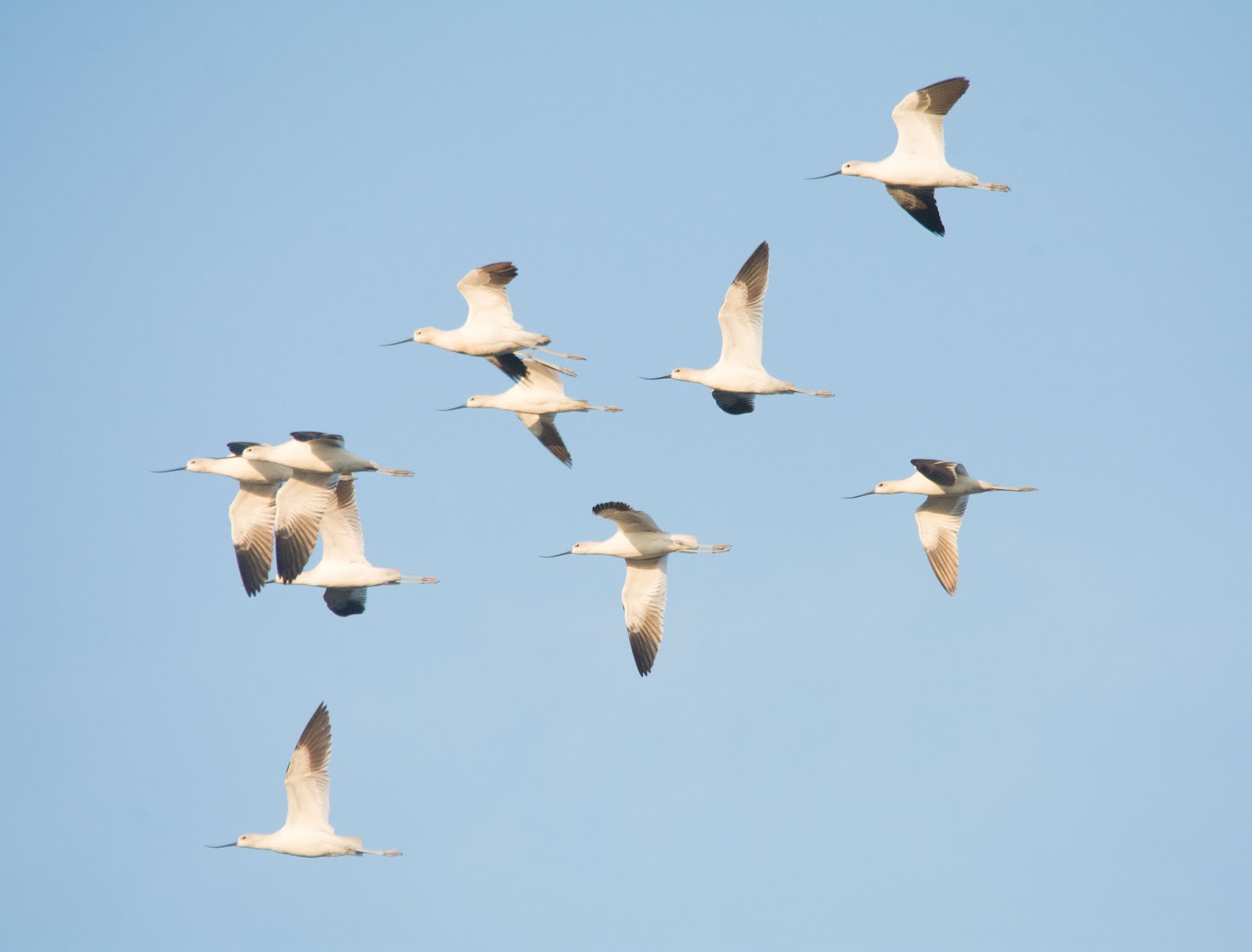
The dozen American Avocets flew up and down Boomer Lake the entire time that I was there, and these were the best shots of them. When they flew from north to south, their height increased, and they pulled closer together the higher that their trajectory became. Then the circling movement came into play and they slowly dropped until the reached about the center of the lake and repeated the process. Once they attempted to land for a moment in the water on the south side of Shorebird Jetty, but soon changed their minds. Perhaps the Great Blue Heron standing in the area on land thwarted their intentions.
An American Crow called from the dam area. and two dozen Double-crested Cormorants were southbound on high. They were likely not planning on resting for a while at the height that they passed through.

Yellow Warbler, View 1

Yellow Warbler, View 2
092419
0832-0923/76-77 F/variable clouds/S-5/86% RH/29.88-29.90 Hg and steady//.16" 24-hour rainfall shortly before dawn
There were slightly fewerMallards today around the lowlands on the southeast corner of the lake with a half dozen Blue-winged Teal in tow.
Two Barn Swallows made their way south, and on the water we had two Canada Geese, a Pied-billed Grebe, three Great Egrets, and a Great Blue Heron.
At The Cove a Nashville Warbler was in the company of eight Yellow Warblers, all partaking of sunflower seeds and insects, which by the way, over the past two weeks held up well with the onslaught.
Monday, August 5, 2019
Birding On a Shoestring: Cheyenne Bottoms, Kansas

Forster's Tern, non-breeding

Forster's Tern, nonbreeding 2

Forster's Tern, nonbreeding 3

Franklin's Gulls

Franklin's Gulls 2

Black Tern (Left) and Franklin's Gull (Right)

Black Tern

Black Tern 2

Franklin's Gull
072819
1300-1700/ partly cloudy/windy, 25-30 mph
After lunchtime was interesting, as there was a lot of water in the marshes, as well as large numbers of birds. Since it was so windy, it appeared that many of the birds would be lying low, which the normal ones were. However, when it came to Barn and Cliff Swallows, they were taking everything in stride from the air, of course.
Much of the sun was in the wrong direction when we drove toward the first bird-filled marshes, making them difficult to identify due to glare. Most of the seasonal birds, including White-faced Ibis, Great Blue Heron, Great Egret and Snowy Egret were there, as well as both Long- and Short-billed Dowitchers, and many of the other usual shorebird suspects.
We also saw the head of a young male buck with short fuzzy antlers in the water, swimming toward shore, then deviating in our direction to follow the shoreline. It almost seemed that he was unable to gain land purchase, but it didn't make sense that he could not. It appeared that he was doing his best to keep his head up, and through observation, he may have been walking on the bottom, as well as swimming. He finally passed us in the water, as we stopped the car to not make him fearful of us.
There were good representations of American Avocets and White-faced Ibis, where we could actually clearly see the white faces. One ibis found a prize, which may have been a frog, and he was doing his best to keep the other birds from stealing it. He dropped it several times, and finally managed to eat it.
Passing other ponds, we observed Pied-billed Grebes, Mallards, and Blue-winged Teal. It was almost like certain species had their own ponds, but it most likely had to do with water depth.
We'd also see a few groups of Franklin's Gulls, an occasional Black Tern, as well as Forster's Terns. The further along we got, we discovered that more representatives of these birds were caught in a wind tunnel. They were flapping their wings, yet not going anywhere, staying fairly stationary. Unless these birds managed to deviate to the right, they stayed within this odd cycle of events. There were eventually Great White Pelicans in the area who were in the water, as well as a few of the Franklin's Gulls and an occasional Ring-billed Gull. A Black-Crowned Night-Heron was also discovered on the tail end of this melee, but it managed to break free of the wind prison.
Many, many more ponds were observed and the wind seemed to lessen in the central part of the refuge. Large numbers of the previously mentioned herons were seen, as well as the White-faced Ibis. It was a most remarkable collection of birds. The further inland we were, a few songbirds turned up, as well as Turkey Vultures and Red-tailed Hawks.
We held out hopes for an American Bittern but we could have missed it, though there was some good habitat.
for more on the adventure:
https://debhirt.blogspot.com/2019/08/birding-on-shoestring-cheyenne-bottoms.html
https://debhirt.blogspot.com/2019/08/birding-on-shoestring-quivira-national.html
Friday, August 17, 2018
Oklahoma Breeding Bird Species Profile: American Avocet
This sandpiper is a bird of shallow waters, where many or a few may congregate to rest or to feed. Food is obtained by walking along with heads down and sweeping the long, thin bill from side to side.
It can be found in marshes, ponds, lakes, lagoons, sewage ponds, flooded fields, mudflats, ponds, etc. The avocet will also sometimes swim and feed by tipping like a dabbling duck on small crustaceans, insects, seeds, and aquatic vegetation.
Its non-breeding plumage is black and white, but in spring it will have a lovely pink to rusty brown head and neck, making it quite distinctive.

Breeding Plumage, 2014
Boomer Lake Park, OK
They could winter in Mexico or along the Florida or southern California coasts, making it a medium distance migrant.
Birds pair in late winter and both birds will incubate, as well as defend the nest site and forage together. Mercury (from coal burning plants), as well as selenium will cause low reproductive success and the death of embryos and chicks.
Natural wetlands are disappearing for reasons of farming and building, and at the present, populations are stable, making this a species of low concern.

Non-breeding plumage, 2017
Estero Llano Grande, TX
These are precocial birds (chicks ready to walk and covered in down).
Subscribe to:
Posts (Atom)