Showing posts with label Vermilion Flycatcher. Show all posts
Showing posts with label Vermilion Flycatcher. Show all posts
Saturday, March 29, 2025

Saturday, September 22, 2018
Oklahoma Vagrants: Vermilion Flycatcher
pete-pete or pete-a-weet
Uncommon and local in diverse mixes of brush, trees, riparian woodlands, agricultural areas, savannah, grassy openings near water, and in desert habitat, the Vermilion Flycatcher will enamor you. The usually solitary bird will sally for small flying insects like a typical flycatcher from an open perch.
This spectacular red passerine of the south and southwest is a star in its own right. The species is dimorphic, and the female is very similar to the Say's Flycatcher with her peach colored belly.
From Alaska to central South America, the wide range is enjoyed by this neotropical migrant, which encompasses over seven million square miles globally.
Males will bound across the high canopy while fluttering and singing a solicitous song in the spring to a chosen female. They will fluff out the feathers, perform aerial acrobatics, and then swoop down to the perch from where they came. The male will offer the female a butterfly to seal the deal.

Male Vermilion Flycatcher
Patagonia Lake SP, Santa Cruz County, AZ
2018
First found in Oklahoma in the twenty-first century, Darwin's flycatcher has visited the panhandle quite often, and has even made guest appearances in other parts of the state. It has even been as far as the state of Maine.
A species of least concern and one not to be easily forgotten, the Galapagos flycatcher will bring a smile to one's face with its friendly nature. Both parents care for the young, and the male will handle parental duties while the female begins a second clutch. These small flycatchers are insectivores.
Land development and water redirection caused a serious problem in the lower Colorado River Valley for this bird. It has rebounded and is spreading its wings as can be seen with its diverse range in other locales.
Other Birds Seen with the Vermilion Flycatcher:
https://debhirt.blogspot.com/2018/05/birding-on-shoestring-american.html
https://debhirt.blogspot.com/2017/02/representatives-of-days-3-through-5-in.html
Saturday, May 5, 2018
Birding On a Shoestring: The American Southwest Portrayed By Assorted Animals

Wilson's Warbler

Northern Rough-winged Swallow

Cinnamon Teal Pair, Male on L

White-faced Ibis Fishing
One in Front Has a Frog

Great-tailed Grackle

Male Vermilion Flycatcher

Female Vermilion Flycatcher
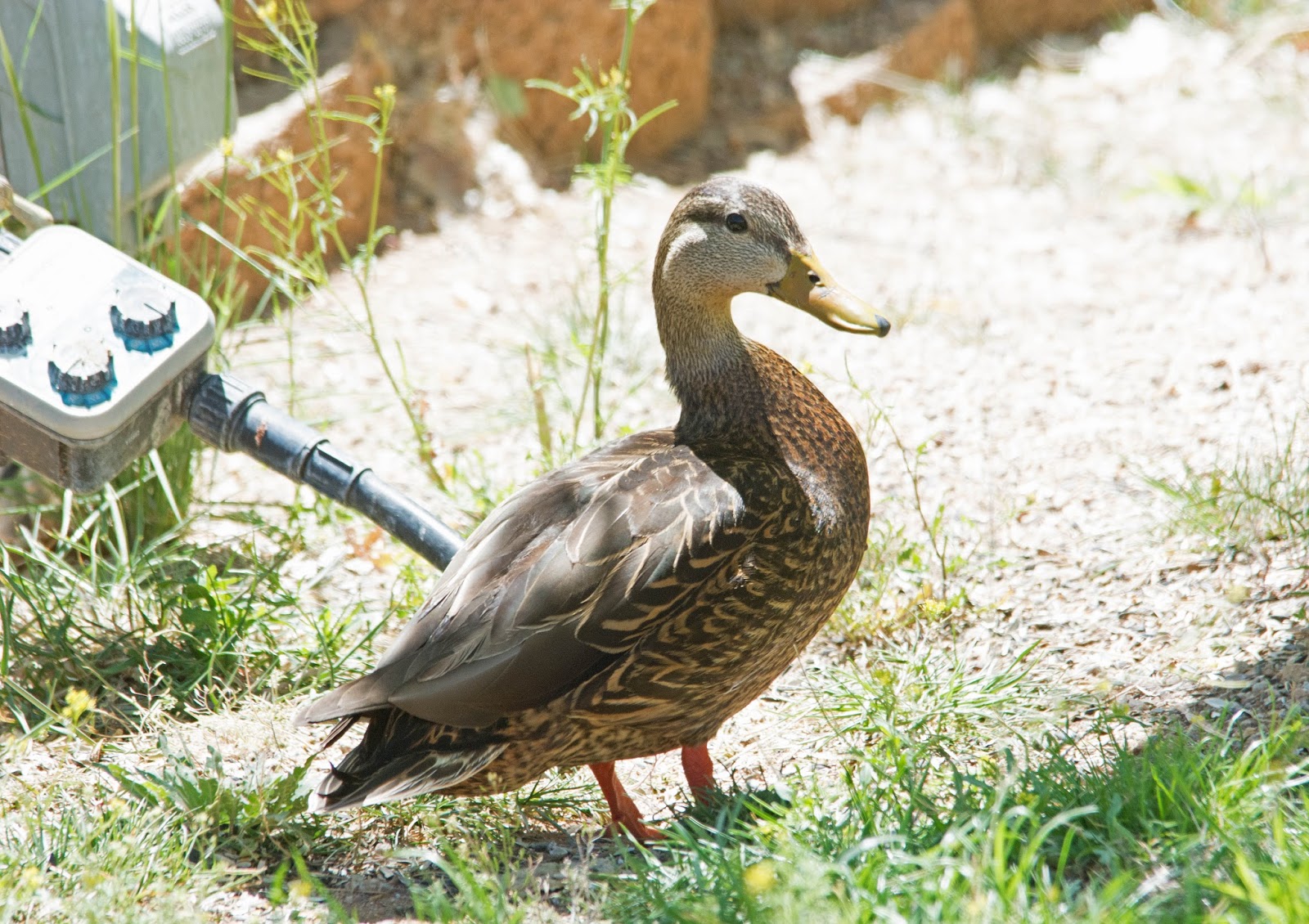
Female Mexican Mallard

Male Gila Woodpecker
Arriving in Tucson, AZ early in the day left a little time for birding, so we managed to
spend an afternoon at the Audubon Mason Center. Unfortunately, I was unable to get the Cactus
Wren there, but that came about a week later, which you'll see soon. This foray from April 19-May
3rd kept us on the run, sometimes rising as early as 0400 to get a jump on travel in order to be an
early birder for the early rising sun, which was at 0600 hrs. AZ does not use daylight saving time, which meant that we were usually awake two hours earlier than normal, and we were on Mountain
Time. Unfortunately, I was still on Oklahoma's daylight savings Central Time the entire trip.
The top photo of the Wilson's Warbler was at the Mason Center and the Gila Woodpecker was also seen there in the cactus scrublands.
The remaining photos were obtained on April 20th, when we drove nearly two hours south to Patagonia, which was in Santa Cruz County, where the remaining shots were taken.
There is much more to come, and I'll work on more photos tomorrow.
Sunday, February 5, 2017
Representatives of Days 3 Through 5 In the Lower Rio Grande Valley

Harris's Hawk

Black-necked Stilt

Belted Kingfisher

Zebra Heliconian

Merlin

Vermilion Flycatcher

Green-winged Teal

Adult Male Anhinga

Juvenile or Female Anhinga
01-16 through 01-18-17
Now comes some of the meat and potatoes. The days are longer and we even ran into a
Night-Heron colony. For those of you that are not aware, Night-Herons are shunned and driven
away by herons, as they tend to eat heron eggs as well as young. So both species will co-exist
peacefully by themselves. The Anhinga was also nearby, too.
The Harris's Hawk family, meaning specific family members, such as a set of parents and their young
will stay together after one season. The whole family can be found hunting together, just like birders.
Extra eyes can help, but they are also louder. It all depends on what your end result might be.
Never fear, as there are plenty of ducks in the winter to be seen, and see, you shall.
There were many more photos, like the well-camouflaged Common Pauraque, Nutria, White-eyed Vireo, Northern Pintail, the Night-Herons, and more, but the photo files appear to be too large for blogspot posting now. You will just have to see them in another fashion.
Happy birding!
Subscribe to:
Posts (Atom)