Showing posts with label Canyon Towhee. Show all posts
Showing posts with label Canyon Towhee. Show all posts
Monday, June 4, 2018

Sunday, May 6, 2018
Birding On a Shoestring: The American Southwest via Southeast Arizona part 2

Gambel's Quail

Magnificent (Rivoli's) Hummingbird

Pink Sided Dark-eyed Junco

Gray headed Dark-eyed Junco

Canyon Towhee

Wilson's Warbler

Acorn Woodpecker

Mexican Jay

Plumbeous Vireo

Cactus

Broad-billed Hummingbird

Violet-crowned Hummingbird

Western and Clark's Grebes

Western Grebe

Clark's Grebe

Black Phoebe

Male Lazuli Bunting


Cassin's Kingbird
Many of these were taken in Madera Canyon, as well as in Patagonia, both in Santa Cruz
County, southeast AZ. Most of the western and southwestern subspecies are clearly different,
very noticeably this grayer version of House Wren. The eastern subspecies is clearly more colorful,
but it will blend in better in this ecoregion.
Also observe how the Cassin's Kingbird differs from the Western Kingbird. It just has a white stripe
at the bottom of the tail, unlike the western, which has white on both sides of the tail.
Both the Clark's and the Western Grebes are much bigger than the ones that come from Central OK.
This is a lovely view of the breeding plumage for both. They can even interbreed, and the intergrade shows interesting characteristics, such as the black on the head. One side of the head can look like the western species and the other side can dominate with the headdress of the Clark's species.
There are also different towhees and juncos, all of whom are lumped into the sparrow family. Not all of them can be seen in spring, but there are more species in the winter.
Arizona is also the hummingbird capital of the world, but again, they all cannot be observed at the
same time of year OR the same elevation. For example, the Violet-crowned Hummingbird nests in
a very limited part of the southeast, and it is very rare and local in cottonwoods and sycamores.
As you can see, Gambel's Quail is much different than the Northern Bobwhit , and even less well known are the Montezuma and Scaled Quail, both of which are interested in different ecosystems.
Hopefully, you have enjoyed what some of Arizona has to offer in the winter, spring, and summer
even though it is spring now. Stay tuned for part 3.
Saturday, May 20, 2017
Birding On a Shoestring: Life on the Oklahoma Panhandle
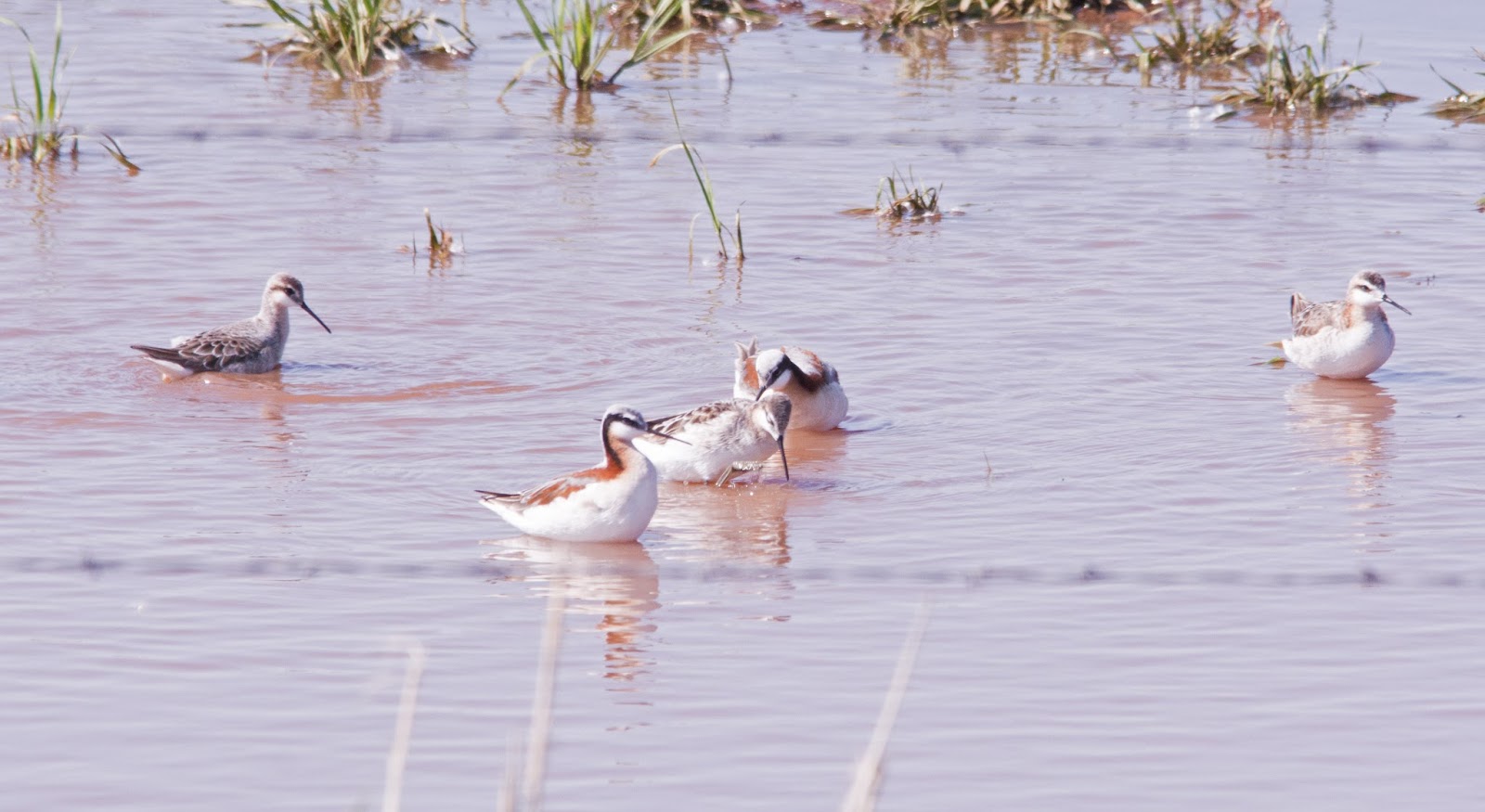
Wilson's Phalarope

Stilt Sandpiper

Wilson's Phalarope

Ditto

American Avocet

Wilson's Phalarope

Lark Bunting

Western Meadowlark

Lark Bunting

Long-billed Curlew

Loggerhead Shrike

Pronghorn Antelope

Swainson's Hawk

House Finch

Juvenile Say's Phoebe


Cassin's Kingbird

Female Bullock's Oriole

Male Orchard Oriole

Chipping Sparrow

White-crowned Sparrow

Male Pronghorn Antelope

Say's Phoebe

Female Black-chinned Hummingbird

Male Black-chinned Hummingbird

Lark Sparrow

White Tailed Deer (Doe)

White Tailed Doe and Fawn (Left)


Ash-throated Flycatcher

Ditto

Canyon Towhee

Cassin's Sparrow

Rock Squirrel

Mule Deer

Black-chinned Hummingbird Nest

Burrowing Owls

Burrowing Owl
Friday, 05-12 through Monday, 05-15-17
This was a trip that I had been wishing for a little over a year, and when the opportunity arose,
my heart was filled with joy. Photos were obtained from the entire panhandle of Oklahoma, which encompasses Beaver, Texas, and Cimarron counties. It holds a wide range of important ecological regions in the state, which makes it an unusual area for western and eastern birds to converge.
We observed long and shortgrass prairie regions, pinyon-juniper habitat, sagebrush wild lands, brushy chaparral, mesa tablelands, Rocky Mountain foothills and rock mesa faces. With these diverse and desert lands came a remarkable and wide range of mammals and birds, most of which I had never encountered before.
Unfortunately, I managed a quick look at one small lizard common to eastern Oklahoma and Texas and met a common garter snake. I had hope for a prairie rattlesnake, but that wasn't in the cards for
this trip.
Many birds were seen but not photographed, like the Common and Chihuahuan Ravens and Prairie Falcon. The Lazuli Bunting and Marsh Wren were heard, along with the Common Poorwill and Western Screech Owl.
As you can see, many beautiful mammals were captured and many birds indigenous to the region, but many more were not. Perhaps this will create a need for a future trip, but it took nearly a day to get
here. The journey was well worth it, and it enriched my first trip to this most important birding area.
These are lands that must be protected at any cost, for our grassland birds are in danger. We have seen great decreases in their presence over the years and the fight for their survival is great, including the Lesser Prairie Chicken. We must make saving their habitat a prime endeavor and you can help by donating to the cause and not buying homes here or destroying this habitat in any fashion. Please help me help THEM.
Perhaps you will enjoy these photos as much as I enjoyed taking them. If you have an interest in this area, which I believe you will after seeing these striking animals, you can help by spending time at Black Mesa State Park and the Black Mesa Bed and Breakfast caters to birders at the Black Mesa Tableland region. Many ranchers raise cattle here and are helping to keep the ecological region alive and well. I tip my hat to these people for this and support their efforts.

Red-headed Woodpecker

Turkey Vulture

Blue-gray Gnatcatcher
Monday, 05-15-17
The grand finale before the return trip home was in Woodward county, just east of the panhandle.
These were all species found at home, so they were just for the fun of it, and one last hurrah. We tried for the Barred Owl, who was not co-operative, but she had young in the nest hole, so it wasn't her fault. Our timing was poor.
Subscribe to:
Posts (Atom)