Translate
Showing posts with label Harris's Hawk. Show all posts
Thursday, December 14, 2017
Lake Thunderbird, Eastland, Texas Falconry, and Lake Hefner
Red-necked Grebe
11-24-17
This was the day that my birding friend called and wanted to do something in way of birds. No matter how I feel, even after six weeks post hand surgery, I said that I wanted to go. We knew about the rare Red-eared Grebe and hoped for a sighting and a photo, if we were lucky. The closest report was at Lake Carl Blackwell, Payne County, but it was not there. We went to the second reporting sight, and there it was, at the local grebe convention. Many birders have seen it, but I never thought that I would be so lucky.
Needless to say, I could not carry my camera, nor could I use my left hand after the hand surgery. I relied on help, so that was the only way that this shot could happen. Thanks to Sylvias Serpentine, who saved my day!
Barred Owl
12-02-17
We were due for another adventure, so The Three Musketeers went to Sequoyah National Wildlife Refuge in Vian, OK, for more action. There was plenty there, but I was not able to do anything yet, other than hit the shutter button and change ISO. At least I got this beautiful Barred Owl. My comrades managed both Ruby- and Red-crowned Kinglets, but they were too fast for me. Thanks for setting up my camera several times, dear friends.
12-07 through 12-10-17
To the hunt, to the hunt, to the hunt! This was the famous Ryan Vance memorial Hunt and what a turnout for the events. Everyone with a raptor came to hunt prey or show their birds at the educational show at the Eastland, TX Museum.
I got myself another trophy or three, which included photos of some gorgeous Harlan's Hawks, which I had never seen before. Believe it or not, the first rabbit kill was done by a dog, not a raptor. To the victor belongs the spoils and did we have a fantastic weekend.
The best part for me was the fact that my doctor cleared me to bring my camera, but I had to follow certain restrictions.
JD and his Red-tailed Hawk
JD's Red-tail solo
Savannah Sparrow
CS's Red-tail at a kill
CS and her Red-tail, who got a rabbit
Wild American Kestrel
Harris's Hawk
Harlan's Hawk #1
Harlan's Hawk #2 (Female)
Harlan's Hawks #2 (on right - female)
and #3 (Male on left)
JD's Red-tail in flight
JD's Red-tail banking
Two Yellow-billed Loons
The last photo was on on return trip after the hunting trip where we observed Yellow-billed Loons on
Lake Hefner in Oklahoma City. What a trip!
Monday, October 2, 2017
September's Stars and Top Quality Hunting Birds
Grasshopper
Bald Eagle
Cattle Egrets
Juvenile Prairie Falcon
Adult Bonelli's Eagle
Ditto
Juvenile Mississippi Kite
Harris's Hawk
Peregrine Falcon
Turkey Vulture
Osprey
Franklin's Gull
Juvenile Little Blue Heron
Ditto
Juvenile Turkey Vulture
Snowy Egret
American White Pelican
Snowy Egret
Juvenile Little Blue Heron
American White Pelican
Ditto, View 2
Peregrine Falcon
Red-tailed Hawk
Female American Kestrel
Great Egret
Green Heron
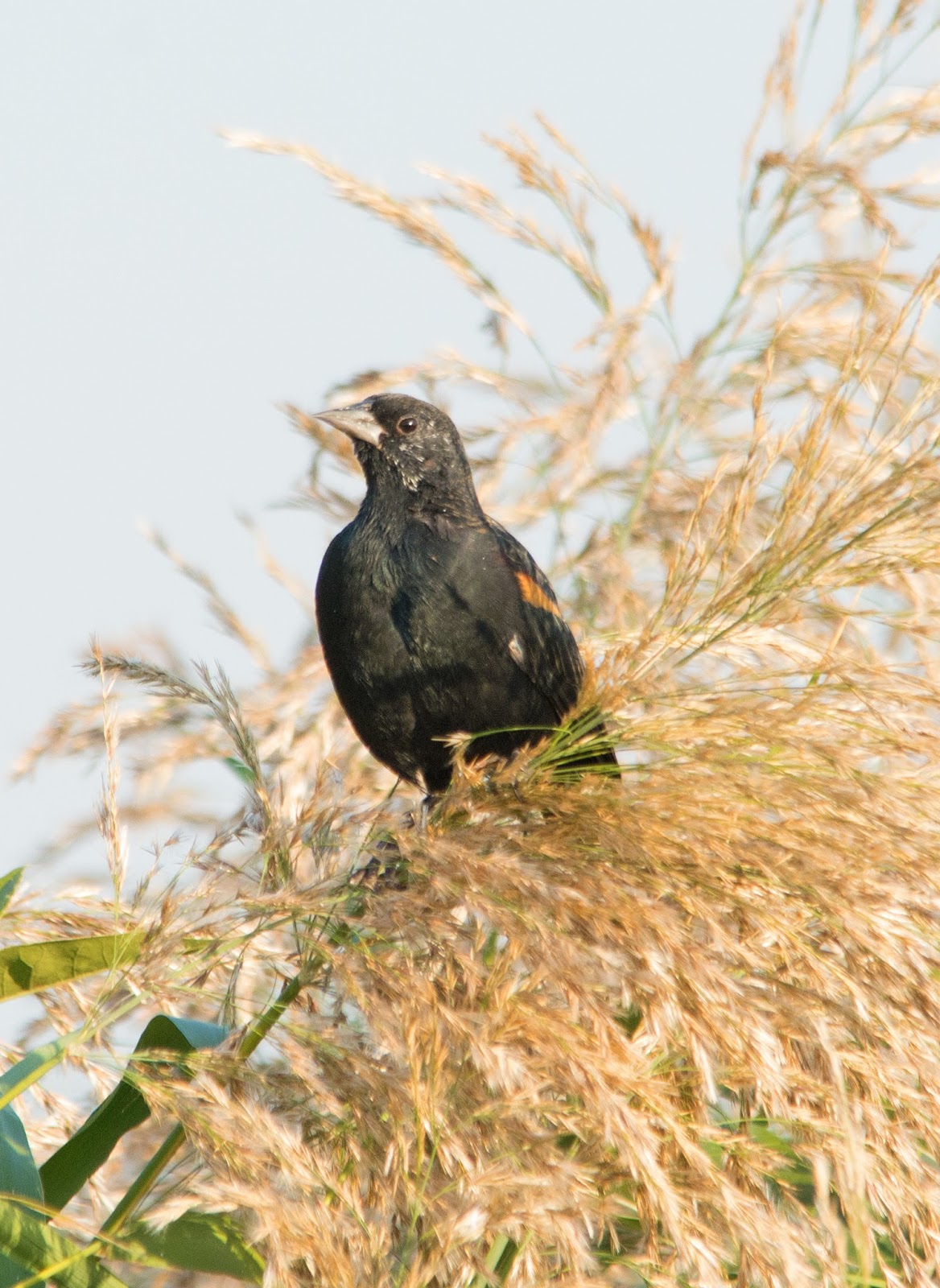
Juvenile Male Red-winged Blackbird
Great Egret (L), Snowy Egret (C), Cattle Egret (R)
September 2017
The summer has been relatively quiet for the numbers of birds that we used to see. By the same token, our numbers for wading birds have increased dramatically, especially migratory Cattle Egrets
and semi-resident Great Egrets.
We have gotten a slight trickle, especially at the end of the month for migratory songbirds, and our Scissor-tailed Flycatchers are still hanging on, perhaps until the end of the month.
We had several late nesting birds, which included woodpeckers and songbirds, but our Green Heron colony lost fledglings, as well as nestlings. That could have been due to a Cooper's Hawk that was found in the area a couple of times, but that is inconclusive.
A couple of unusual birds that normally reside south of here managed to visit southwest Oklahoma. The Groove-billed Ani hasn't been seen in in our fair state since 1979 and it appears that Mexico's Masked Duck spent a couple of weeks in US waters. The ani was around for a much shorter period.
Also photographed above are a number of raptors that we don't get to see at such close range. One of them is the Bonelli's Eagle, which is a raptor from Africa and Eurasia. This beautiful female beat the odds. She was picked up in the Middle East where she was for sale. She was the victim of a shooting, and a terrible disease. It took three solid years of the best care to get her back into the falconry circuit, and I wish to commend the gentleman for the best care that she could have received.
Also, the above young Mississippi Kite was born much later than normal, and he or she was fortunately found by a caring individual shortly after a rain storm. He is being cared for by an area rehabilitator and was taken in on August 15, possibly at the age of 32-35 days. He weighed in at 288 grams and had a setback that dropped his weight to 200 grams. In this photo, he was approximately 69 days of age. There is no question that without human intervention, he would have died.
There are also numerous shots of wading birds from Great Salt Plains in the spillway area. Note the egret with a grasshopper in its mouth. We also noticed large numbers of dead carp there, too.
The rest of the birds pictured above are identified and are some of the best specimens. They are all very healthy birds that got a new lease on life. First and second year raptors have an 85% mortality rate their first two years of life. With proper human intervention, they can be trained to hunt to the best of their ability. Healthy adults will be released into the wild with their new skill set and will make their handlers proud of their newfound keen and confident hunting prowess.
Please enjoy the photos. Keep your eyes on the ground and your head in the clouds. Happy birding!
Sunday, February 5, 2017
Representatives of Days 3 Through 5 In the Lower Rio Grande Valley
Harris's Hawk
Black-necked Stilt
Belted Kingfisher
Zebra Heliconian
Merlin
Vermilion Flycatcher
Green-winged Teal
Adult Male Anhinga
Juvenile or Female Anhinga
01-16 through 01-18-17
Now comes some of the meat and potatoes. The days are longer and we even ran into a
Night-Heron colony. For those of you that are not aware, Night-Herons are shunned and driven
away by herons, as they tend to eat heron eggs as well as young. So both species will co-exist
peacefully by themselves. The Anhinga was also nearby, too.
The Harris's Hawk family, meaning specific family members, such as a set of parents and their young
will stay together after one season. The whole family can be found hunting together, just like birders.
Extra eyes can help, but they are also louder. It all depends on what your end result might be.
Never fear, as there are plenty of ducks in the winter to be seen, and see, you shall.
There were many more photos, like the well-camouflaged Common Pauraque, Nutria, White-eyed Vireo, Northern Pintail, the Night-Herons, and more, but the photo files appear to be too large for blogspot posting now. You will just have to see them in another fashion.
Happy birding!
Subscribe to:
Posts (Atom)