Showing posts with label Red-necked Grebe. Show all posts
Showing posts with label Red-necked Grebe. Show all posts
Sunday, December 27, 2020

Thursday, December 3, 2020
Saturday, November 14, 2020
Saturday, November 7, 2020
Sunday, November 1, 2020
110120 November Begets Ducks and More Waterbirds

Red-necked Grebe 1

Red-necked Grebe 2

Ring-necked Duck

Red-necked Grebe 3


Red-necked Grebe 3

Ruddy Duck

Common Loon
Today was another birding extravaganza with a second Red-necked Grebe, not in the exact vicinity as the first, but still remaining as a companion of other grebes. In the area of Heron Cove, a Colorado visiting birder and writer discovered three Horned Grebes, eight Pied-billed Grebes, a Common Loon, several Ruddy Ducks, a Ring-necked Duck, migrant Mallards, Franklins Gull, and multiple additional gulls (like Ring-billed Gulls ), Killdeer, and Great Blue Herons on Shorebird Jetty.
With all the action at Heron Cove and surrounding lowlands, which included Killdeer, House Finches, and more, there was no need to travel further, since time was spent getting better Ring-necked Grebe photos.
Happy winter birding!
Friday, October 30, 2020
103020 Post Three Day Rainstorm with Rarity

103020 Franklin's Gull

Downy Woodpecker


Ditto, View 2
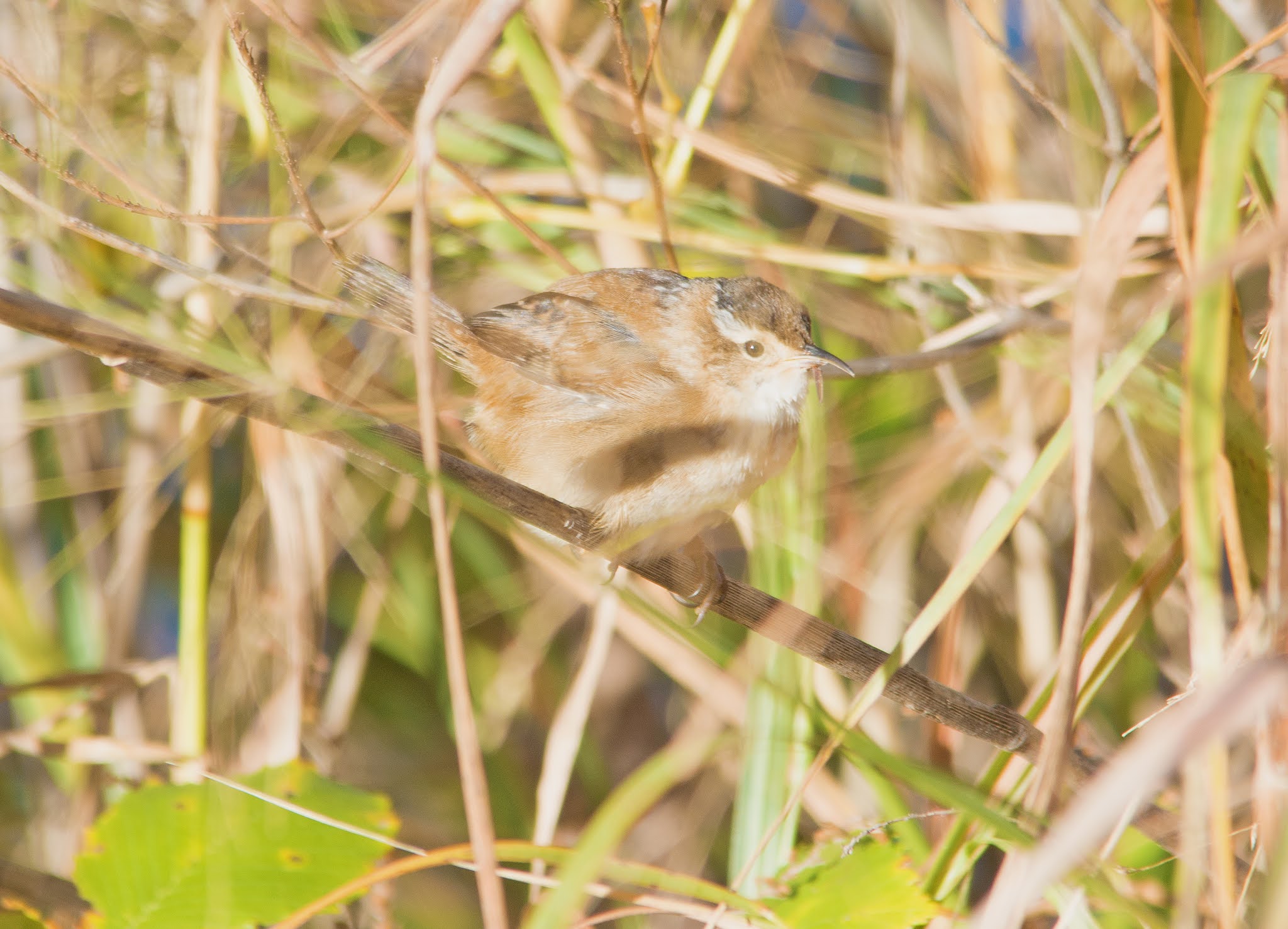
Immature Marsh Wren
Monday through Wednesday October 26-28, Stillwater, Oklahoma, home of Boomer Lake Park, received over four inches of rain. On Thursday afternoon, writer ventured out to see what might be found, which was somewhat expected, except for the rare Red-breasted Mergansers and the Red-necked Grebe.
Oh, isn't Oklahoma landlocked, you say? Yes, yes, it is. When they migrate over terra firma, it is usually overnight but with several days worth of rain, lots of birds came down for our hospitality. They usually overwinter in the north, but these birds know how to vacation in Hawai'i and Bermuda. So they think ahead. Migrants can appear on any body of water during migration, especially larger lakes, and they are actually very common birds. This is the first one that has been recorded via eBird at Boomer Lake Park.
This uncommon waterbird breeds in the Boreal Forest and sticks to coastal regions except for small patches in the northern US. It has a solid black cap, a heavy yellow billed angled downward, pale earpatch, and a dark crown and cheeks. The eyes are surprisingly not red, and the bill in usually held downward. Another notable characteristic is the thick neck and broad head.
These remarkable birds have an odd habit of consuming large quantities of its own feathers and will even feed them to their young. Perhaps the feathers protect the stomach from indigestibles.
If the Great Lakes freeze over this year, we could have many more of these grebes wandering about the eastern part of the US.
Surprisingly, writer now has photographed all the grebes in this country. It's a nice feeling.
We also had a wide assortment of ducks and other waterbirds over this time period. Even though we've had even earlier visiting waterbirds this year, they still bring ooo's and aaahhhhh's during the pre-winter seasons. It's also been nice seeing Bonaparte's Gulls much earlier than we generally do.
Thursday, December 14, 2017
Lake Thunderbird, Eastland, Texas Falconry, and Lake Hefner

Red-necked Grebe
11-24-17
This was the day that my birding friend called and wanted to do something in way of birds. No matter how I feel, even after six weeks post hand surgery, I said that I wanted to go. We knew about the rare Red-eared Grebe and hoped for a sighting and a photo, if we were lucky. The closest report was at Lake Carl Blackwell, Payne County, but it was not there. We went to the second reporting sight, and there it was, at the local grebe convention. Many birders have seen it, but I never thought that I would be so lucky.
Needless to say, I could not carry my camera, nor could I use my left hand after the hand surgery. I relied on help, so that was the only way that this shot could happen. Thanks to Sylvias Serpentine, who saved my day!

Barred Owl
12-02-17
We were due for another adventure, so The Three Musketeers went to Sequoyah National Wildlife Refuge in Vian, OK, for more action. There was plenty there, but I was not able to do anything yet, other than hit the shutter button and change ISO. At least I got this beautiful Barred Owl. My comrades managed both Ruby- and Red-crowned Kinglets, but they were too fast for me. Thanks for setting up my camera several times, dear friends.
12-07 through 12-10-17
To the hunt, to the hunt, to the hunt! This was the famous Ryan Vance memorial Hunt and what a turnout for the events. Everyone with a raptor came to hunt prey or show their birds at the educational show at the Eastland, TX Museum.
I got myself another trophy or three, which included photos of some gorgeous Harlan's Hawks, which I had never seen before. Believe it or not, the first rabbit kill was done by a dog, not a raptor. To the victor belongs the spoils and did we have a fantastic weekend.
The best part for me was the fact that my doctor cleared me to bring my camera, but I had to follow certain restrictions.

JD and his Red-tailed Hawk

JD's Red-tail solo

Savannah Sparrow

CS's Red-tail at a kill

CS and her Red-tail, who got a rabbit

Wild American Kestrel

Harris's Hawk

Harlan's Hawk #1

Harlan's Hawk #2 (Female)

Harlan's Hawks #2 (on right - female)
and #3 (Male on left)

JD's Red-tail in flight

JD's Red-tail banking

Two Yellow-billed Loons
The last photo was on on return trip after the hunting trip where we observed Yellow-billed Loons on
Lake Hefner in Oklahoma City. What a trip!
Subscribe to:
Posts (Atom)