Translate

Showing posts with label Cattle Egrets. Show all posts

Friday, September 14, 2018

Oklahoma Vagrants: South Polar Skua


Rare from Antarctic nesting grounds, a few of these birds can rarely pass on either of our open oceans from May through October.  They practice kleptoparasitism, like many open water birds and eat fish on the open water.

Once known as MacCormick's skua, this predatory large seabird nests off the edges of Antarctica, hence the name.  Having a very large migratory range, some may winter as far north as Greenland.

Large birds to many of us, they are actually small in comparison to skuas in general.  They have both light- and dark morph birds, where the light subspecies contrasts beautifully with a dark upperside.  The dark adult shows a pale crescent and nape with uniform dark upperparts.

During the second week of August 2013, this territorial bird visited the dual county area of Lake Overholser, both Canadian and Oklahoma Counties, where it sustained itself on eight Cattle Egrets, a far cry from the normal fish diet.  Brian Marra obtained a beautiful photo of the skua attacking a Yellow-crowned Night-Heron on 8 August, which follows:


                    copyright, Brian Marra 2013

Thusly, Mr. Marra was a witness of some very rare natural history observed by few humans.  This is the only eBird sighting in Oklahoma at this time.  Oddly enough, several Cattle Egrets made it to the Goose Island area of Boomer Lake in Stillwater a short time after the skua arrived in Oklahoma.

This stocky, gull-like bird has been observed at the South Pole.  A bird to be reckoned with during breeding season, it has flown directly at a person's head in order to protect its nest.  One photographer in 1911, said that he was nearly blinded by one of the species' members.

Skuas begin nesting when six or seven years of age, and those short summers have their toll on the process.  Even though the female lays two eggs, the older chick will eat the younger or drive it away and it dies.  If the older chick survives, it battled the effects of the wind successfully.

The Adelie Penguin youngster can also be a formidable foe, as those flippers are perfect for apprehending a meal, which would be the well-feathered baby skua.  It is all due to survival of the fittest in that fierce climate.  The skua brings those survival instincts into adulthood, and it must eat.

Conversely, this skua enjoys the eggs of penguins, but the Brown Skua usually eats them first.

The species is normally a pelagic bird and only visits land while breeding.


Monday, October 2, 2017

September's Stars and Top Quality Hunting Birds


                                                                    Grasshopper


                                                                      Bald Eagle


                                                                      Cattle Egrets


                                                             Juvenile Prairie Falcon


                                                               Adult Bonelli's Eagle


                                                                         Ditto


                                                           Juvenile Mississippi Kite


                                                                      Harris's Hawk


                                                                   Peregrine Falcon


                                                                       Turkey Vulture


                                                                            Osprey


                                                                     Franklin's Gull


                                                          Juvenile Little Blue Heron


                                                                        Ditto


                                                             Juvenile Turkey Vulture


                                                                    Snowy Egret


                                                              American White Pelican


                                                                      Snowy Egret


                                                            Juvenile Little Blue Heron


                                                             American White Pelican


                                                                    Ditto, View 2


                                                                  Peregrine Falcon


                                                                   Red-tailed Hawk


                                                            Female American Kestrel


                                                                       Great Egret


                                                                     Green Heron


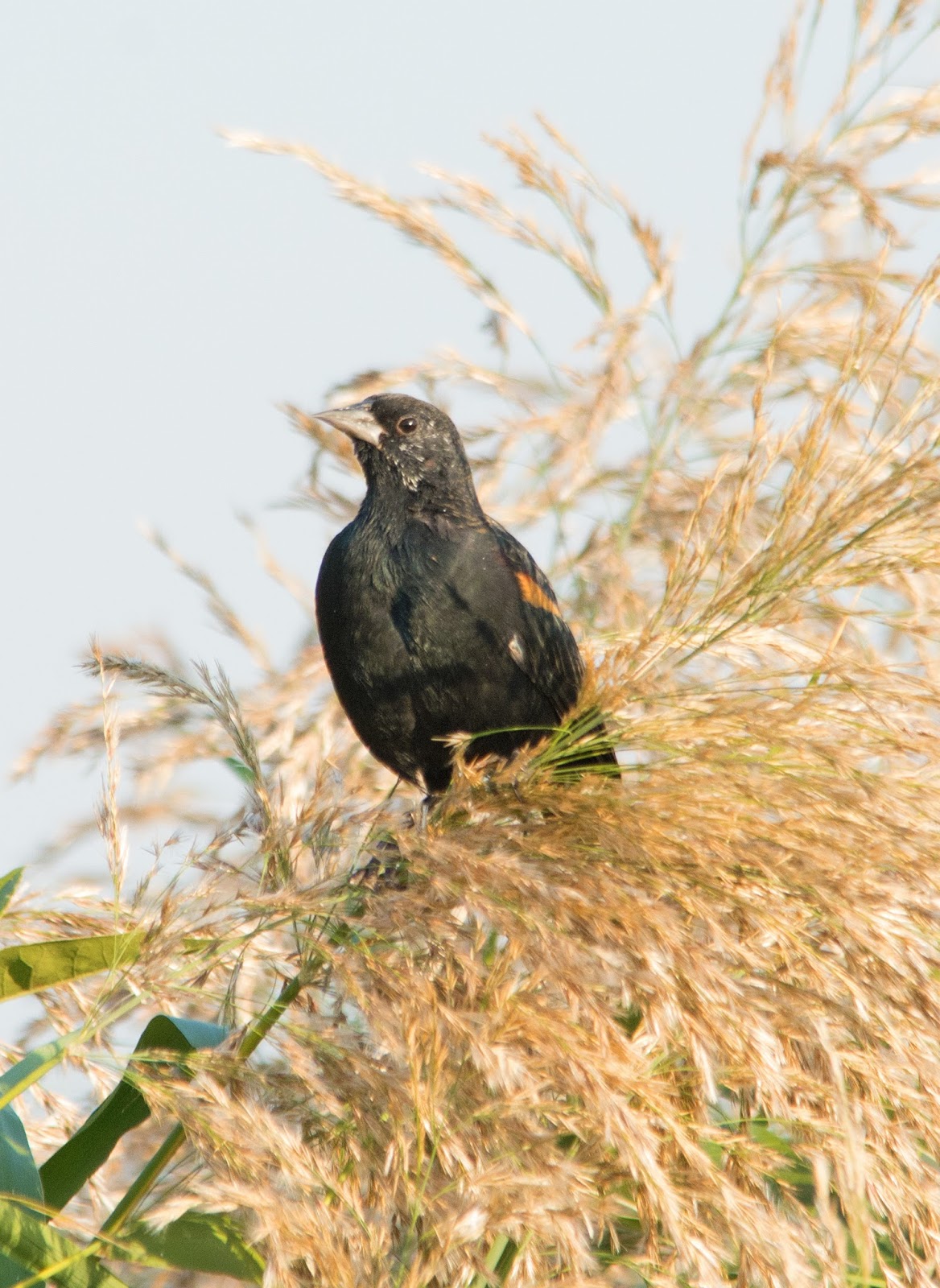
                                                    Juvenile Male Red-winged Blackbird


                                          Great Egret (L), Snowy Egret (C), Cattle Egret (R)


September 2017

The summer has been relatively quiet for the numbers of birds that we used to see.  By the same token, our numbers for wading birds have increased dramatically, especially migratory Cattle Egrets
and semi-resident Great Egrets.

We have gotten a slight trickle, especially at the end of the month for migratory songbirds, and our Scissor-tailed Flycatchers are still hanging on, perhaps until the end of the month.

We had several late nesting birds, which included woodpeckers and songbirds, but our Green Heron colony lost fledglings, as well as nestlings.  That could have been due to a Cooper's Hawk that was found in the area a couple of times, but that is inconclusive.

A couple of unusual birds that normally reside south of here managed to visit southwest Oklahoma.  The Groove-billed Ani hasn't been seen in in our fair state since 1979 and it appears that Mexico's Masked Duck spent a couple of weeks in US waters.  The ani was around for a much shorter period.

Also photographed above are a number of raptors that we don't get to see at such close range.  One of them is the Bonelli's Eagle, which is a raptor from Africa and Eurasia.  This beautiful female beat the odds.  She was picked up in the Middle East where she was for sale.  She was the victim of a shooting, and a terrible disease.  It took three solid years of the best care to get her back into the falconry circuit, and I wish to commend the gentleman for the best care that she could have received.

Also, the above young Mississippi Kite was born much later than normal, and he or she was fortunately found by a caring individual shortly after a rain storm.  He is being cared for by an area rehabilitator  and was taken in on August 15, possibly at the age of 32-35 days.  He weighed in at 288 grams and had a setback that dropped his weight to 200 grams.  In this photo, he was approximately 69 days of age.  There is no question that without human intervention, he would have died.

There are also numerous shots of wading birds from Great Salt Plains in the spillway area.  Note the egret with a grasshopper in its mouth.  We also noticed large numbers of dead carp there, too.

The rest of the birds pictured above are identified and are some of the best specimens.  They are all very healthy birds that got a new lease on life.  First and second year raptors have an 85% mortality rate their first two years of life.  With proper human intervention, they can be trained to hunt to the best of their ability.  Healthy adults will be released into the wild with their new skill set and will make their handlers proud of their newfound keen and confident hunting prowess.

Please enjoy the photos.  Keep your eyes on the ground and your head in the clouds.  Happy birding!


Sunday, September 14, 2014

A Wide Range of Offerings For All to Enjoy


                                                                    Cooper's Hawk


                                                                      Great Egret


                                                                European Starling


                                                                         Blue Jay


                                                                    Eastern Kingbird


                                                                          Ditto


                                                                           Blue Jay


                                         Very Thin Juvenile Blue Jay with Brown Thrasher


                                                                     Juvenile Blue Jay


                                                         Juvenile Scissor-tailed Flycatcher


                                                                Great Egret in Flight
                                                   

                                                             Great Egret with Crawdad


                                                                        Close Up


                                                                       Great Egret


                                                                      Ditto, In Flight


                                                                              Ditto


                                                                        Great Egret


                                                                  Tufted Titmouse


                                                                  Carolina Chickadee


                                                                Male Northern Cardinal


                                                              Great Egret on 09-12-14


                                                             8 Cattle Egrets on 09-12-14

0730-1230/Mostly Cloudy/10-15 mph winds

It has been quite a while since I've been out, as you can see.  Fall Migration is underway and the
hawks are also visiting the lake during the mornings.  They should also be out later in the day, too.
Plenty of Yellow Warblers and the American Goldfinch are enjoying the fall offerings at the lake,
nyjer(thistle), as well as plenty of sunflower seeds and nectar, too.  There are young Red-bellied woodpeckers, which are preceded by their calls.  Get out and enjoy!