Showing posts with label Butterflies. Show all posts
Showing posts with label Butterflies. Show all posts
Saturday, August 20, 2022

Tuesday, September 17, 2019
Warbler and Monarch Central On Boomer Lake

Yellow Warbler

Juvenile Male Common Yellowthroat

Ditto, View 2

Monarch Butterfly on
Sunflower
The Yellow Warblers have been on Boomer Lake for the past two weeks and have been far reaching, spending much of their time around willows, sunflowers, Bradford pears, sycamores and many other woody stemmed native plants. Monarchs have been in the area of nectar giving plants, clustering around sunflowers, along with many of the lepidoptera, like swallowtails.
The juvenile male Common Yellowthroat is a warbler and has been in the midst of the Yellow Warblers around the sunflowers on the northern and western side of Heron Cove. This area tends to be a warbler and general songbird magnet due to the native deciduous trees that attract beneficial insects.
Sunday, October 14, 2018
Sunday, September 2, 2018
Sunday, August 5, 2018
Monday, December 11, 2017
Sunday, February 5, 2017
Representatives of Days 3 Through 5 In the Lower Rio Grande Valley

Harris's Hawk

Black-necked Stilt

Belted Kingfisher

Zebra Heliconian

Merlin

Vermilion Flycatcher

Green-winged Teal

Adult Male Anhinga

Juvenile or Female Anhinga
01-16 through 01-18-17
Now comes some of the meat and potatoes. The days are longer and we even ran into a
Night-Heron colony. For those of you that are not aware, Night-Herons are shunned and driven
away by herons, as they tend to eat heron eggs as well as young. So both species will co-exist
peacefully by themselves. The Anhinga was also nearby, too.
The Harris's Hawk family, meaning specific family members, such as a set of parents and their young
will stay together after one season. The whole family can be found hunting together, just like birders.
Extra eyes can help, but they are also louder. It all depends on what your end result might be.
Never fear, as there are plenty of ducks in the winter to be seen, and see, you shall.
There were many more photos, like the well-camouflaged Common Pauraque, Nutria, White-eyed Vireo, Northern Pintail, the Night-Herons, and more, but the photo files appear to be too large for blogspot posting now. You will just have to see them in another fashion.
Happy birding!
Tuesday, September 6, 2016
Less Birds, But Good Quality Ones at Boomer Lake

2nd Summer Yellow-crowned Night-Heron

Bird #2, 2nd Summer Yellow-crowned Night-Heron

Scissor-tailed Flycatcher in Flight

Female Red-Spotted Purple

Male Scissor-tailed Flycatcher
These photos were taken over the past several days. It was quite surprising to see two
immature Yellow-crowned Night-Herons at The Southern Cove. (which I should perhaps
rename Heron Cove?) These birds were not seen together, and are clearly two different birds.
There has been no eBird record of Yellow-crowned Night-Herons since June of 2012 on Boomer Lake, which would have made that sighting in 2012 an adult bird. Since these birds are on their second summer, they could have been born at Teal Ridge, which has had adult Yellow-crowned Night-Herons every summer that I know about.
The Red-Spotted Purple Butterfly had been seen just off the Kameoka Trail near Boomer Creek, and they seem to be slightly more prevalent than usual in the tri-state area this year. For the most part, our butterfly population appears to be on yet another yearly downward spiral, due to loss of habitat,
lack of native milkweed, and too many pesticides wafting through the air.
Our Scissor-tailed Flycatchers are being seen again, soon to be heading south. They have been roosting together overnight, so chances are excellent that you'll see a good group of them at Boomer
Lake just before nightfall. Last year, they were seen on the northernmost jetty just south of Goose
Island. In previous years, they had a roost tree on the west side of the lake.
Also at dusk, you'll see more grackles and Red-winged Blackbirds at Boomer Lake, which are
nearly non-existent on the lake during the day. During the day, there have been large numbers of
Mallards, and less than the usual numbers of Killdeer.
Sunday, April 10, 2016
Another Day In the Life of Songbird Central

Ring-billed Gull
First Cycle

Osprey

Great Blue Heron

Yellow-rumped Warbler(Myrtle)
Breeding Plumage

Ditto

Female Black Swallowtail
0825-1130 hrs./65-75 degrees F/partly cloudy/25-30 mph wind gusts
These shots were from yesterday and today. Even though today had some eventful winds that
actually pushed me backward, it was still a remarkable day for birding. For the first time this
year, the Osprey came to visit. One tends to find Ospreys where eagles reside, so this seems
to show that our American Bald Eagles find this a worthy place in which to live. Since they
still visit the lake, it appears to me that they have young this year, a banner event.
Yesterday, I heard the Marsh Wren on the north side of the lake in the reeds and rushes. It
never came out, but I had noticed something in the grasses in the past. It had been filled with
song yesterday, hence the positive ID on the bird.
Yellow-Rumped Warblers are all over the area, but the Song Sparrows are moving north now. There are still a few hangers-on, and the Savannah Sparrow was recently seen, too. We still have plenty of Harris's and Field Sparrows, AND even though they will soon be covered, we do have at least one breeding pair of Eastern Meadowlarks. It would be nice if they could raise a clutch, but their field usually gets mowed.
Another Scissor-tailed Flycatcher was observed today, and one Cattle Egret was seen just east of
Goose Island.
There are at least two broods of Canada Goslings, one of five and another of three young. I was
told that there was a single gosling seen with its parents recently, so there will be more coming.
Killdeer eggs have also been laid, more male Mallards are out and about than females, so the hens
are likely on theirs nests, too.
There had been large rafts of Pied-billed Grebes, Ruddy Ducks, Blue-winged Teal. and Northern Shovelers this morning, but once the wind subsides and they are well-rested, they will be on their way, too.
Let the spring and summer games begin, as we are ready!
Saturday, August 29, 2015
Summer is Still Going Strong with Medium Migratory Movement

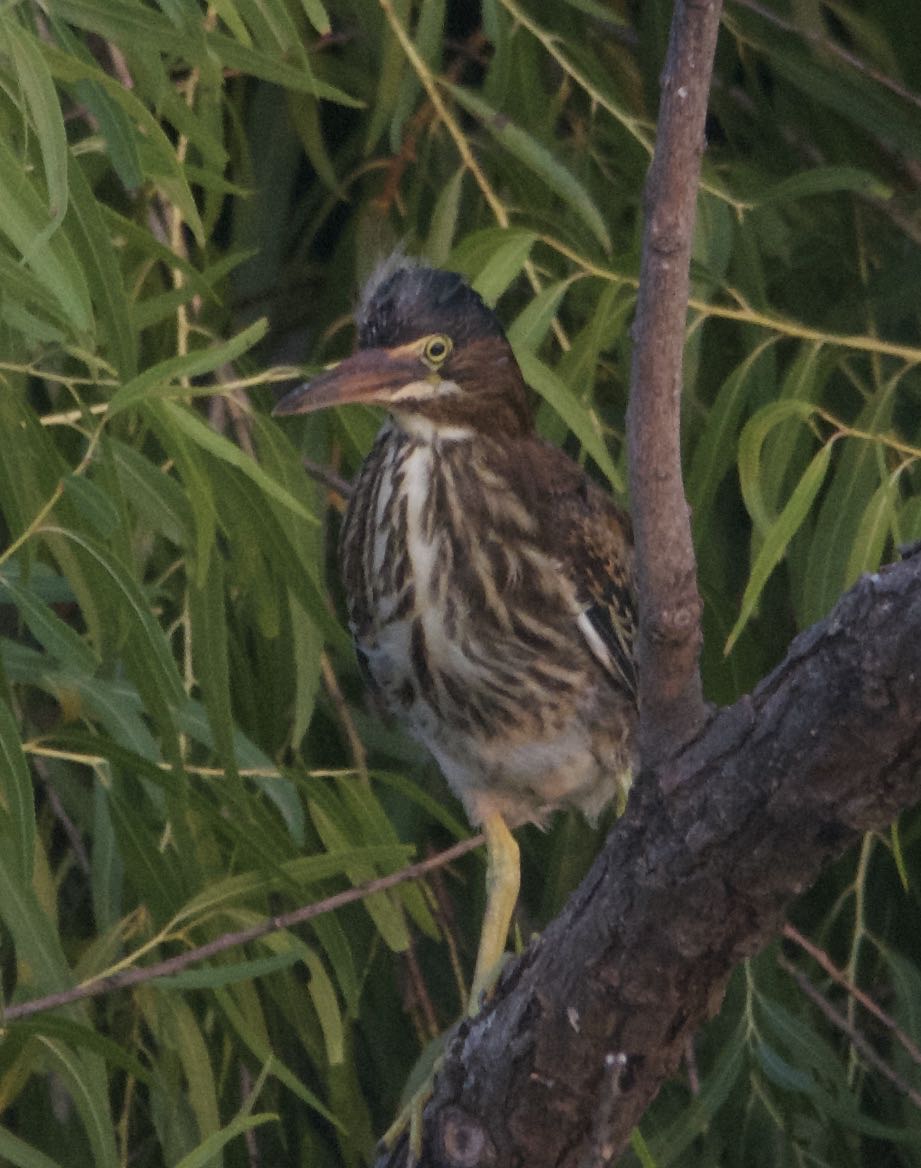
Adult Green Heron(Parent)

Green Heron Chicks, Clutch 2

Great Blue Heron

Ditto

Green Heron Chick, Clutch 2

Ditto, Gaping

Green Heron Chick, Clutch 2

Mississippi Kite
Green Heron Chick, Clutch 2

Ditto

Ditto

Green Heron Chicks, Clutch 2
"Partners in Crime"

Green Heron Chick, Clutch 2


Dragonfly

Molting Great Egret

Viceroy

Gulf Fritillary
Photos of the young Green Herons were over the past several days. They are growing quickly,
as they need to do in order to get ready for migration. Finally, we're getting a few butterflies
in the area, but each year they seem to be lessening, most likely due to prevalent use of pesticides
in Meico, where they overwinter. Native milkweed plants are also invasive, so farmers are eradicating food for the young butterflies and caterpillars by removing them.
Migratory movement is about medium strength, still plenty of assorted flycatchers in the area, as well as Blue-Gray Gnatcatchers and Yellow Warblers. Fall birds are moving in, with good populations of
assorted woodpeckers and still numerous Eastern Phoebes.
Eastern Kingbirds, Common and Great-tailed Grackles are roosting, so they will be on the move
soon enough. Then the Scissor-tailed Flycatchers will be right behind them. If you notice, a few
of them have been spending their days at the lake.
Share staples with those at your feeders, and you'll be rewarded with migratory stopovers. Songbirds
enjoy bathing in, as well as the sound of running water. Please provide black oil sunflower seeds and suet for those birds on the move, as they are high calorie nutrients.
Sunday, July 12, 2015
Immature Youngsters Almost Ready for Fall Migration

Viceroy

Male Northern Cardinal

Juvenile Brown Thrasher

Female Red-winged Blackbird

Immature Northern Mockingbird

Immature Eastern Phoebe

Immature Eastern Phoebe

Female Red-winged Blackbird
0645-0915/76-82 degrees/sunny/20 mph wind gusts
There is a strong crop of young birds all over the lake, who will be easily ready for fall migration. Time is still on our side to admire their progress. This has been a fabulous year for most of them.
For the ones that didn't make it, it was not their fault, but due to natural selection. The parents
have done a wonderful job so far, and some of them will have second and third clutches this
season.
Subscribe to:
Posts (Atom)