Showing posts with label Black-necked Stilt. Show all posts
Showing posts with label Black-necked Stilt. Show all posts
Sunday, March 13, 2022

Sunday, October 17, 2021
Monday, March 30, 2020
Birding On a Shoestring: SPI Conference Center and Laguna Atascosa, TX

Long-billed Thrasher

Black-necked Stilt

Common Gallinule

Black-bellied Whistling-Duck

Black Skimmer
02-28-20

White-tailed Kite
02-29-20
These photos, except the last one were taken at the SPI Conference Center on South Padre Island, Texas.
The final photo was taken at the Laguna Atascosa NWR of Los Fresnos, Texas. Writer has visited there several times over the past five years, and had never seen all of the property due to area closures, even during this visit. It comprises 120,000+ acres, and there are several rare birds and animals found there, the most rare of which are the ocelot and the Aplomado Falcon. A few years ago, a birding friend and I both witnessed an ocelot on the unpaved entryway that is now paved with speed bumps, which is a very rare occurrence.
The White-tailed Kite was photographed during a tram tour that took about 2 1/2 hours, very reasonably priced. We saw such wonders like the white tailed Kite, Crested Caracara, Gull-billed and Caspian Tern at Atascosa Lake, which was at the end of the tour and the grand finale. Take the tour and hope that it is led by Wanda. There were also exotic animals on the property. The area was closed as ocelots are there, rarely out during the daylight hours.
Saturday, August 3, 2019
Birding On a Shoestring: Quivira National Wildlife Refuge, Kansas

Black-necked Stilt

Long-billed Dowitcher

Assorted Shorebirds #1

Snowy Plover

White-rumped Sandpiper

Baird's Sandpiper

White-rumped Sandpiper

Assorted Shorebirds #2

Assorted Shorebirds #3

Greater Yellowlegs (Left)
Killdeer (Right)

Greater Yellowlegs (Center)
Baird's Sandpiper (Right)
White-rumped Sandpiper (Left)

Northern Cliff Swallow

Ruddy Duck and Ducklings

Blue-winged Teal (Front)
Immature and Juvenile American Coot (Center and Rear)

American Coot Adult (Left)
Recently Hatched American Coot (Right)

adult male Black-necked Stilt (Rear)
Juvenile Black-necked Stilts ( Center)
adult female possibly on nest (Front)
072719
Taking about five hours, my birding buddy and I arrived at Quivira around 1130ish. Several area residents had informed us at pitstops that there had been plenty of rain this year, so we could expect some wonderful birds. This information was taken to heart, and the more observed, the better it got.
Primed for this adventure, my eyes had been on weather conditions, past and present. It was a given that this adventure was a little too early for both the Red Knot and Buff-breasted Sandpiper, but it was a solid time for the many resident breeding birds and their offspring. There was no disappointment.
The first thing we did was visit the tower area, which had good views of Barn Swallows, Black-necked Stilts in flight that were constantly calling, Great Egret, Great Blue Heron, Spotted Sandpiper, and more.
Eventually making it to Little Salt Marsh, the numbers and species of shorebirds was thrilling, even though many of the most common migrants were there. Just seeing them in their natural state, both on the shore and foraging in the shallow water brought back memories of home in Maine.
Though my hunt for the Bobolink was unsuccessful, a fabulous photo of the Northern Cliff Swallow was unparalleled. There are hopes to return to another part of KS at a later time when the Bobolink and other target birds will be more accessible.
We drove through the Big Salt Marsh area, where were encountered many water birds, which included the above family of Black-necked Stilts, and took a short walking tour at Migrant's Mile Nature Trail. This was a former marsh that had a little water. Sampling my first sand plums, we heard the Common Yellowthroat, and semi-observed a few others.
The prairie grass area also netted the Northern Cliff Swallow. Many other grassland birds, like the meadowlark and Dickcissels were heard there.
Juvenile American Coots, Blue-winged Teal, Black-necked Stilts, and Ruddy Ducks were somewhat unexpected and most welcome. Never had I observed the young of these species.
Once we arrived, we never left until it was time to resettle round the Cheyenne Bottoms area in Barton County. A short stop was made just prior to the Kansas Wetlands Education Center closing for the day, where we semi-solidified plus for Sunday. Stay tuned for the Cheyenne Bottoms and Cheyenne Bottoms Preserve adventure.
for more on the adventure:
https://debhirt.blogspot.com/2019/08/birding-on-shoestring-cheyenne-bottoms_5.html
https://debhirt.blogspot.com/2019/08/birding-on-shoestring-cheyenne-bottoms.html
Sunday, February 5, 2017
Representatives of Days 3 Through 5 In the Lower Rio Grande Valley

Harris's Hawk

Black-necked Stilt

Belted Kingfisher

Zebra Heliconian

Merlin

Vermilion Flycatcher

Green-winged Teal

Adult Male Anhinga

Juvenile or Female Anhinga
01-16 through 01-18-17
Now comes some of the meat and potatoes. The days are longer and we even ran into a
Night-Heron colony. For those of you that are not aware, Night-Herons are shunned and driven
away by herons, as they tend to eat heron eggs as well as young. So both species will co-exist
peacefully by themselves. The Anhinga was also nearby, too.
The Harris's Hawk family, meaning specific family members, such as a set of parents and their young
will stay together after one season. The whole family can be found hunting together, just like birders.
Extra eyes can help, but they are also louder. It all depends on what your end result might be.
Never fear, as there are plenty of ducks in the winter to be seen, and see, you shall.
There were many more photos, like the well-camouflaged Common Pauraque, Nutria, White-eyed Vireo, Northern Pintail, the Night-Herons, and more, but the photo files appear to be too large for blogspot posting now. You will just have to see them in another fashion.
Happy birding!
Wednesday, April 29, 2015
Birding On a Shoestring: Port Bolivar--Rollover Pass and Fort Travis County Park

Black-necked Stilt

American Avocets

Neotropic Cormorant

Black-bellied Whistling-Duck

Brown Pelican

Song Sparrow

Black-necked Stilt

Clapper Rail
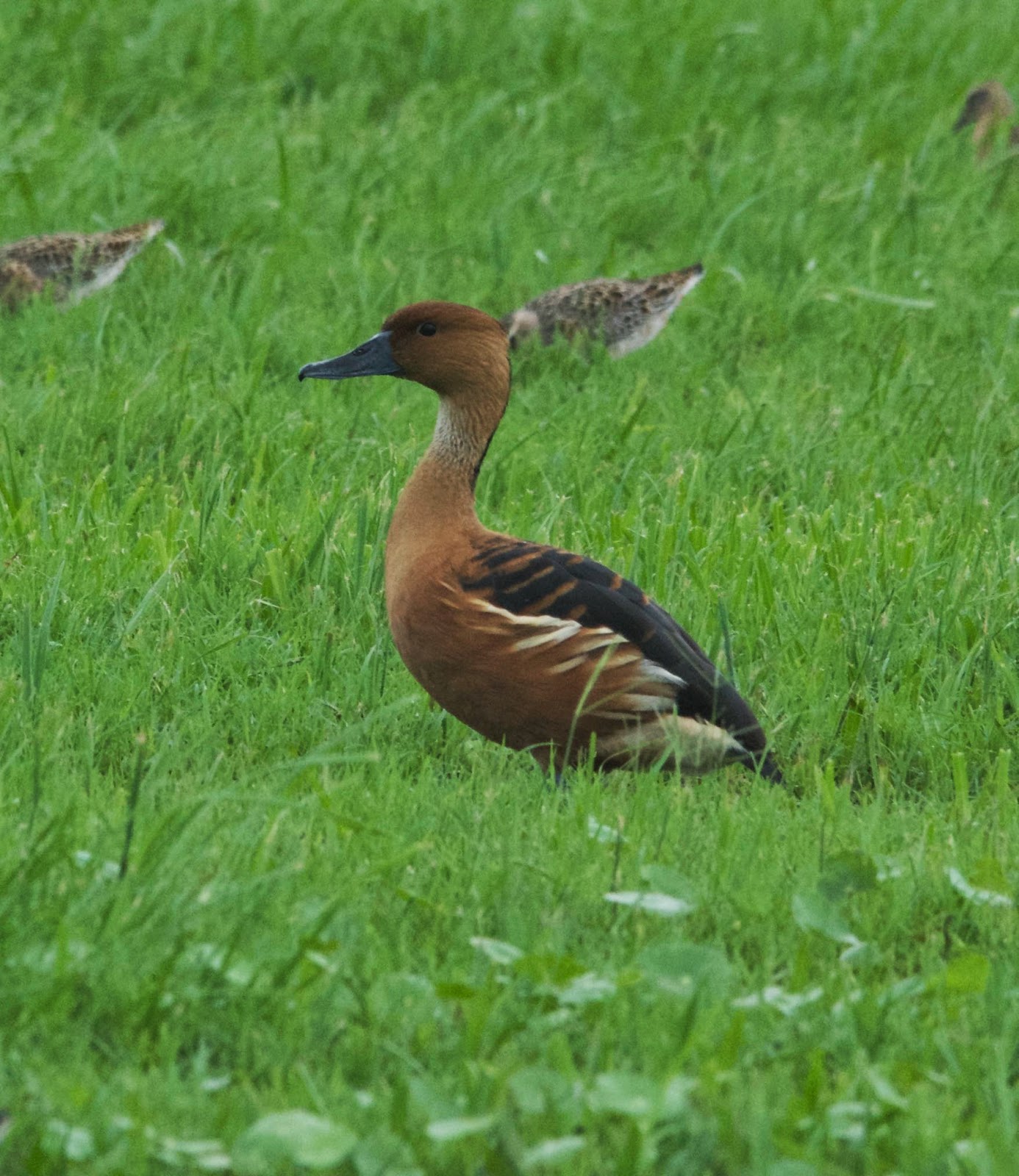
Fulvous Whistling Duck
These are from Rollover Pass and Fort Travis County Park in Port Bolivar, TX.
Subscribe to:
Posts (Atom)