Showing posts with label Painted Bunting. Show all posts
Showing posts with label Painted Bunting. Show all posts
Sunday, May 11, 2025

Monday, September 30, 2024
Sunday, June 4, 2023
Sunday, April 23, 2023
Sunday, April 17, 2022
Sunday, August 8, 2021
Sunday, February 14, 2021
Sunday, April 26, 2020
Sunday, July 21, 2019
Sunday, December 16, 2018
Sunday, September 23, 2018
Wednesday, August 22, 2018
Oklahoma Breeding Bird Species Profile: Painted Bunting
A sweet, ongoing warble that sounds like graffiti, graffiti, spaghetti for two, and that is the sound of the male (or immature male) Painting Bunting. The male receives his handsome dress no earlier than his second year of life. This uncommon beauty is located along forest edges, wooded ravines, shrubby river bottoms, or in tall trees, and it is very at home along riparian forest. If you have ever heard that song, you will never forget it.
One of the most beautiful and colorful birds, this splash of radiance is found from May through July in the better part of Oklahoma, except the panhandle, which lacks forest and brushy thickets.
Males are very territorial and will battle other interlopers while females are arriving in the area. They have been known to wound or kill other males, and if the female should be caught up within a fracas, she can also risk injury. This species favors invertebrates, and will even remove prey from spider's webs in order to feed. The males are relentless during spring.

Male Painted Bunting
Boomer Creek, 2015
Often parasitized by the Brown-headed Cowbird, this member of the cardinal family is known collectively as a mural or palette of buntings. When males migrate to warmer regions for the winter, they still retain their beautiful plumage and do not molt into drabness.
Due to loss of habitat, the species is declining in both the US and Central America. They may still be trapped as cage birds in the illegal trade south of our country, and have a near threatened conservation status.
If you have had any of these birds in your back yard, they will visit feeders, and you'll be even more fortunate if you have the perfect habitat for a nesting pair.
Sunday, May 1, 2016
The Charge of the Boomer Brigade

American Coot

Northern Cardinal

Green Heron

Yellow-rumped Warbler(Myrtle)

Northern Cardinal(Female)

Painted Bunting (Male)

Yellow Warbler(Male)

Cedar Waxwing

Yellow Warbler(Female)

Baltimore Oriole(Male)

Mallard Pair(Full Frame)

American Goldfinch
(Male- Breeding Plumage)

Spotted Sandpiper

White-faced Ibis

Northern Shoveler(Male)
0700-1140 hrs./49-59 degrees/15 mph to light and variable NW winds/partly cloudy
These photos were taken over the past couple of days, with weather conditions about the same.
The odd thing was, that when I was out early yesterday, it was mostly cloudy, then today it became
mostly cloudy when I was returning from my photo shoots.
Yesterday's shoot was the morning after a low pressure system, and with today still having a chill
and being the second day after the rain, subjects were still slightly extraordinary. Females of the
species are now moving in, and last year's new birds will also be on their way after the females,
which is based on species hierarchy.
The first five photos were from yesterday. It was good to see Green Heron again, and I now know
that the water snakes didn't pluck him from the grasp of the living. Having keen vision for fishing,
he likely discovered either one or both snakes sunning near where one of the heron nests had been located last year and just took a few days to go elsewhere.
Most of the Yellow-rumped Warblers are in their breeding dress, which you will notice from the
earlier photos. The yellow head patch is quite apparent and the rest of the yellow patches on the rump and on the flanks look just as bright. The bird also has bright blue and black upon it, making
this a very striking spring bird, as the wood warblers are.
Today the Cedar Waxwings were coming through in large numbers, which I estimated at 225, which
is stable movement for just one species. Our lake is very healthy with seeds, fruit, and protein, so
this will be another spectacular year. Even though El Nino is bringing us cold fronts as well as a
great deal of unsettled weather, we will be the recipients of the more uncommon birds. If I could only obtain photos of all the species that I see, it would be more helpful for you, but for various reasons, I cannot. When in the deep woods, it is sometimes hard to have good movement in order
to quickly set up my gear. Not only that warblers are fast, and many of them stay in the higher story
of a tree.
We are now in the presence of both Baltimore and Orchard Orioles, and I saw a female Baltimore
yesterday. The beauty of the spring and summer birds is that they can go right to their nesting areas,
which isn't always in the same tree, but it is quite close.
A pin oak is located next to the restrooms on the east side of the lake, and several birds nest there
including the scissor-tail, both Baltimore and Orchard Orioles, and a Warbling Vireo has been
languishing there, as well.
The American Goldfinch has been around for the past couple of day in breeding finery, along with
two Cattle Egret today, one on the northernmost western jetty, and the other on Goose Island on the
east side. Yellow Warblers are galore on the east side, three or four Spotted Sandpipers have been
doing their rocking rock in various locales, and there was a lone White-faced Ibis on the creek, as well as a couple of families of first born Mallard ducklings. There are three Northern Shovelers in the vicinity, and this is an excellent area for many other beauties, too, like the buntings.
Take some time out to enjoy nature. I promise you that you'll not be disappointed, unless you're
allergic to cottonwood fluff. Perhaps I'll locate something new tomorrow.
Saturday, August 1, 2015
Birds Are in Our Future and in Our Parks

Northern Flicker(Yellow-shafted)

Yellow-billed Cuckoo

American Robin

Male Painted Bunting
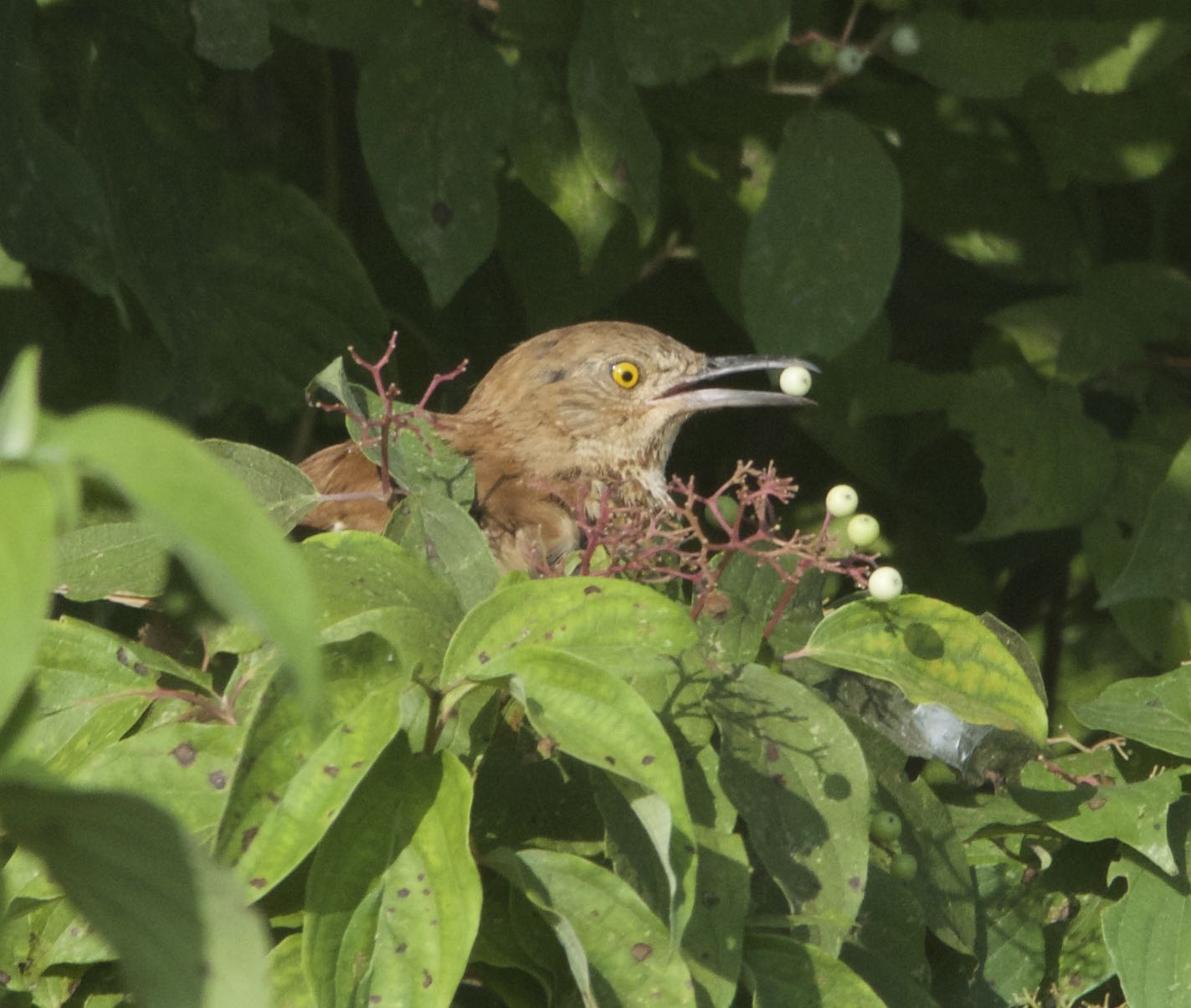
Brown Thrasher

Fledgling House Sparrow

Great Blue Heron

Mallard Hen with Ducklings
0650-0954/77-86 degrees F/partly cloudy/light and variable winds
Morning temperatures have been slightly cooler over the past few days and the days are getting shorter, which signifies fall migration is near. Actually, it has already begun in some parts of the country. Migration is a very strong pull for birds, and they actually have their moods affected.
They are antsy, and cannot sit still still.
How can this be when young are still being raised? Quite simply, not every species will migrate at the same time. The hawks begin movement around now, which is why you're seeing them more. Some of our birds like the Purple Martin and Scissor-tailed Flycatcher will begin roosting behaviors, which means that they will gather together in large groups and spend the night in a tree or two. This isn't going to happen right this moment, but the signs have already begun. But now IS the time to keep your feeders stocked and help those neotropical migrants. Some of them will double their weight so that they can travel thousands of miles to their destination. Some will cross the Gulf of Mexico without stopping, as they have to do so. There is no stopping point in the middle, and this is a very dangerous time for birds. If they are tired, they will perish by drowning in the gulf.
Get ready for a great deal of movement within the next month. You'll be seeing some very drab and ragged birds at your feeders in the fall. They were busy breeding and will be busy heading to their winter homes, which will not be a vacation. Young birds that were born this year will be the last to leave, so they will not get the prime habitat that their parents do. They will have to settle for scrub, and they may not come back next year. They also have to deal with pesticides that we rejected in this country a decade ago. Those pesticides can kill them, and others will cause them to not to be fully functional. The life of a neotropical migrant is difficult.
But you can help. Buy shade grown coffee which will ensure that the tropical forests are not cut down, that these lovely birds that we enjoy will have somewhere to live and thrive. And the bonus is that you will enjoy some of the finest coffee that money can buy. It is not expensive coffee, and that is the best part. This is just one of the coffees that you can buy to help our warblers, flycatchers, vireos, and other neotropical birds:
http://www.amazon.com/Audubon-Whole-Coffee-Breakfast-Blend/dp/B006BXUCJ4/ref=sr_1_4?s=grocery&ie=UTF8&qid=1438448683&sr=1-4
Sunday, July 26, 2015
Immature Green Herons Take Notice of the Lay of the Land

http://www.mbr-pwrc.usgs.gov/id/htmwav/h6010so.mp3
Male Painted Bunting

Juvenile Eastern Phoebe
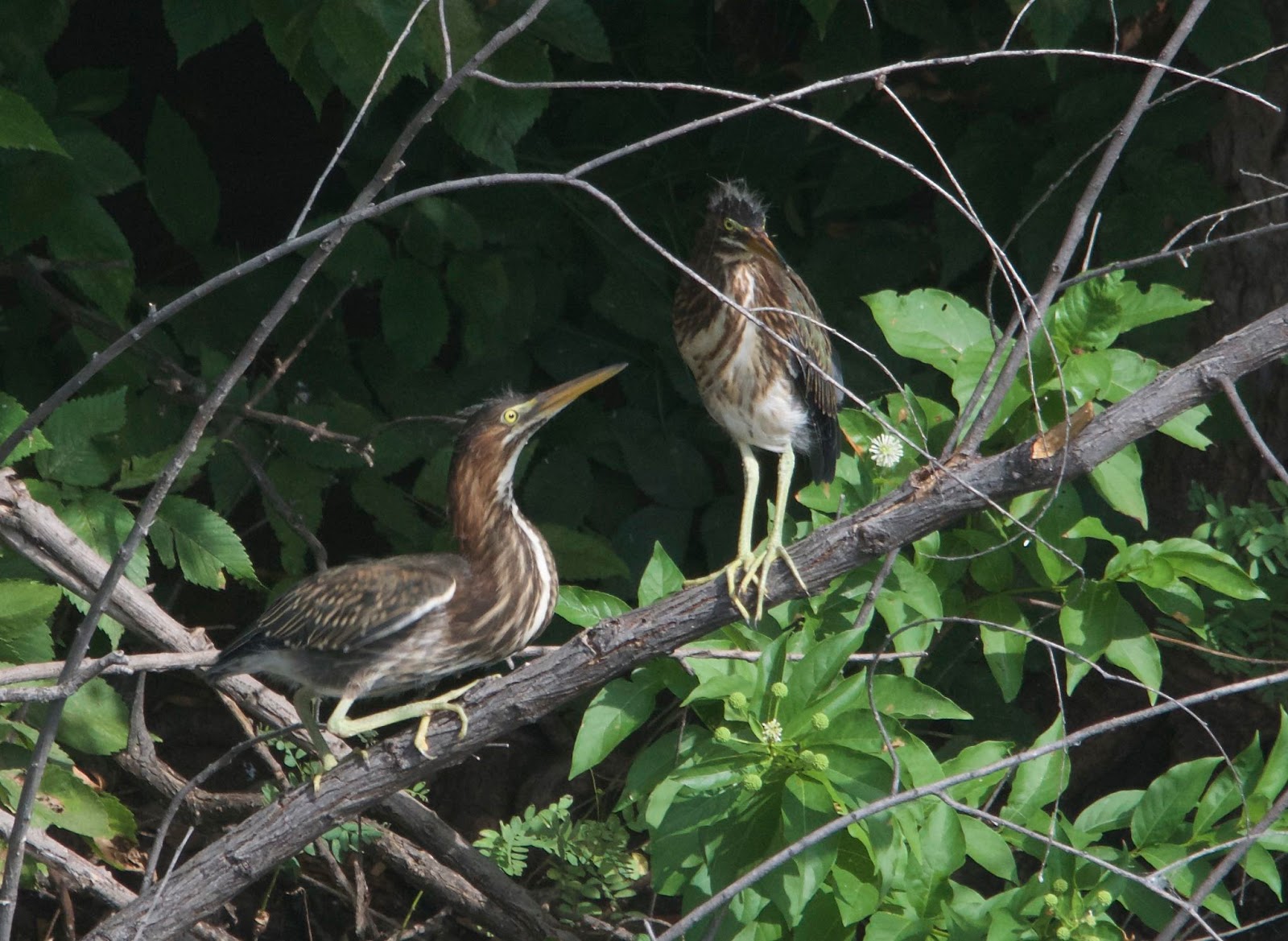
Juvenile Green Herons

Juvenile Green Heron

Great Blue Heron
"Back in the Saddle"

Juvenile Green Heron
0700-0955/79-88 degrees/cloudy to partly cloudy/light and variable winds
In no uncertain terms, the young Green Herons were going further from the nesting area,
and the eldest was practicing fishing techniques, to some degree. There is a possibility that
there could be two clutches instead of one. It would be nice to turn this area into a colony,
which will take a few years, but I believe the site is a good one. It will take years to establish
this as such, so we will wait to see how this plays out.
A male Painted Bunting has been out and about for a couple of days now, belting out his song
and bringing my attention right to him at the top of this tree. He remained for a short time, then
went off to seek other venues.
Our Eastern Phoebes are still in residence, and there are six juvenile American Robins to two
parents, which is welcomed in the vicinity that they were in. Also noticed was at least one
Western Kingbird. A few young Northern Mockingbirds were raised here, and I have noticed a couple of Brown Thrashers over the past couple of days, too. Riparian forest is healthy for a number of species, and this is as upcoming area for the city to cultivate.
Monday, April 21, 2014
South Padre Island/Laguna Atascosa/Valley Land Fund Migratory Bird Sanctuary

Snowy Egret

Ditto

Sandpiper

Plain Chachalaca

Baltimore Oriole

Indigo Bunting


Female Painted Bunting

Brown Headed Cowbird

Brown Thrasher

Bronzed Cowbird(right)

Green Jay

Monday, April 14, 2014
Aransas National Wildlife Refuge, east of Corpus Christi, TX

Palamedes Swallowtail

Black Vulture

Ditto

White Tailed Deer

Ditto

Turkey Vulture(Front)

Male Painted Bunting

Alligator

Feral Hog or Javalina
73 degrees/mostly cloudy/0830-1130
Subscribe to:
Posts (Atom)