Showing posts with label Forster's Tern. Show all posts
Showing posts with label Forster's Tern. Show all posts
Saturday, July 4, 2026

Saturday, April 20, 2024
Sunday, July 9, 2023
Sunday, August 14, 2022
Saturday, May 7, 2022
Saturday, August 7, 2021
Saturday, April 24, 2021
Tuesday, September 1, 2020
Sunday, August 16, 2020
Sunday, June 21, 2020
Thursday, April 30, 2020
043020 The Migrant Balance Is In Check

042920 Lincoln's Sparrow

Neotropic Cormorants

043020 Forster's Tern
Least Sandpiper

Female Yellow-headed Blackbird

Clay-colored Sparrow

American Bullfrog
04-30-20
The Barn and Cliff Swallows have been building more nests under the Lakeview Rd. Bridge. There were seven swallows observed today, and several more nests. Some of the nests are the standard mud cup nests with grasses that are for Barn Swallows. Cliff Swallows make nests that are also cup shaped, but they look like they are constructed with mud pellets and are not smooth structures. Swallows can be found collecting their mud on the higher ground by Heron Cove and have all the grass removed from the ground, as well as mud puddles and along stream and river banks. Since many of the banks on Boomer Lake have concrete, that's why the swallows here create their own source.
Yellow Warblers are arriving slowly, but numbers are increasing. I listed seven today, but that was on the conservative side. Today seemed like there were less Yellow-rumped Warblers, most of them hidden within tree leaves.
An Eastern Bluebird was on the short powerlines as writer rounded the bend enroute to Shorebird Jetty. A lone Chimney Swift was overhead, my good luck sign for the day.
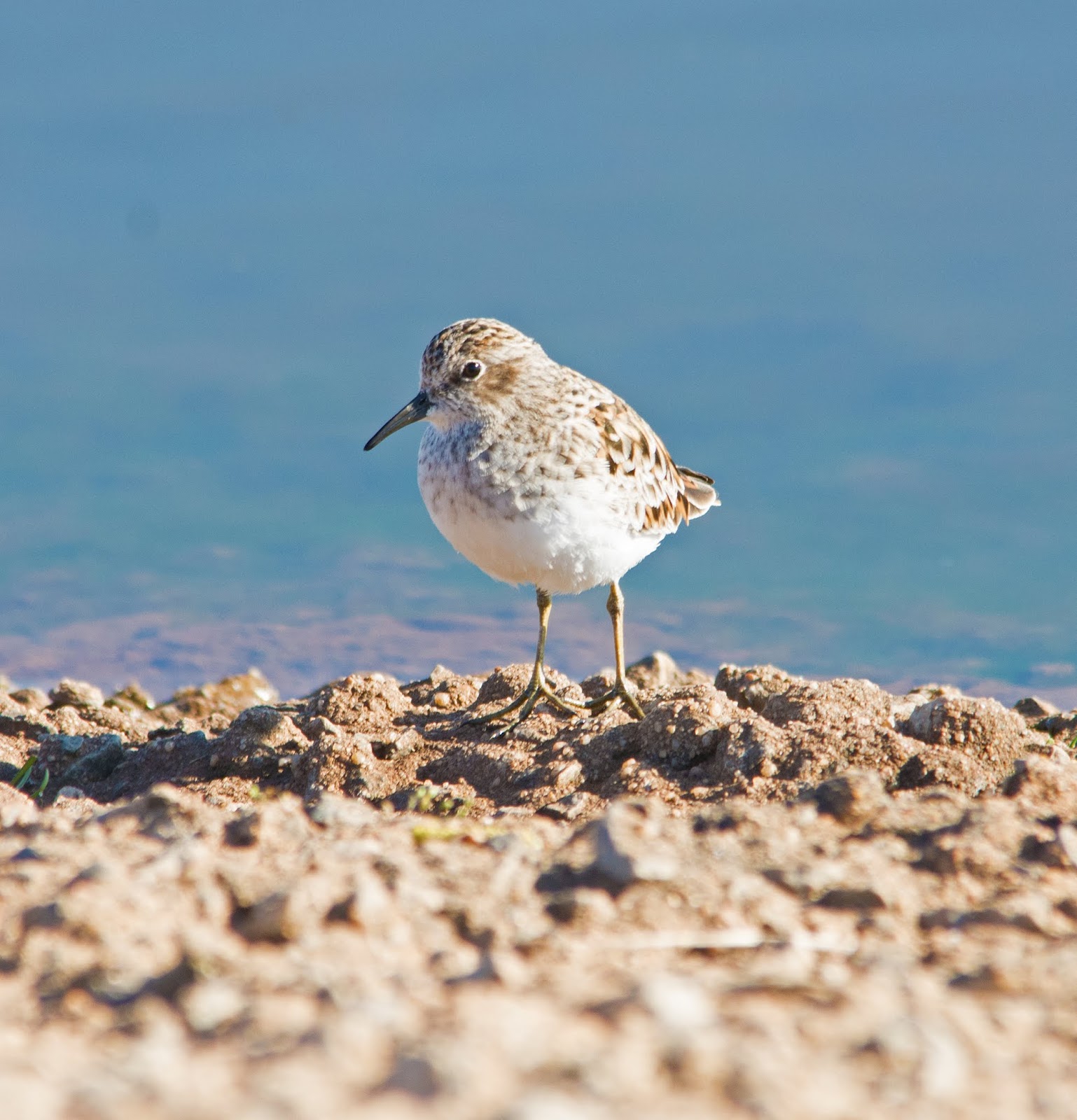
Our usual three Savannah Sparrows were found on Shorebird Jetty, as well as three Spotted Sandpipers. A couple of Scissor-tailed Flycatchers were discovered noisily hanging around the east side of the middle portion of the scrubs. Toward the west side of the jetty, two Least Sandpipers held over from yesterday, and a female Yellow-headed Blackbird allowed photos in the same area. The Forster's Tern that had been sitting on the west side snag by the southwest jetty became mobile, and the photo here was taken on the west side of the jetty. Five Blue-winged Teal flew in from the north while I was in the area and parked themselves off the stretch where the Brown Thrasher nest was recently build on the west side of the bald cypress trees by the east side sidewalk.
A Baltimore Oriole was seen and heard in one of the trees along the sidewalk just south of the east side restrooms. I haven't discovered a females yet, or she is silently in a nest, but both usually forage. I think I saw a female Orchard Oriole in the large oak north of the restrooms. They were only twenty feet from the water, so I thought they were coming to spend some time, but they didn't. However, there were five Turkey Vultures riding the thermals skyward. Western and Eastern Kingbirds paid tribute to their own business after that, with one Western Kingbird in a tree branch. I double-checked just to make certain that it wasn't a Couch's (with the white border on both sides of the tail), but it wasn't. These days, it is necessary to check with temperature anomalies.
More Yellow Warblers were found between Finch Corner and Memorial Jetty, as well as an Eastern Kingbird.
A group of four Clay-colored Sparrows were foraging on the scrub stretch across from Kicker, which is where the above photo was made. Yellow Warblers, an Orchard Oriole and Scissor-tailed Flycatchers were also seen here.
There was only one Neotropic Cormorant when I went by the usual snag off the northwest jetty, and there were five Blue-winged Teal off Goose Island.
There is still no sign of the male Bell's Vireo that has been settling the area south of the last Purple Martin House. There are some at Couch Park, but ours are usually here at Boomer around now. Disruption will force them to move on, so I am hoping for the best, even with the loss of the sixty foot tree that was across from the sheltered and treed area on the north Kicker field. A new metal telephone poles took some habitat out of the area that was critical habitat.
Twenty-seven Purple Martins were on this side of the lake today, which tends to vary on a daily basis. Peering north from the high point across from the north end of Goose Island, a Red-shouldered Hawk was sitting on a snag at Boomer Creek. Down below in the marsh grass was a Common Yellowthroat male, though not the same one from the marsh woods up ahead.
The Marsh was a lot more productive than yesterday with Northern Cardinals, a Brown Thrasher, a couple of Swainson's Thrushes, Prothonotary and Yellow Warblers, Red-bellied Woodpecker, Eastern Towhee (calling "drink your teaaaa!" This bird has been heard here more than once and is likely waiting for the mulberries to ripen before it moves on. Once nesting happens, it won't have many opportunities to get any of those and there may not be any where it nests north of here. There was even a Savannah Sparrow in a small red cedar in these woods today, and a Great Crested Flycatcher also vocalized from the area, too. There was also a White-eyed Vireo, Blue-gray Gnatcatcher, and a social Ruby-crowned Kinglet within the mostly riparian wooded region with second story trees and leaf litter in parts. This is likely going to be ideal for the Kentucky Warbler and Ovenbird before much more time passes.
I startled the leopard frog from its perch in the creek and it grunted in exasperation, but gave me this shot for being in the right place at the right time. Even though there is not break in the marsh grass, I heard a Virginia Rail, but was unable to see it. That is not unusual though, as most rails are very secretive. Oddly enough, there was a Clapper Rail in Texas that I encountered several years ago off High Island somewhere. A tip was given to my birding pal that the rail met everyone in the dirt parking lot for potential snacks. Imagine that! I also got lucky with a King Rail maybe four years ago at Red Slough that would sit out in the open. Some birds are so much more tolerant.
Today I only stayed for forty-five minutes or so and cut through the former construction area that still has what may be a generator for lighting to find my Northern Mockingbird for the day. Fifty-eight species were listed for the day.
There were a conservative five Great Blue Herons for the day, but the two Green Herons were missing today as well as yesterday. I even stood on the bank to see at least if I could hear them. Nothing. Hopefully, they are not pulling out of the area, too.
Saturday, February 29, 2020
Monday, September 2, 2019
Sunday, August 11, 2019
Monday, August 5, 2019
Birding On a Shoestring: Cheyenne Bottoms, Kansas

Forster's Tern, non-breeding

Forster's Tern, nonbreeding 2

Forster's Tern, nonbreeding 3

Franklin's Gulls

Franklin's Gulls 2

Black Tern (Left) and Franklin's Gull (Right)

Black Tern

Black Tern 2

Franklin's Gull
072819
1300-1700/ partly cloudy/windy, 25-30 mph
After lunchtime was interesting, as there was a lot of water in the marshes, as well as large numbers of birds. Since it was so windy, it appeared that many of the birds would be lying low, which the normal ones were. However, when it came to Barn and Cliff Swallows, they were taking everything in stride from the air, of course.
Much of the sun was in the wrong direction when we drove toward the first bird-filled marshes, making them difficult to identify due to glare. Most of the seasonal birds, including White-faced Ibis, Great Blue Heron, Great Egret and Snowy Egret were there, as well as both Long- and Short-billed Dowitchers, and many of the other usual shorebird suspects.
We also saw the head of a young male buck with short fuzzy antlers in the water, swimming toward shore, then deviating in our direction to follow the shoreline. It almost seemed that he was unable to gain land purchase, but it didn't make sense that he could not. It appeared that he was doing his best to keep his head up, and through observation, he may have been walking on the bottom, as well as swimming. He finally passed us in the water, as we stopped the car to not make him fearful of us.
There were good representations of American Avocets and White-faced Ibis, where we could actually clearly see the white faces. One ibis found a prize, which may have been a frog, and he was doing his best to keep the other birds from stealing it. He dropped it several times, and finally managed to eat it.
Passing other ponds, we observed Pied-billed Grebes, Mallards, and Blue-winged Teal. It was almost like certain species had their own ponds, but it most likely had to do with water depth.
We'd also see a few groups of Franklin's Gulls, an occasional Black Tern, as well as Forster's Terns. The further along we got, we discovered that more representatives of these birds were caught in a wind tunnel. They were flapping their wings, yet not going anywhere, staying fairly stationary. Unless these birds managed to deviate to the right, they stayed within this odd cycle of events. There were eventually Great White Pelicans in the area who were in the water, as well as a few of the Franklin's Gulls and an occasional Ring-billed Gull. A Black-Crowned Night-Heron was also discovered on the tail end of this melee, but it managed to break free of the wind prison.
Many, many more ponds were observed and the wind seemed to lessen in the central part of the refuge. Large numbers of the previously mentioned herons were seen, as well as the White-faced Ibis. It was a most remarkable collection of birds. The further inland we were, a few songbirds turned up, as well as Turkey Vultures and Red-tailed Hawks.
We held out hopes for an American Bittern but we could have missed it, though there was some good habitat.
for more on the adventure:
https://debhirt.blogspot.com/2019/08/birding-on-shoestring-cheyenne-bottoms.html
https://debhirt.blogspot.com/2019/08/birding-on-shoestring-quivira-national.html
Sunday, June 2, 2019
Sunday, May 26, 2019
Wednesday, May 3, 2017
Pre- and Post-Storm Events
On May Day, We Recovered From the Blows of the Storm:

Male Warbling Vireo

Ditto


Scissor-tailed Flycatcher

Male Clay-colored Sparrow


Cliff Swallow

Forster's Tern

Female Yellow-headed Blackbird
On the Day of the Storm's Final Hoorah, April 30th, At Approximately 5 p.m., When Winds Were Between 18-24 MPH:

Clay-colored Sparrow

Scissor-tailed Flycatcher
04-30 and 05-01-17
The more migrants that I have coming in, the more photo ops there are.
On 04-29, there were plenty of birds that had come down the day prior due to impending storm conditions, and there were a few that were dealing with wind and rain that showed themselves. On 04-30, when we were still dealing with higher winds and light rain throughout the day, and even higher winds in the afternoon, a few birds from the fallout showed themselves looking for food.
Even though you can't see a lot of it, the second to the last photo with the Clay-colored Sparrow in a bad cypress tree is being buffeted by the wind with the head feathers showing wind direction. The camera just happened to freeze the movement of the branch.
The last photo of the Scissor-tailed Flycatcher, was also showing a bouncing birding the wind, again frame frozen. My photo of the Yellow Warbler, also in the same area, was covered by the branches due to wind gusts and by the time I photographed her, her view was not as I liked it. Most of the birds that were out were water birds, Mallards, Canada Geese, Franklin's Gulls, Spotted Sandpipers and Forster's Terns.
Most of the smaller birds were taking cover within the confines of branches and bushes. They were quieter, but could still be heard to some degree.
As you can see, I did reap the benefits of our latest storm, which was a little more powerful than today's rain.
On Sunday, the last day of the month, Boomer Lake managed to swell its banks in some spots and Spotted Sandpipers were on land along with Mallards. Land depressions also contained water, which was fitting for the few Blue-winged Teal who had taken refuge here.
Subscribe to:
Posts (Atom)