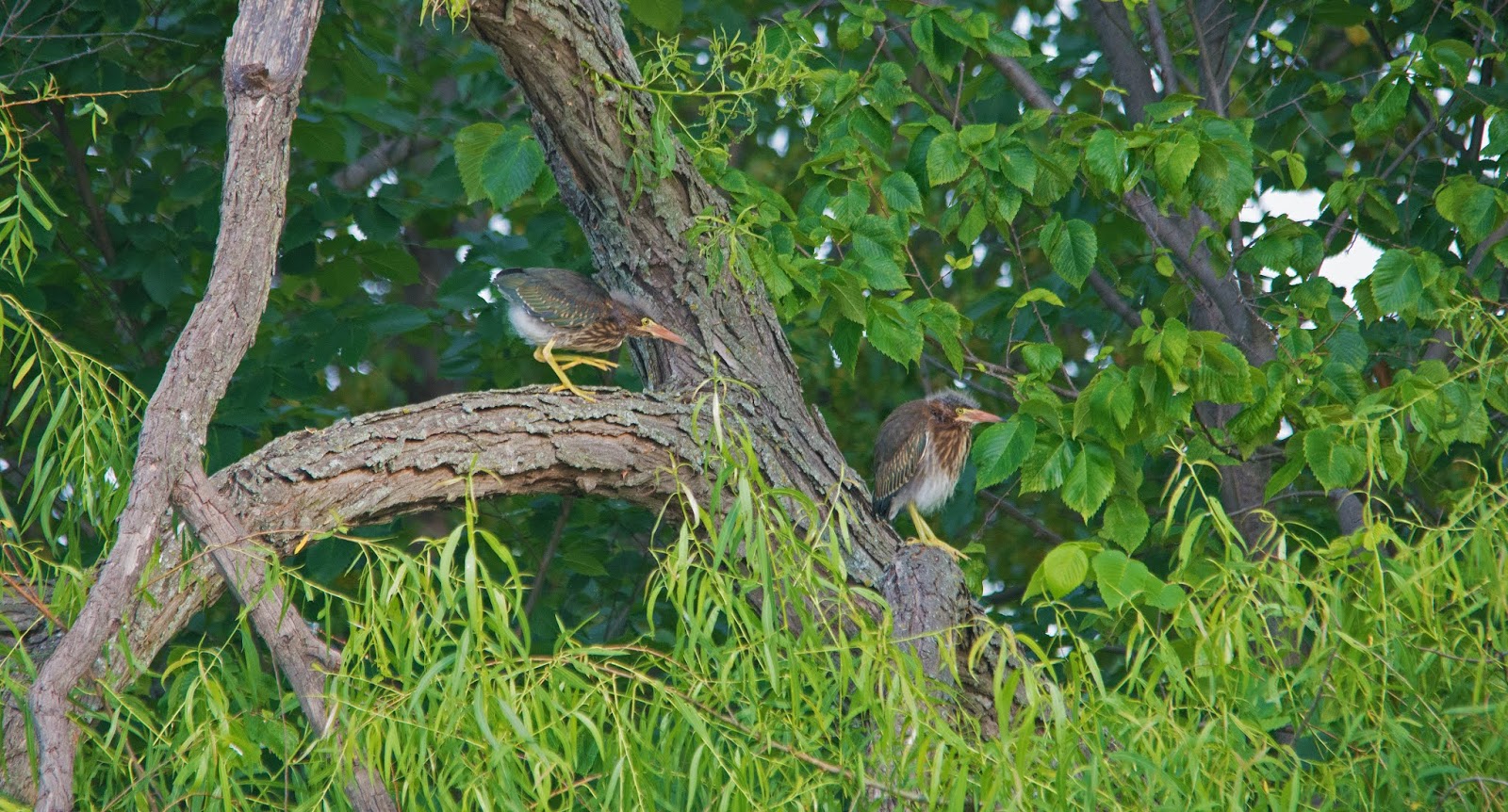
Having a photo shoot with a wild animal can be challenging as we see here. Rarely are these animals in such a location where we can take advantage of lighting and other natural habitat. This is the month where the heat index is clearly against us even in the earlier hours of the day. Once the sun rises, we are at its mercy. However, if one is fortunate enough to be in the shade during these escapades, life becomes a little better.
But when the subject decides to feed, the shoot is over.
Adult Cliff Swallow
Attending Nestling at Mud Nest
View 2
061119
0700-0837/63-69 F/partly cloudy/SE-6/74-66% RH/30.18 Hg and falling-30.23 Hg and steady
It appeared on this date that the two eldest Green Herons may have fledged, as they could not be located with the others. The helpers were also missing, which tells me that it was getting critical
that these birds begin to fly to start caring for themselves.
The second nest has been attended for a couple of weeks, so it is suspected that there will soon
be more young in the colony that will need exercise/flight attention in ten days to two weeks so another nest can be started.
This was also a good day to hang off the side of the hill at the Lakeview Road Bridge to get more
photos of Cliff Swallows, as more birds are fledging from the nest.
A small heron with slender neck and bill, the Tricolored Heron forages in shallow water and will sometimes join other heron species when prey is abundant. It is a resident heron in the southern states and can be a vagrant in the northern US and Canada.
Often running in the water and stirring up silt from the bottom of its chosen venue, it behaves somewhat like the Snowy and Reddish Egret in its dance routine for prey. Often mantling to cast shadows to entice killifish and minnows, they will follow the Double-crested Cormorant or Pied-billed Grebe to snag what delicacies that they have left behind.
Favoring coastal estuaries, the Louisiana Heron could well be the single bird apart from the others, so no heron shapes bears not watching. Most predominant at Red Slough, they can also be found at Lake Hefner, Arcadia Lake, or Great Salt Plains where one of the earliest was found in 1980 in Oklahoma.
Tri-colored Heron
Bolivar Flats, TX 2015
The male selects breeding sites, and they are colonial nesters, often with others of the heron clan. The female is in charge of nest building, while the male gathers the material. The stick platform has a hollow within, which is lined with fine materials.
Climate change seems to be sending this species in a northeasterly direction, which is not uncommon.
The Tri-colored Heron is the only dark heron with a white belly.
One of six American Crows
Trying to Drive Our Heron Away, a Juvenile
Mississippi Kite
View 2
View 3
View 4
View 5
082518 through 082718
There was some pretty intense work weather permitting or not. The goal was to get a few in flight photos, but times were windy, other times were very cloudy, and it was just a matter of doing the best possible in view of the circumstances.
The last day was the most interesting with a murder of six American Crows stopping by. A juvenile Mississippi Kite was the unfortunate victim of the eldest crow, and was driven off the Bald Cypress tree where he was sitting first, likely with a parent.
The action was captured, as can be seen and hopefully, you'll be able to picture the scenario through my eyes.
Here's another shot of the juvenile Great Blue Heron from the last set of photos, just making itself at home at Heron Cove.
Very limited as an Oklahoma breeding species even now, the Yellow-crowned Night-Heron is located in diverse habitats. Sometimes it is found in saline or fresh water, but is usually seen in quiet, tree lined river habitats.
This bird is not as nocturnal as could be considered, and can be quite active during daylight hours.
It roosts in trees like other herons, often hidden from view within foliage. It can also be found on the ground in dense reeds or shrubs and will usually forage upon crabs, mussels, fish, crayfish, and other crustaceans. They favor edges of ponds or streams while walking in the water at twilight or early morning. They are dependent upon the tide in mudflats.
Adult Yellow-crowned Night-Heron
in breeding plumage
Estero Llano Grande NWR, 2017
Night-Herons usually nest in small colonies and groups, atypical of other herons. They are generally near or over water. Both parents will feed their young, usually via regurgitation or dropping food directly in the nest itself. When the young are old enough to learn how to forage, this instruction is usually done at night.
These birds are thinner than the Black-crowned Night-Heron with a dark, thin bill. Juveniles have small white spots, whereas the Black-crowned will have broad blurry streaks and larger white spots on the wing coverts. The immature Yellow-crowned takes nearly three years to molt into full adult plumage.
A common heron of Oklahoma, the Snowy Egret was once a victim of human selfishness. During the early 1900s, its feathers were taken for the millinery (hat) trade. Through the Migratory Treaty Bird Act of 1918, taking any birds or bird parts, which included feathers, saved the life of this bird, as well as the remainder of the herons and egrets.
This beautiful heron is utterly spectacular in adult breeding plumage. It has an air of mystery about it, and it is truly a graceful animal, appearing delicate and similar to royalty . The species nests in island trees, as well as single trees growing in water. Some will forage for food in open water where there is plenty of room, while others prefer solitary foraging. The species breeds on the coast or inland where there are lakes, estuaries and other appropriate bodies of water.
Snowy Egret
High Breeding Plumage
High Island, Texas
The medium sized adult birds have bright yellow feet, which will become orange or red-orange during times of high breeding plumage, its plumes or aegretta, will stand up and they will run from the head, the breast, down the back, and curve upward at the tail.
Enemies are snakes, raccoons, the Fish Crow, and sometimes even the older nestmates. The youngest usually does not survive due to the aggressiveness of its siblings. They are incubated as the eggs are laid, so the youngest could be a week junior to the eldest.
One of the classics that this bird is known for, is its feeding technique. It was born with its own personal fishing lures, which are the yellow feet. When the snowy is foraging it will use its feet in a rakelike manner or move them upward and in a circular motion to drawn food skyward. It will then easily take its prey from the top of the water.
Snowy Egret
nonbreeding Plumage
Known as the Bird With the Golden Slippers, the Snowy Egret gives the impression of an ethereal nature, especially in breeding plumage. To make them even more interesting, they have a "wah-wah-wah" call which almost sounds like a gurgling, and that clearly designates a Snowy Egret colony.
Many of these wading birds will overwinter on the Gulf coast, but good numbers will also go as far as central Brazil. It all depends upon where they settle pre-breeding that determines post-breeding locale.
Oddly enough, in the 1830s, this bird was nesting as far north as New Jersey, and by the mid-1800's, it was at the Great Salt lake. As time progresses in the global warming situation, they could well become northbound once again. It will all depend on the survival of their preferred food sources.
A heron that is found in shallow salt water, the Reddish Egret is the most uncommon of all in the United States. The species comes in two morphs, white and dark, both of which can be found in the same nest.
Dark morph Reddish Egret
Also the most acrobatic of the species, this wader runs, jumps, spins about, and is most famous for its canopy hunting technique. Not only does it run with wings raised, it flies over shallow water seeking groups of fish, which are rapid movers, necessitating that it move in the same manner. It takes about three years for a Reddish Egret to become skillful at this form of feeding.
Having a pink bill with a black tip, a medium to large sized bird, it also has blue-gray legs as a defining feature. The white morph is just that with the same color scheme on the bill. The dark morph is blue- or slate-gray with a reddish neck and head, and the immature is paler, but the red-brown neck could be missing. It tales three years for the adult plumes, and the mature lores are bright violet, as is the bill and legs.
White morph Reddish Egret
As many of our beautiful herons suffered greatly due to the millinery trade, this bird never really recovered, and the current difficulty is habitat degradation. There remains only 1500 to 2000 pairs of this colorful bird, and they are coastal denizens nesingt in colonies with other herons. Their lavish courtship displays are very animated, involving shaking the head, hooplike flight, bill clacking, and raising head, neck, and back feathers.
Reddish Egrets nest on stick platforms, as many other herons do. It is suspected that some of them nest inland in Texas.
These birds are classified as near threatened. They are found in the Caribbean, southern coastal, California coastal, and will migrate to the southeast coast of the US. Most of the population resides in Texas, followed by Florida, then Louisiana. This specialized heron likes barren and shallow flats that are quite salty. The diet is mostly killifish and sheephead minnows, followed by crustaceans and frogs.