Showing posts with label birds. Show all posts
Showing posts with label birds. Show all posts
Saturday, November 18, 2023

Sunday, January 12, 2020
Tuesday, September 17, 2019
Warbler and Monarch Central On Boomer Lake

Yellow Warbler

Juvenile Male Common Yellowthroat

Ditto, View 2

Monarch Butterfly on
Sunflower
The Yellow Warblers have been on Boomer Lake for the past two weeks and have been far reaching, spending much of their time around willows, sunflowers, Bradford pears, sycamores and many other woody stemmed native plants. Monarchs have been in the area of nectar giving plants, clustering around sunflowers, along with many of the lepidoptera, like swallowtails.
The juvenile male Common Yellowthroat is a warbler and has been in the midst of the Yellow Warblers around the sunflowers on the northern and western side of Heron Cove. This area tends to be a warbler and general songbird magnet due to the native deciduous trees that attract beneficial insects.
Sunday, April 28, 2019
Monday, November 19, 2018
Sunday, October 28, 2018
Sunday, October 21, 2018
Friday, October 5, 2018
Long Term Effects Regarding Late 1960s Eastern Spruce Budworm Outbreak
One of the finest pieces of work in the field of ornithology that I have found was begun in the late 1960s and the effects are still being seen today, including even more research potential regarding the eastern spruce budworm.
One can only imagine that never has such material led to wide reaching data as this, but it continues to excite as well as direct us into more extensive information than thought possible even a half decade later. History is being written regarding this, even this far in the future with additional crossbill subspecies.
I shall touch upon the highlights and try to fill in the blanks regarding modern eBird data gleaned through public information, as well as include what we may expect in the future with global warming continuing to thwart the avian world. It is common knowledge that many species of animals, not just birds, are moving in a north and easterly direction. It will both be interesting and likely shocking to see what the next half century will bring, especially regarding the survival of both generalist and specialist birds, especially along mountain ranges where the crossbills are even likelier to wander into the deep southwestern states and Mexico.
Numerous small scale studies have been put together and expounded upon with then trending spruce budworm defoliation, Christmas Bird Count (CBC), and Breeding Bird Survey (BBS) data as a junction of the original phenomena.
It was never dreamed initially that this information would reach such heights in the investigation process, nor that it would affect the movement of seven distinct species by the time it was considered at an end.
It was not suspected that global warming or climate change really existed at the time or how quickly the forward motion of the laying of eggs by the eastern spruce budworm, followed by climactic action could lead to such a large scale defoliation.
Because these infestations became larger over time with the right recipe--warm dry springs and large scale conifer forest with the correct percentage of white spruce, balsam fir, and black spruce--one infestation quickly flowed into another, only enlarging.
As the years passed, one pesticide replaced another to attempt to kill off the budworm, of course to no avail. Replanting the forest was attempted with likely infected seedlings, large scale fire suppression, and extensive clear cutting all around the eastern portion of the US, where many individuals depended upon wood heat over the winter from southern Canadian provinces, including the New England states.
To make a long story short, there was a forest collapse and many of the dead trees were felled. Outbreaks were minimized with the planting of least susceptible trees like jack pines and black spruce, but this change also affected birds that preferred living and nesting within the balsam fir. At that time, the rare irruptions of Black-capped Chickadee and Red-breasted Nuthatch, occurred in a synchronized manner, and it was assumed that since food sources collapsed, the affected birds would seek sustenance elsewhere.
Ebird as well as CBC data was utilized, picking up trends of irruptions which went from every other year to some that were more or less often, and affected other birds such as Red- and White-winged Crossbills, Evening Grosbeak, Pine Siskin, and Purple Finch. The finches and grosbeaks followed the increase of the budworm expansion, which the other five species increased and decreased inversely.
The interesting thing about the Black-capped Chickadee irruptions was the fact that it was discovered that they shared three contact zones with the Carolina Chickadee and hybridized as intermediate species, as a result of the events.
The Boreal Chickadee, which is even more northern than the other two, also got in on the action and periodically came to southern New England, New York and Pennsylvania as well as the south central states as another irruptive species.
The Pine Grosbeak was believed to have come south at the end of the budworm infestation and it was caused by destruction of the Boreal Forest. This was why it appears that it has not been continual.
The crossbills are believed to have declined due to large scale budworm destruction, but these days, Red Crossbills have a much larger range than the White-winged Crossbill ever did with their current ten species. The white-winged Crossbill never had such a large irruptive pattern.
There were also spruce budworm warblers, like the Bay-breasted, Blackpoll, Cape May, and Tennessee Warblers. They will still periodically show up during outbreaks in the southern states.
So, in a nutshell, we are still observing from time to time, the aftereffects of many birds that were initially affected by the change in their habitats. They are still predisposed to wander as irruptives as the circumstances dictate.
I wish to thank Nicholas Bolgiano, Zach, Falls, Erskine, Morse, Crawford, Jennings, Hagan, Hussell, Patten, Burger, Sauer, Blais, Raske, Kettela, and the many other individuals that invested the thousands of man hours in order for us all to benefit from their tireless efforts for the good of ornithology. You are all a credit to your schools and your research papers that opened the doors for us all. May we remotely aspire to your teachings.
For More Information on the Red-breasted Nuthatch:
https://debhirt.blogspot.com/2018/10/oklahoma-irruptive-species-profile-red.html
For More Information on the Pine Siskin:
https://debhirt.blogspot.com/2018/10/oklahoma-irruptive-species-profile-pine.html
Saturday, September 29, 2018
Sustainable Coffee Now
Do it for the birds, our environment, and your health. Buy organic GMO free, sustainable bird-friendly coffee. Ask your grocery stores to carry healthy coffee that is not bitter, which is grown in the sun. Help me help THEM.
Sunday, September 23, 2018
Oklahoma Vagrants: Black-throated Sparrow
The Black-throated Sparrow is known for arid desert scrubland, and that is where such areas on the Oklahoma Panhandle give one exactly what asked for since 1974. They are frequently seen in the open upon the ground or on twiggy shrubs in canyons. 2018 has been the year of sightings in Oklahoma in both spring and fall at Easter Pageant, as well as a few other sparse observations in Cimarron County. They are still not often seen here.
A small sparrow with striking marks that include the black throat and bib, the singing male has a notable call in the spring. The species feeds on seeds and insects, and can occur up to 7,000 feet elevation. They are often under cacti and shrubs, and if proper habitat can be cultivated, they will come to feeders. Insects are usually only consumed during the breeding season and seeds for the remainder of the year.

Black-throated Sparrow (Texas subspecies)
Rio Grande Valley, Texas 2017
Frequent hosts to the Brown-headed Cowbird, some of the young sparrows will not survive. Other problems include excessive heat, fire suppression, and loss of habitat due to urbanization.
The desert sparrow can withstand a great deal of heat, obtaining necessary water from food sources. Resident birds remain in the southern US, while northern breeders tend to join them there, as well as in Mexico.
See the Western Subspecies of this bird with others in Arizona:
https://debhirt.blogspot.com/2018/05/birding-on-shoestring-wilds-of-arizona.html
Sunday, September 16, 2018
Oklahoma Vagrants: Cassin's Finch
Uncommon in western montane coniferous forests, this finch has a more pointed and longer bill than the Purple Finch, as well as a longer primary projection. The most distinguishing characteristics between House Finch and Purple Finch are the short, deeply forked tail and the peaked head. They usually forage upon the ground, feeding on fruit, insects, buds, and conifer seeds.
First seen in Oklahoma in 2000, the American rosefinch has steadily become more common and was observed several times during 2018 at the Black Mesa Bed in Breakfast in winter, as well as New Year's Eve, as well as once in spring. It was also seen in the spring this year in Guymon. In Oklahoma, they appear to be moving west to central to likely survive climate change over the next few decades.
These birds breed throughout western conifer belts of the interior mountains between 3,000 and 10,000 feet. They favor most pines, spruce, and quaking aspen. Some prefer open sagebrush scrub with interspersed western juniper. Breeding numbers tend to change as the food supply does over yearly periods. Some northernmost birds will migrate south for the winter, yet others choose not to do so.

Cassin's Finch
Madera Canyon, AZ 2018
In late summer and early fall they will flock with Red Crossbills, Pine Siskins, Evening Grosbeaks, and other assorted birds of the mountains to forage and seek out salt through mineral deposits. In the winter, they migrate to lower valleys, or altitudinal migration.
Saturday, August 18, 2018
Oklahoma Breeding Bird Species Profile: Belted Kingfisher
Photographers can be birders, but not all birders are photographers, and not all photographers know the difference between a male and a female Belted Kingfisher, as can be seen in this video. However, it was a good video to show how close one can get in a blind.
These uncommon but ubiquitous birds will fish for minnows on any exposed perch just a few feet over water. They will hover, often like the American Kestrel to locate prey, and will even do the same for observers that they know mean them no harm. They also will take lizard, insects, salamanders, frogs, and even mice.

Male Belted Kingfisher
Kingfishers dive headfirst to glean prey from the water and incorporate quick bursts of a couple of wing flaps with several slower ones in order for them to remain aloft and steady.
The only breeding kingfisher in Oklahoma, this pandemic breeder prefers to breed near water where they can set up nesting areas in sand- or mudbanks. Sandy clay soil seems to be the preferred substrate and nesting is near a snag or a dying tree. Nesting usually begins in late April or June.
Their preference for food lends to small fish, and the male will retire away from the nest site. They have a large territory of a mile or better. Young remain in the nest and under care for a good month. They are taught to fish, then the parent will beat the fish almost to unconsciousness to provide good practice for their understudies. Surprisingly, the young are fit to be on their own in about ten days to two weeks.
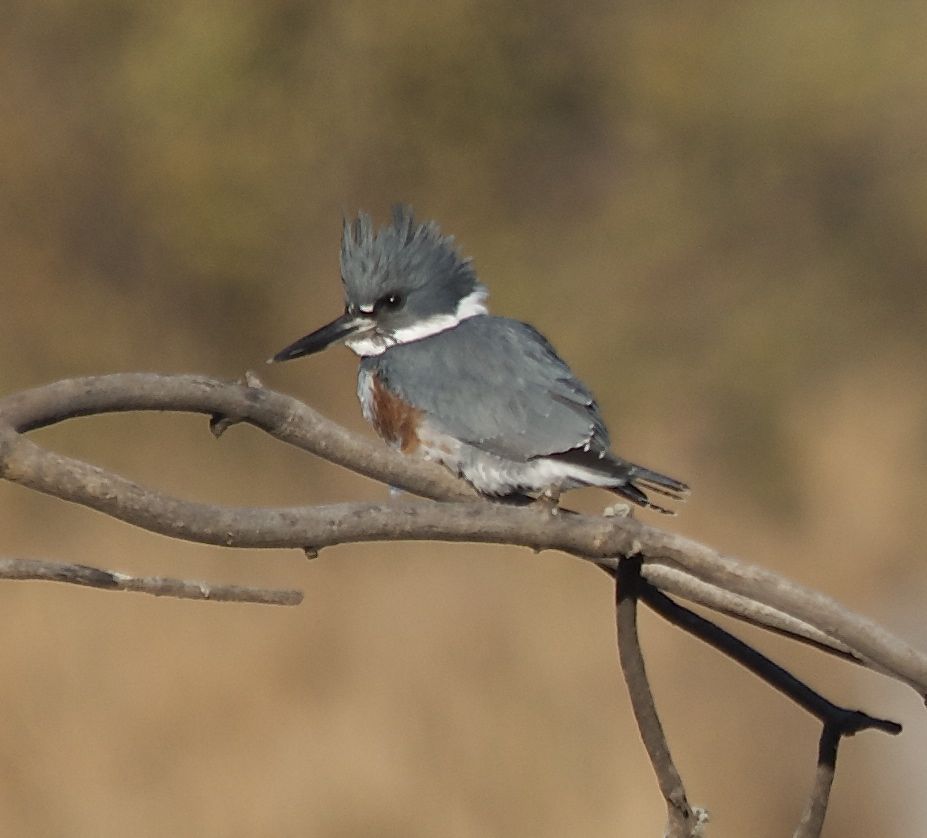
Female Belted Kingfisher
Their harsh, rattling call can often be heard before they make an appearance.
Most of the kingfishers that I have seen regularly are during the winter months where courtship is at a slow place. Both sexes will appear shy for quite some time, then suddenly they see fit to pair. After pairing, they show themselves occasionally, then get busy with nesting business. in the summer.

Male Belted Kingfisher
Sunday, August 12, 2018
Sunday, August 5, 2018
Tuesday, July 24, 2018
Sunday, July 22, 2018
Sunday, July 8, 2018
Monday, April 16, 2018
Tuesday, March 27, 2018
Monday, March 26, 2018
Subscribe to:
Posts (Atom)