Showing posts with label Tufted Titmouse. Show all posts
Showing posts with label Tufted Titmouse. Show all posts
Saturday, February 21, 2026

Saturday, July 6, 2024
Saturday, April 13, 2024
Sunday, March 26, 2023
Sunday, February 12, 2023
Saturday, July 23, 2022
Saturday, March 26, 2022
Sunday, September 12, 2021
Wednesday, June 16, 2021
Saturday, May 16, 2020
051620 Storms to Yard Birds and Back Again

051420 Great Blue Heron
Shortly after writer was on the lake, it began raining to some degree, forcing me to believe that this would be a fast trip. The roiling clouds showed unsettled weather but it wasn't supposed to rain for an hour. Figuring that either the birds just arrived and came down or they did the night before, chances were good that there would be a few things on the lake. Not really so, other than several Snowy Egrets flying in the direction of the wind, away from the storm. Even Shorebird Jetty showed little for birds. The jetty was also very windy, beginning S-18, finally gusting to 31 mph. Batten down the hatches.
This Great Blue Heron landed upon Shorebird jetty while wind and rain were part of the general atmosphere. I observed the bird in what appeared like slow motion. Its wings were outstretched to keep if from being thrust into the forward-facing wind and it bounced as it came down. It was also at a run, rapidly slowing down to keep from going into the high water that was nearly lapping at the shores of the jetty, nearly cresting the land.
Several minutes of this and a northbound flying Great Egret made me wonder if we might not be soon heading for Kansas, but we remained safe. Needless to say, when the clouds parted, it was best to head back to base. The rain never stopped, even with the partly cloudy weather after the front went through.

051520 Least Flycatcher
It was not raining (yet), but it was warm and humid. Birding was better. Having found seven Franklin's Gulls upon the water, it was impossible to get good shots due to the darkness. A Bell's Vireo was heard north of where there was an adult last year prior to fireworks, yet it slowly made its way closer to The Cove, singing all the way. An American Redstart was briefly spotted and heard in the run of trees south of Bald Cypress Row. There were more birds there, but I was unable to hear or see any more. Swainson's Thrush was in the southern line of trees west of Bald Cypress Row in song, the tremolo effect just like the Veery and Song Thrush. The bird has a well developed syrinx, which makes its dual song similar to the double sound of a twelve string guitar. It sounds almost ethereal with the quality of reverberation. Since Swainson's had been in the area for the past two weeks, my curiosity had been piqued to hear its song, which finally happened for the first time today. It was worth waiting for. Also located was a male Common Yellowthroat and over two hundred Cedar Waxwings were heard in two hours. All they cared about was stripping mulberry bushes and trees of the ripe fruit, then they wafted away in song to seek more.
051620
Slightly cooler, mostly cloudy and a little rain opened the day at Boomer Lake. There was a high count of three Barn Swallows and six Cliff Swallows around the Lakeview Road Bridge. Three Carolina Chickadees, one parent and two immatures, were found on the north end of Heron Cove in the line of trees off the water at the bottom of the hill midway between The Cove and Shorebird Jetty, as was a Least Flycatcher. A female robin was coaxing her older immature down a Bald Cypress. There were five Spotted Sandpipers, a northbound Great Egret, a total of four Green Herons, one at The Cove and three more that may have come from Boomer Creek. Two out of the three soon returned north. Two Bell's Vireos were found, one just shy of Heron Cove and the other in the deciduous trees between the northeast jetty and Goose Island. Three male Eastern Bluebirds were hawking insects from the power lines while four or five Western Kingbirds filled the skies with boisterous activity. A conservative three dozen Cedar Waxwings were in search of breakfast all over the lake, likely many more. A male and female Orchard Oriole lay claim to separate territories, while a dozen Yellow Warblers filled the air with song, and a Turkey Vulture rode thermals alone.

051620 Immature Barred Owl

Tufted Titmouse
These above beauties were obtained through an invitation. An area resident though of writer today and wanted to share the immature Barred Owl, since I had never seen one. It was a wonderful afternoon as a result. The titmouse was a bonus, as were several other birds that I didn't photograph.
Tuesday, April 28, 2020
042820 Migrants Hiding Within the Trees and Leaf Litter

042620 American Coot

White-faced Ibis

Swainson's Thrush

042720 Franklin's Gull

042820 Spotted Sandpiper

Clay-colored Sparrow

Tufted Titmouse

Common Yellowthroat
Southwestern Subspecies
Three Barn Swallows were sailing around under the Lakeview Road Bridge with the Bald Eagle off on a distant power pole. The swallows circled around the water, then along the lowlands of the southeast corner of the lake. Writer then scanned the short grass just in case there might be Buff-breasted Sandpipers coming in early. Some of the grass is a little long, but they should be able to work with it. Hopefully, they will come here for a much-wanted photo if the grass doesn't grow much more.
Writer swung around The Cove for Yellow-rumped and the sounds of Yellow Warbler, as well as Warbling Vireo. Upon initial inspection, no Green Herons in sight, but there were Great-tailed Grackles and a couple of Red-winged Blackbirds. Eyeing the water on the north side, there were two dozen Franklin's Gulls, one Great Blue Heron cast overhead in a southeast direction, while another was discovered on the north side of Heron Cove proper, as well as one Double-crested Cormorant.
The sound of a Nashville Warbler permeated the air, but the area around the bend heading north is very thick, mostly with the dreaded Bradford pear. I have a solid fear that if they continue to be allowed to grow, they will choke out what few natives we have, and the migrants will pick and choose where they want to go. Hopefully, we won't lose them in the future.
A female Yellow Warbler was discovered in the scrub before the Brown Thrasher's nesting area. A tail was observed poking from the thrasher nest. Passing the area, a male and female Yellow Warbler were observed going through the top branches and greenery in search of insects. One Yellow-rumped Warbler was also discovered within the same area.
Shorebird Jetty hosted three Spotted Sandpipers, five Purple Martins within their plastic house, and European Starlings littered the ground around the house. A couple of Red-winged Blackbirds were foraging just west of this area. No additional birds of interest were seen beyond this area, save for a Savannah Sparrow, a lone American Coot, and a couple of House Sparrows.
Along the stretch between Shorebird and Memorial Jetties, another Yellow-rumped Warbler was heard, a Scissor-tailed Flycatcher was seen, and the sound of an Eastern Kingbird permeated the area, who was found atop the high wires. American Robins assaulted the ground seeking worms, while starlings searched for insect fodder. Three Western Kingbirds were enjoying their morning on the high wires. The Purple Martins were out catching breakfast.
A couple of Mourning Doves were on Memorial Jetty, Mallards were enjoying the water, and a Spotted Sandpiper patrolled its area around the north side perimeter. Social Scissor-tailed Flycatchers were in the large oak bordering the storm drain overflow ramp, attracting the three Western Kingbirds, and a Warbling Vireo announced its presence. A male Orchard Oriole kept calling for "Marguerite," until he tired of that and moved north. Three Clay-colored sparrows roved between the overflow, the bank, and the north side of the trees, while the Western Kingbirds relocated to the low wires on the east side across from Kicker. A pair of Brown Thrashers tossed leaves while foraging along the bank, sometimes sharing space with the Clay-colored Sparrows.
What could have been another Nashville Warbler sounded out along the west side of the willows/cottonwoods, but that was all. Most of the Purple Martins from the Kicker House returned from their foray to gather again and feed a female that is believed to be caring for eggs/young. With the House Sparrows that reside there, at least one bird will have to remain at all times to avoid possible harm to the eggs/young.
Cardinals were observed throughout the walk, and they still continued to call as the journey progressed. All trumpet vines remained unused, while the largest one by the Kicker martin house still shows no sign of flowering.
a single male Blue-winged Teal was discovered with a small group of Mallards along the northeast jetty, along with a Scissor-tailed Flycatcher, and a Yellow-rumped Warbler. It appeared that our eleven Mallard Ducklings were shortchanged to eight, and a Canada Goose pair were herding three of their goslings, while a nearby Mallard drake flew off and landed in the water on the south side of the jetty. Perhaps the young annoyed him. Two American Coots lazily swam along the east shoreline.
A few Canada Geese and European Starlings were holding down the Kicker field, while a single Northern Mockingbird flew west from the small group of trees west of the protected zone surrounded by trees. The mocker flashed into a small tree north of the ficus, then returned to the original group of trees. I really hope that the Bell's Vireo that has been breeding here for years will return, even though the family was displaced by the addition of the new power poles. Unfortunately some of the vireo's territory was removed with the construction. The family moved just north of there into the scrub south of the northeast jetty.
High Point Ridge had very little scenery other than a few Double-crested Cormorants and Canada Geese swimming in the water.
Below the banks where the red cedars cluster, all was quiet, as well as the new road to the line of towering giant metal electrical poles, until we reached the woods. An hour was spent observing and photographing the Southwestern subspecies of Common Yellowthroat and Tufted Titmouse. The Pileated Woodpecker, Harris's Sparrow, and Red-bellied Woodpecker were seen and not heard, as was the Northern Flicker calling from afar. The Carolina Chickadees reminded all of their presence, while a brave Swainson's Thrush let me hear its call for the first time.
Working around and back on the main trail, there was little activity, save for a single Northern Mockingbird and European Starlings. Fifty-three species for the day was respectable enough.
Saturday, September 8, 2018
Oklahoma Breeding Bird Species Profile: Tufted Titmouse
peter-peter-pete!
Uniformly pale gray with gray crest, black forehead and buffy-orange flanks, this common bird is often in mixed flocks including chickadees, nuthatches, kinglets, and other forest birds. Its range has been expanding north over the past half century. This species comes to feeders frequently during fall and winter and is often found in deciduous forests.
Foraging along foliage and branches, as well as seeking insects within bark folds, it is commonly seen upside down while consuming fruit and seeds from trees. Caterpillars are a favorite summer staple. During winter, they enjoy seeds, fruit, nuts, and berries.
This species is monogamous and pairs for life, and both sexes contribute to nest building within a nestbox, old woodpecker hole, or natural cavity. Besides the normal lichen, moss, hair, bark and grass, the cup nest will include snakeskin and fur from raccoons, squirrels, and opossums. Titmice have even stolen dog and human hair on the wing. The female incubates five to seven eggs for nearly two weeks for one or two broods a year.

Tufted Titmouse
Boomer Lake Park, 2015
There is a very small hybrid zone for the Tufted and Black-crested Titmouse, which stabilizes over time. Many of these birds nest just a short distance from where they were hatched. A group of titmice is known as a banditry or dissimulation.
One of five titmouse species in the country, this one does not migrate. Many will stay within a nest cavity through the winter.
Sunday, March 18, 2018
Spring and Winter Birds Are Melding

American Coots

Tufted Titmouse

Carolina Wren

Canada Geese

Carolina Wren

Carolina Wren

Dark-eyed Junco (Slated-colored)

Ditto
Feb. and March 2018
The winter has been somewhat slow, and not all photos could make it into the blog. Here is a representation of a few things. Spring migrants have been coming in and dribs and drabs, like the Great-tailed and Common Grackles, Red-winged Blackbirds (the adults and juveniles were both seen today, Killdeer, and both the Neotropic and Double-crested Cormorants.
Most of the adult double-crested are heading north in order to breed, but the weather might not be quite to their liking. The northern hemisphere in general has not had the best conditions, but here in the southern states, we are more than ready for what is here and what is coming.
Much of what we're expecting is already in Texas, so it won't be more than a few weeks that more birds will be here.
Populations have increased from our own woods, and this weekend was quite good birding.
Sunday, April 24, 2016
First Time Seen At Boomer Lake, the Neotropic Cormorant

Cedar Waxwing

Tufted Titmouse

Great-tailed Grackle

Neotropic Cormorant(foreground)

White-crowned Sparrow
0710-1030 hrs./62-74 degrees F/partly cloudy/light and variable winds to 17 mph wind gusts
It is said that there is a first time for everything, and the highlight of this week was finding a
Neotropic Cormorant on Boomer Lake. This bird is found year round in the southern and
southeast portion of Texas, and can summer in the southernmost sliver of Oklahoma. It migrates
through Oklahoma and can rarely be found slightly north of here.
The Cedar Waxwing has been in the area for quite some time this year, feeding on seeds and berries,
like the mulberry, found commonly in the south. They tried the fruit of the western soapberry tree, but I observed no real interest in it, as it was discarded. Once I had tasted the fruit, which tastes like
soap, so I can understand why it was not ingested.
The White-crowned Sparrow shown here is one of the East Taiga subspecies, which has a pink
bill.
Monday, March 30, 2015
Spring and Things Have Sprung

Blue-winged Teal Pair in Flight

Male Eastern Bluebird

Northern Cardinal

Great Blue Heron in Flight

Ditto, Overhead

Pied-billed Grebe

Red-winged Blackbird, First Year

Tufted Titmouse

American Robin

Mallard Drake

Female Northern Cardinal

Bell's Vireo Nest From Last Year

Female Eastern Bluebird

Male Eastern Bluebird
These are basically "Best of Show" over the past two days, both prime days for seeing some of
the finest birds of the current season. End of March denizens appear to be a week or two early,
depending inherently upon the weather fluctuations. Northern Cardinals and Eastern Bluebirds
are giving a strong species showing for the season.
Sunday, September 14, 2014
A Wide Range of Offerings For All to Enjoy

Cooper's Hawk

Great Egret
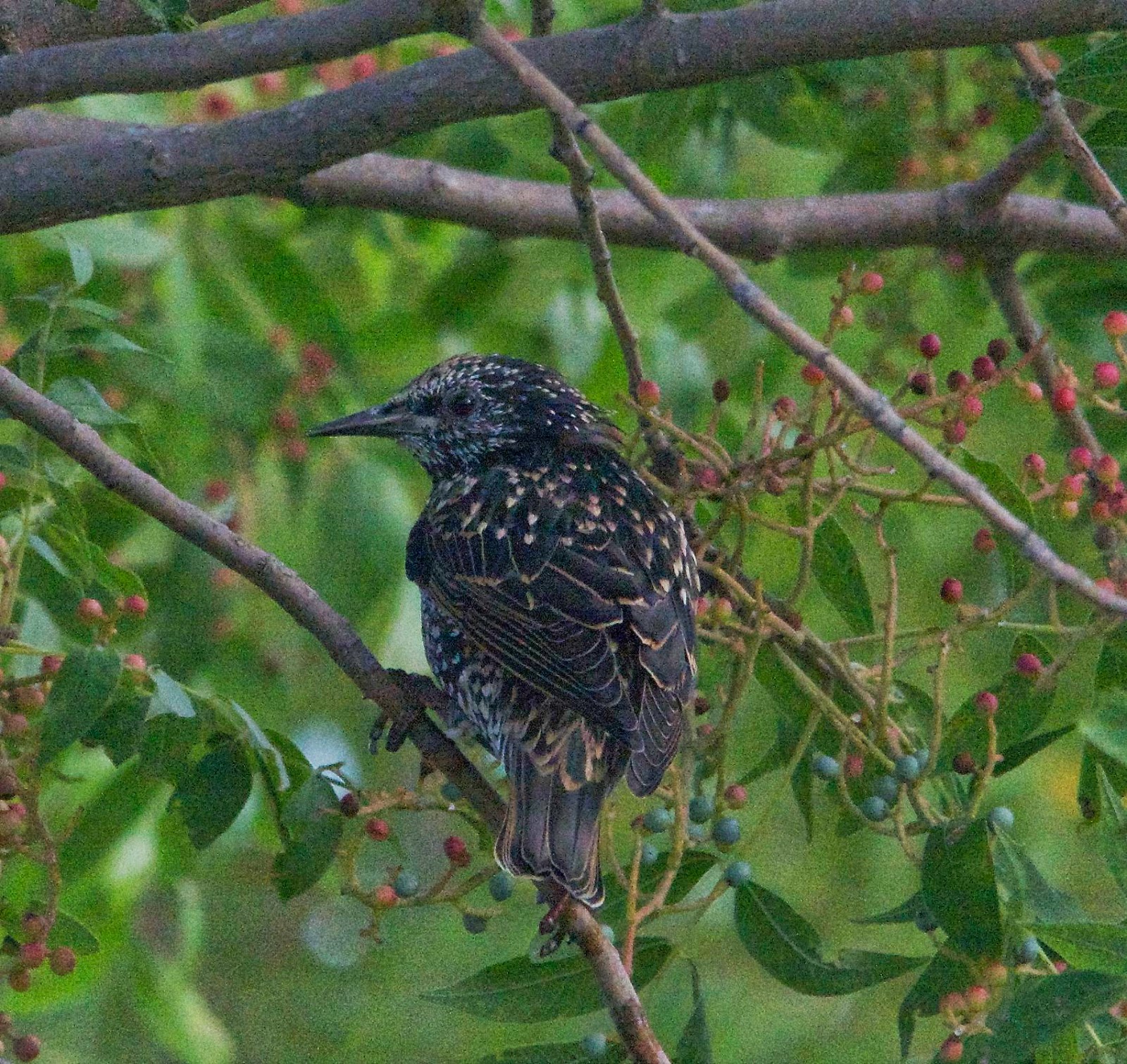
European Starling

Blue Jay

Eastern Kingbird

Ditto

Blue Jay

Very Thin Juvenile Blue Jay with Brown Thrasher

Juvenile Blue Jay

Juvenile Scissor-tailed Flycatcher

Great Egret in Flight

Great Egret with Crawdad

Close Up

Great Egret

Ditto, In Flight

Ditto

Great Egret

Tufted Titmouse

Carolina Chickadee

Male Northern Cardinal

Great Egret on 09-12-14

8 Cattle Egrets on 09-12-14
0730-1230/Mostly Cloudy/10-15 mph winds
It has been quite a while since I've been out, as you can see. Fall Migration is underway and the
hawks are also visiting the lake during the mornings. They should also be out later in the day, too.
Plenty of Yellow Warblers and the American Goldfinch are enjoying the fall offerings at the lake,
nyjer(thistle), as well as plenty of sunflower seeds and nectar, too. There are young Red-bellied woodpeckers, which are preceded by their calls. Get out and enjoy!
Subscribe to:
Posts (Atom)