Sunday, August 12, 2018

Saturday, August 11, 2018
Oklahoma Breeding Bird Species Profile: Purple Martin
One of the most remarkable birds that many of you are acquainted with is the fascinating Purple Martin, the largest swallow in the United States.
Martins once nested in the wild, but human intervention and attraction led them to depend upon our generosity. These swallows used to be strictly east of the Rockies, but are now moving west to spread their pest control services.
Scouts, or elders, will seek communal areas usually in February or March in Oklahoma, then set up shop soon thereafter and wait for other potential members to fill the space. The group will be unrelated, but many of the young birds will return to the area where they were hatched and raised. The scout probably raised young there the year prior, and sometimes migrants will use the house for a rest stop. The eventual colony could have adults, subadults, and hatch year birds.

Juvenile Purple Martins
Oklahoma 2015
The Purple Martin Conservation Association keeps excellent records on when scouts arrive all over the country, and all landlords and enthusiasts are invited to complete a survey to improve records at https://www.purplemartin.org/research/88/purple-martin-survey/
We are grateful for our birds on Boomer Lake in Stillwater, OK, as they are some of the best pest control specialists. If anyone has martin houses, they will eradicate mosquitoes, gnats, no-see-ums, and many other undesirable insects. The key is to never use pesticides around these birds or any others. If planting trees, shrubs, or other native plants in your area, also keep herbicides out of the equation. These chemicals kill birds, bats, bees, and other pollinator species.

Adult Female Purple Martin, 2015
There are roosts in downtown Tulsa where martins will assemble from mid-June to early September and have been doing so for many years. The roosts number into five figures until the birds head south, usually to Mexico or South America. Most of them return to Brazil.
The Purple Martin Conservation Association will provide advice on the website for the best places to set up apartment houses and gourds, which need to be near water and in open areas to keep predators at bay. Baffles are also necessary to have on the posts to keep snakes, raccoons, and other egg- and nestling-eating animals away.
During the early spring of 2018, while monitoring Boomer Lake for birds, what martins had arrived were creating a ruckus and two were over my head. Upon soon approaching one of the many houses, a Cooper's Hawk was atop it, which was chased away. Wouldn't you know a few days later, the resident swallows, removed it themselves, hot on its tail. To my knowledge, the hawk never returned. They are quick studies, which should keep this species well qualified in survival techniques.

Adult Male Purple Martin, 2015
Thursday, August 9, 2018
Oklahoma Winter Bird Profile: Rusty Blackbird
Known as a bird with a light iris, the Rusty Blackbird is uncommon and can be found in Oklahoma in winter, if you are lucky. Though drab and a loner, they once darkened the skies, much like the now extinct Passenger Pigeon.
A breeding bird of the boreal forest, this blackbird has been declining in population since the middle of last century for unestablished reasons. One possibility is the loss of habitat in wintering regions in the southeast, where most of the species is located during that time.
Birds of the northeast have been showing high concentrations of mercury, not unusual where coal happens to be a source of heat and powering electrical plants. If that fossil fuel becomes reestablished, chances are good that it will destroy the remaining populations, unless it relocates itself elsewhere.
Rusty Blackbirds forage on the ground and will wade in water in order to turn over leaves and twigs while seeking insects, which could also have high mercury concentrations. Some of Oklahoma's lakes and other larger bodies of water can be suspect, especially around the Sooner Lake power plant, which is still partially coal fired.

Rusty Blackbird
Boomer Lake Park, 2016
Logging in the winter ranges around bogs, fens and other wet methane reaches of spaghnum moss, the mechanical sound of a rusty hinge can be heard. This is the sound of the Rusty Blackbird, which was once ubiquitous at the turn of the 1900s.
Climate change is no doubt playing a part in the loss of this population. The rain comes and goes, their favorite invertebrates choked out by their loss of habitat, excess heat and cold, or any other negative effects. Either their food departs for cooler or warmer climates as the seasons change, or they migrate to possibly even less favorable conditions.
Acid rain is likely another suspect in some of this mystery, because it was caused by the combustion of fossil fuels. It is due to the emission of sulfur dioxide and nitrogen oxides. Also, we must look at the effects of toxic algal blooms, which destroys ecosystems that these birds favor, and that's where pesticide runoff will accumulate, which can also kill the inhabitants of these systems. A stronger case is the Dead Zone in the Gulf of Mexico, which is spreading to their wintering areas.
What is most necessary is the preservation of crucial wetlands, less disturbance, and more birders to seek out their habitats and report their findings to the International Rusty Blackbird Working Group during select spring migrations and on eBird.
In the winter, the rusty seeks pine seeds, acorns, and whatever available fruit it can locate.
They can be found on edges of lakes or ponds, in pecan orchards, agricultural areas, flooded forests, swamps, flooded roadside ditches, and the like.
Rusty Blackbird(s) have been seen during most winters at Sanborn or Boomer Lakes from 2013-2018.
Wednesday, August 8, 2018
Oklahoma Breeding Bird Species Profile: Burrowing Owl
One of the most fascinating birds to observe is the Burrowing Owl. A creature of distinct personality with much vitality and liveliness, this is truly a raptor that anyone would like.
These little owls are uncommon and localized. They are found in flat, open areas, including short grass prairie. They often reside with prairie dogs and ground squirrels, who dig their own burrows.
They hunt for small rodents, like mice and voles, and also enjoy insects and lizards. Unless they are breeding or have young, they are solitary animals.

Burrowing Owls
Keys, OK 2017
What few groups there are reside year round in Florida, Texas, the Oklahoma panhandle, New Mexico, southern California, and Mexico. Some will also migrate to portions of the west and even to southwest Canadian provinces.
The biggest enemy of the Burrowing Owl is loss of habitat. Many prairie dogs were lost in the 1920s due to rampant pesticide use, which took away one of the owl's symbionts.

Through extensive research, enemy mammals of the species were found, and it was also discovered that they did well with manmade burrows. Cameras are placed in and around these surrogate living spaces, which has shown scientists the hatching of their young and their private lives as a species.
Both male and female adults are the same size. They are about ten inches tall and weigh roughly six ounces. They are diurnal, and are found both on the ground or atop fence posts. They use dung both in the burrows and around them to attract insects, which are used for food. Known by some as the howdy owl, these birds sometimes appear to be nodding as a form of greeting.
Some Burrowing Owls even nest within manmade areas of cities, such as Tucson, Arizona.
There are two subspecies, Florida and the Western. They are not difficult to tell apart, due to range, as well as the physical characteristics. The adult Florida has a streaked crown and is darker brown with white spots.
What subspecies is this owl?

Burrowing Owl
2018
Tuesday, August 7, 2018
Oklahoma Breeding Bird Species Profile: Fish Crow
A coastal corvid that favors waterfronts on the eastern and southern coasts, the Fish Crow comes inland more often as the years pass. The only way to really know the difference between this crow and the American Crow, is the higher pitched voice, and it tends to vocalize what sounds like "nuh-uh." It is also a little smaller than the American Crow, but unless the two are next to one another, it is impossible to tell, unless the voice comes into play. Juvenile American Crows can be heard from late spring through August to September, and they can sound like an adult Fish Crow. They usually tend to be near a nesting site with adults in the area.
Less widespread than its larger cousin, who will summer in Canada, it doesn't fear humans and is frequently found in semisuburban regions. It is also more tolerant of being photographed. If actually compared between the two species the legs are shorter and the upper feathers have more pronounced body to them. There is also a distinctive hook to the bill. The tail is slightly longer and they seem to hover and soar more than the American Crow would. If observed in flight and on foot, it appears to have a boa around the neck through posturing of the body. Feathers also appear glossier, with a greenish or blue tinge.
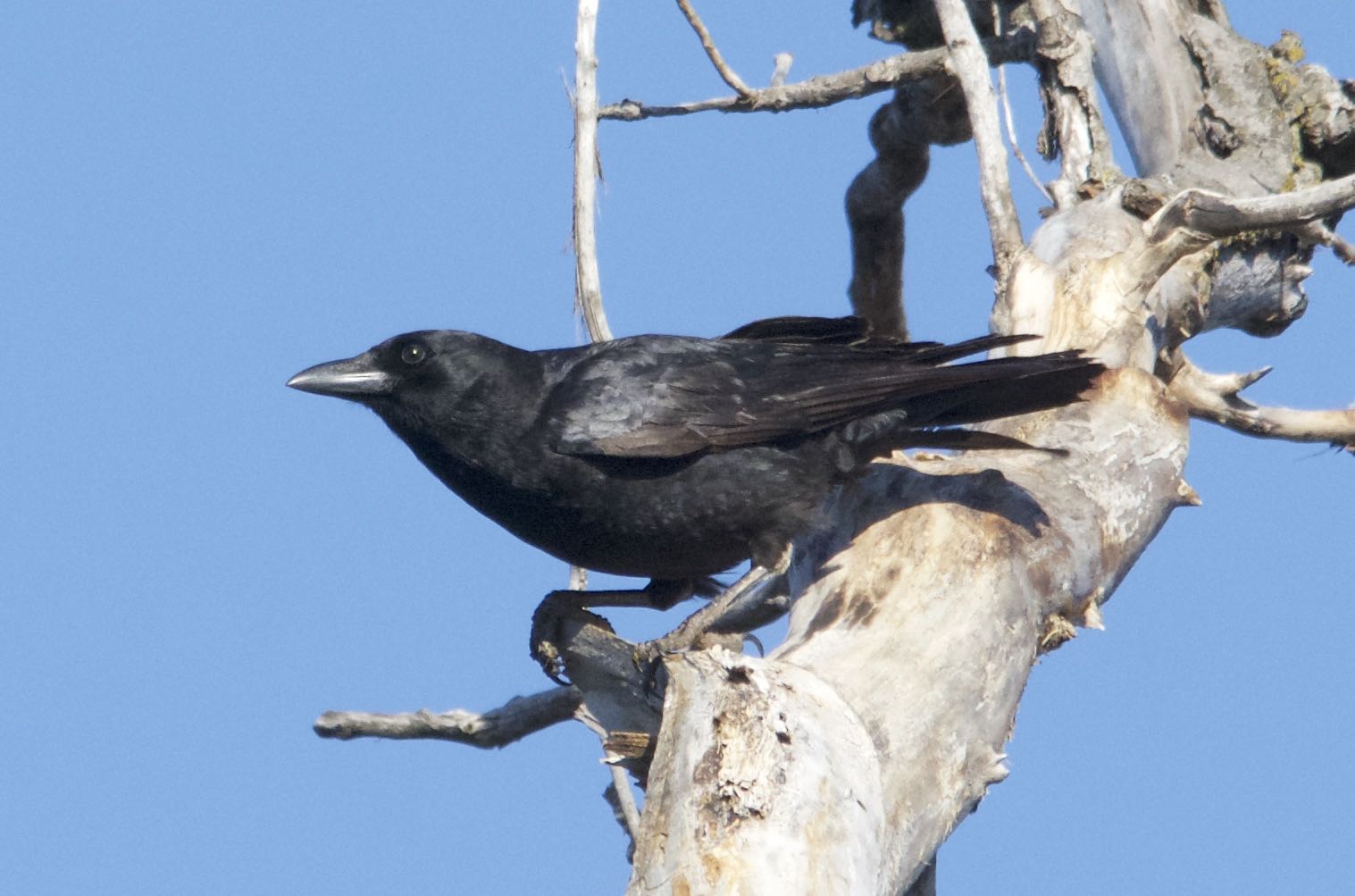
Boomer Creek
March 2016
Expect them to be in areas where known heron rookeries are present, for they enjoy their eggs and nestlings, which is likely why they are found in Stillwater frequently during heron nesting season. They cluster around Meridian Technology, Sanborn Lake, and Boomer Lake Park.
They appear to be showing range expansion in both the north and east, and they tend to breed from April through June.
Monday, August 6, 2018
Oklahoma Breeding Bird Species Profile: Snowy Egret
A common heron of Oklahoma, the Snowy Egret was once a victim of human selfishness. During the early 1900s, its feathers were taken for the millinery (hat) trade. Through the Migratory Treaty Bird Act of 1918, taking any birds or bird parts, which included feathers, saved the life of this bird, as well as the remainder of the herons and egrets.
This beautiful heron is utterly spectacular in adult breeding plumage. It has an air of mystery about it, and it is truly a graceful animal, appearing delicate and similar to royalty . The species nests in island trees, as well as single trees growing in water. Some will forage for food in open water where there is plenty of room, while others prefer solitary foraging. The species breeds on the coast or inland where there are lakes, estuaries and other appropriate bodies of water.

Snowy Egret
High Breeding Plumage
High Island, Texas
The medium sized adult birds have bright yellow feet, which will become orange or red-orange during times of high breeding plumage, its plumes or aegretta, will stand up and they will run from the head, the breast, down the back, and curve upward at the tail.
Enemies are snakes, raccoons, the Fish Crow, and sometimes even the older nestmates. The youngest usually does not survive due to the aggressiveness of its siblings. They are incubated as the eggs are laid, so the youngest could be a week junior to the eldest.
One of the classics that this bird is known for, is its feeding technique. It was born with its own personal fishing lures, which are the yellow feet. When the snowy is foraging it will use its feet in a rakelike manner or move them upward and in a circular motion to drawn food skyward. It will then easily take its prey from the top of the water.

Snowy Egret
nonbreeding Plumage
Known as the Bird With the Golden Slippers, the Snowy Egret gives the impression of an ethereal nature, especially in breeding plumage. To make them even more interesting, they have a "wah-wah-wah" call which almost sounds like a gurgling, and that clearly designates a Snowy Egret colony.
Many of these wading birds will overwinter on the Gulf coast, but good numbers will also go as far as central Brazil. It all depends upon where they settle pre-breeding that determines post-breeding locale.
Oddly enough, in the 1830s, this bird was nesting as far north as New Jersey, and by the mid-1800's, it was at the Great Salt lake. As time progresses in the global warming situation, they could well become northbound once again. It will all depend on the survival of their preferred food sources.

Snowy Egret
Texas
January 2017
Sunday, August 5, 2018
Oklahoma Breeding Bird Species Profile: Warbling Vireo
Happy-go-lucky and charismatic, the nondescript Warbling Vireo is just that, a mesmerizing singer. If one travels edges of riparian birding venues, if your mood is poor, it won't be for long. This bird has a wanton and uplifting sound quality that will keep anybody wanting more of it. Many have hoped that a family will just happen to choose a nearby tree for nesting purposes, just for the joyful sounds that will constantly come from the vicinity.
Favoring cottonwoods and aspens, this loner gleans insects from mid- to upper-story levels. However, if a young member of the family has recently fledged, the entire family goes along for the ride. This is a common breeding bird of most of the country, yet many never get to see it for long, as it is always on the move within the leaves, just like its quarry.
The nest is much more a work of art than the remaining vireos in Payne County. It is usually high in its tree of choice, well sheltered by a leaf canopy. They are in the slenderest of branches in a fork that they can find, usually in an area that no predator can safely alight near the top of the tree. However, in recent years, one nest was located where the tree was in a gully, so it was nearly at eye level.

Warbling Vireo Nest
Photographed January 2017
A pair was met shortly after they arrived in early spring a couple of years ago. The two stayed in close proximity and foraged together, but they both made themselves quite available for photos. I believe that the male could have been courting the female, as he did a great deal of fluttering about and she remained rather cool to his behavior.

Male Warbling Vireo
After the young fledge, they are very light colored, and they sound nothing like the parents, giving an odd, non-descript single note. This was what drew me to them, the color and the sound that emanated from the fledgling. The parents were constantly feeding the young, which were always on the parent's tail. Try as I might, I was unable to get a good photo of the young, as they were darting about so quickly.
This family unit was observed in July of 2018. They disappeared from the nesting area about a week later, but it is believed that they still reside in the area. Several pair were noted in a mile-and-a-half region.

Female Warbling Vireo
Subscribe to:
Posts (Atom)