Showing posts with label Oklahoma. Show all posts
Showing posts with label Oklahoma. Show all posts
Saturday, May 22, 2021

Saturday, August 11, 2018
Oklahoma Breeding Bird Species Profile: Purple Martin
One of the most remarkable birds that many of you are acquainted with is the fascinating Purple Martin, the largest swallow in the United States.
Martins once nested in the wild, but human intervention and attraction led them to depend upon our generosity. These swallows used to be strictly east of the Rockies, but are now moving west to spread their pest control services.
Scouts, or elders, will seek communal areas usually in February or March in Oklahoma, then set up shop soon thereafter and wait for other potential members to fill the space. The group will be unrelated, but many of the young birds will return to the area where they were hatched and raised. The scout probably raised young there the year prior, and sometimes migrants will use the house for a rest stop. The eventual colony could have adults, subadults, and hatch year birds.

Juvenile Purple Martins
Oklahoma 2015
The Purple Martin Conservation Association keeps excellent records on when scouts arrive all over the country, and all landlords and enthusiasts are invited to complete a survey to improve records at https://www.purplemartin.org/research/88/purple-martin-survey/
We are grateful for our birds on Boomer Lake in Stillwater, OK, as they are some of the best pest control specialists. If anyone has martin houses, they will eradicate mosquitoes, gnats, no-see-ums, and many other undesirable insects. The key is to never use pesticides around these birds or any others. If planting trees, shrubs, or other native plants in your area, also keep herbicides out of the equation. These chemicals kill birds, bats, bees, and other pollinator species.

Adult Female Purple Martin, 2015
There are roosts in downtown Tulsa where martins will assemble from mid-June to early September and have been doing so for many years. The roosts number into five figures until the birds head south, usually to Mexico or South America. Most of them return to Brazil.
The Purple Martin Conservation Association will provide advice on the website for the best places to set up apartment houses and gourds, which need to be near water and in open areas to keep predators at bay. Baffles are also necessary to have on the posts to keep snakes, raccoons, and other egg- and nestling-eating animals away.
During the early spring of 2018, while monitoring Boomer Lake for birds, what martins had arrived were creating a ruckus and two were over my head. Upon soon approaching one of the many houses, a Cooper's Hawk was atop it, which was chased away. Wouldn't you know a few days later, the resident swallows, removed it themselves, hot on its tail. To my knowledge, the hawk never returned. They are quick studies, which should keep this species well qualified in survival techniques.

Adult Male Purple Martin, 2015
Sunday, August 5, 2018
Oklahoma Breeding Bird Species Profile: Warbling Vireo
Happy-go-lucky and charismatic, the nondescript Warbling Vireo is just that, a mesmerizing singer. If one travels edges of riparian birding venues, if your mood is poor, it won't be for long. This bird has a wanton and uplifting sound quality that will keep anybody wanting more of it. Many have hoped that a family will just happen to choose a nearby tree for nesting purposes, just for the joyful sounds that will constantly come from the vicinity.
Favoring cottonwoods and aspens, this loner gleans insects from mid- to upper-story levels. However, if a young member of the family has recently fledged, the entire family goes along for the ride. This is a common breeding bird of most of the country, yet many never get to see it for long, as it is always on the move within the leaves, just like its quarry.
The nest is much more a work of art than the remaining vireos in Payne County. It is usually high in its tree of choice, well sheltered by a leaf canopy. They are in the slenderest of branches in a fork that they can find, usually in an area that no predator can safely alight near the top of the tree. However, in recent years, one nest was located where the tree was in a gully, so it was nearly at eye level.

Warbling Vireo Nest
Photographed January 2017
A pair was met shortly after they arrived in early spring a couple of years ago. The two stayed in close proximity and foraged together, but they both made themselves quite available for photos. I believe that the male could have been courting the female, as he did a great deal of fluttering about and she remained rather cool to his behavior.

Male Warbling Vireo
After the young fledge, they are very light colored, and they sound nothing like the parents, giving an odd, non-descript single note. This was what drew me to them, the color and the sound that emanated from the fledgling. The parents were constantly feeding the young, which were always on the parent's tail. Try as I might, I was unable to get a good photo of the young, as they were darting about so quickly.
This family unit was observed in July of 2018. They disappeared from the nesting area about a week later, but it is believed that they still reside in the area. Several pair were noted in a mile-and-a-half region.

Female Warbling Vireo
Saturday, August 4, 2018
Sunday, March 25, 2018
Put Hackberry Flats in Tillman County, OK On Your Birding List
03-24-18 Hackberry Flats WMA/Tillman County, OK
1037-1600 hrs./69-82 F/partly cloudy
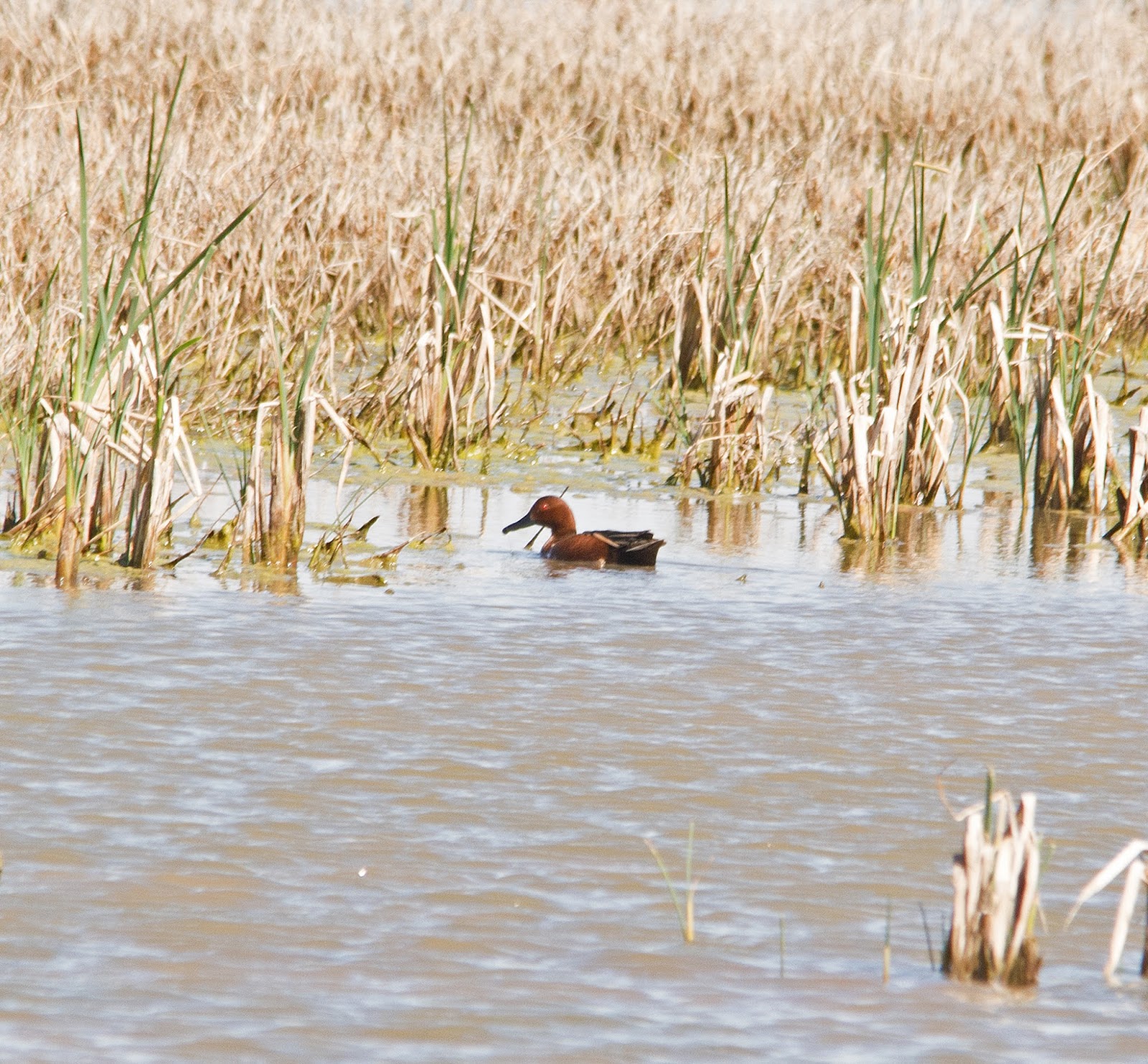
Male Cinnamon Teal

Eared Grebe Approaching Breeding Plumage

Eared Grebe (Front) Showing Size
Difference in Comparison to Ruddy Duck

Cinnamon Teal Showing Characteristic
Speculum Coloring

Juvenile White-crowned Sparrow
(Last Year's Late Hatch)

Golden Eagle (Larger Bird)
03-25-18 Boomer Lake Park, Stillwater, OK
1127-1239/53-29 F/partly to mostly cloudy/E-13/75-72% RH/29.87-29.91 Hg and steady

Franklin's Gulls Highlighted Among
Ring-billed Gulls

Franklin's Gull (Second Plumage View)

Five Franklin's Gulls Showing Plumage Attributes
Hackberry Flats is the first set of photos, followed by three photos of Franklin's Gulls the following day.
Hackberry is about four hours from Stillwater, unless one chooses Rte. 44, which we did not do on the way. Consequently, we got there on the late side, but that could well have worked in our favor.
We had an exemplary day, as we observed several things of interest, but we were unable to locate a Snowy Plover which had been reported for a couple of days.
Not only did we see a Great Horned Owl at 1500 hrs. on an electrical pole, we managed a Golden Eagle, also observed on an electrical pole. We both got shows of its underside, which proved beyond a shadow of a doubt what we had. As a matter of fact, this is such a rare record, because the only other sightings listed on eBird were two others in February 2017.
It was an outstanding day, as many shore/water/wading birds tend to change as often as teens change their clothing. For that reason we visited the waterways a few times in order to maximize what we could list on eBird.
Leaving the Stillwater residence, I was not expecting such a spectacular day, since barometric pressure was flat, but all in all, the four hour drive was well worth it.
It was my first time at Hackberry, as it was another birder's, but the third person had been there before.
Do I recommend this location? Absolutely! It is hard to plan great birding, especially if one has never been to a location, but it was encouraging due to the fact that this is a wetland. It is in
pristine condition, which makes it a good spot for wildlife, knowing that it remains unspoiled by humanity.
Friday, October 20, 2017
Sunday, June 19, 2016
The Saga of the Green Heron Clan


Friday, 06-17-16
0655-0830 hrs./76-83 degrees F/sunny/10 mph SE winds/ 83% RH
Another sweltering day in the neighborhood, due to extreme humidity. The sun was
beating on me and the Green Herons, but we kept with the photo shoot for as long as we could.
An adult eventually took three youngsters out of the four to learn about surviving life as a
Green Heron, but the baby stayed here.
All the juvenile birds were up and about before my arrival for the past several days developing
a solid routine. Since all good things must come to an end, we probably won't be seeing a lot of
these juveniles any more, as they will remain out on their own for the most part.
The next part of the journey will be clutch #2, when the time has arrived for the rest of the 2016
Saga of the Green Heron clan.
Friday, June 17, 2016
Here's Looking at You, Kid: Day 8 with the First Family of 2016

Green Heron Chicks in a Row
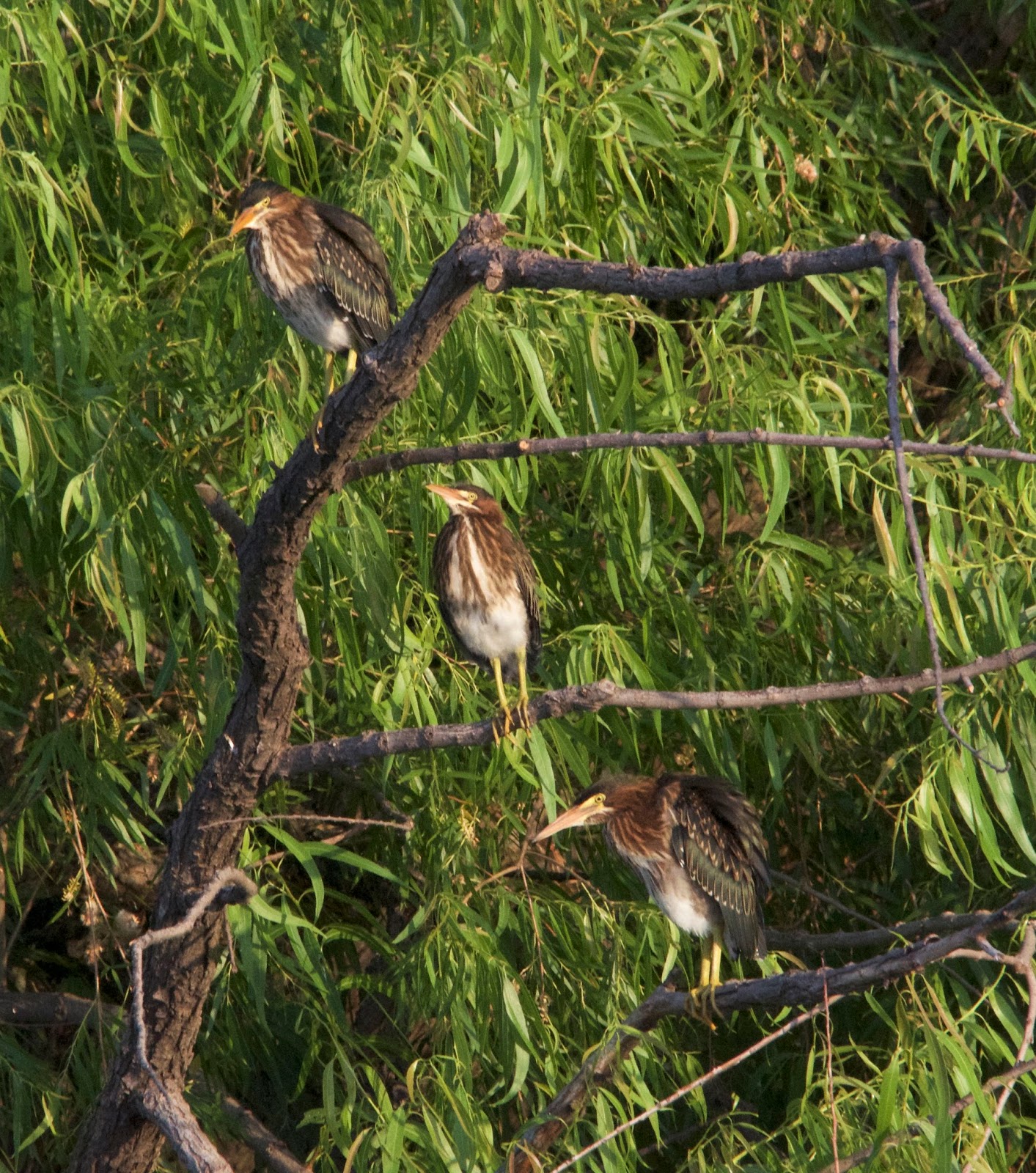
Three Green Heron Chicks on a Diagonal

Two Juveniles(Left) Stirred Up By Adult(Right)

"Strike Up a Pose"

Adult Green Heron

Juvenile Green Heron

Juvenile Green Heron

Juvenile Green Heron

Last Born Green Heron Juvenile of June 2016

Adult Green Heron

Juvenile Green Heron

Same Bird as Above
06-16-16
As can be observed, the chicks are getting older. I believe that the youngest is the only one
now showing any downy tufts of feathers on the head. They're all progressing nicely, a good
early group. Chances are excellent that we could easily see three clutches from this family
during the summer, if good weather holds out and plenty of food is available.
Today the oldest bird left the younger ones on their own, returned for the other two, and only
the baby remained.
Birds are still very astute to their surroundings and miss nothing going on around them, a great
necessity for longevity. The other is a strong will to survive, to which the baby is still a little
lacking in this regard.
However, they are all foraging well, and with time, all good things will happen for the First
Family of 2016.
Thursday, June 16, 2016
Day 7 with the Green Heron Family


Last Born Green Heron Chicks


All four Green Heron Chicks!

Three Out of Four Green Heron Chicks


Second and Third Born Green Heron Chicks


06-15-16
0650-0800 hrs./76-80 degrees F, feels like 86/sunny/10 mph S winds/82% RH
This was an excruciatingly hot day, but these neotropical migrants are used to heat, even
newly born birds, as it is genetic. Again, the oldest went of with a parent, and the rest
of the young ones stood by to wait for their return. Here's what they did, as today was a
day of observation for the younger birds.
These juveniles take in everything that they see, no matter what it is. Larger birds are a
perceived threat, and smaller birds and insects are a sight of curiosity. It may appear in the
photos that these little ones are really doing nothing, but they are taking in a lot of information,
which prepares them for their future as an adult, IF they make it that far. Half of the baby birds
don't survive their first season, as migration takes a toll on their bodies.
Wednesday, June 15, 2016
Green Heron Chick Growth Process


06-13-16 Day 5
0657-0838 hrs./73-75 degrees F/cloudy/light and variable winds/86% RH
Since these are all topical, I have refrained from naming the species. Also for this reason, it had
been cloudy and there was a good chance for rain, so I took the best of these shots obtained.
Possibly in view of the weather as well, all the Green Herons did was just sit around.


06-14-16
0655-0839 hrs./incremental cloudiness/10 mph southeast winds/87% RH
This was another cloudy day, where the sun was in-and-out, mostly in. It was a relatively quiet
day, but a parent took the two eldest birds away from the cove. There was an attempt to locate
them in the area, but it was not possible to determine their whereabouts. The two youngest birds stayed together in the area for about half an hour, then the youngest left the area, running up a limb to the nest tree.
Fortunately, it was a good day in that a good photo of three of the Green Heron chicks could be
obtained together. This gives one an approximate idea on how they are aging, especially when one notes the lessening of downy feathers upon their heads as they get older. It is even possible for the
layperson to determine which birds are the oldest.
Subscribe to:
Posts (Atom)