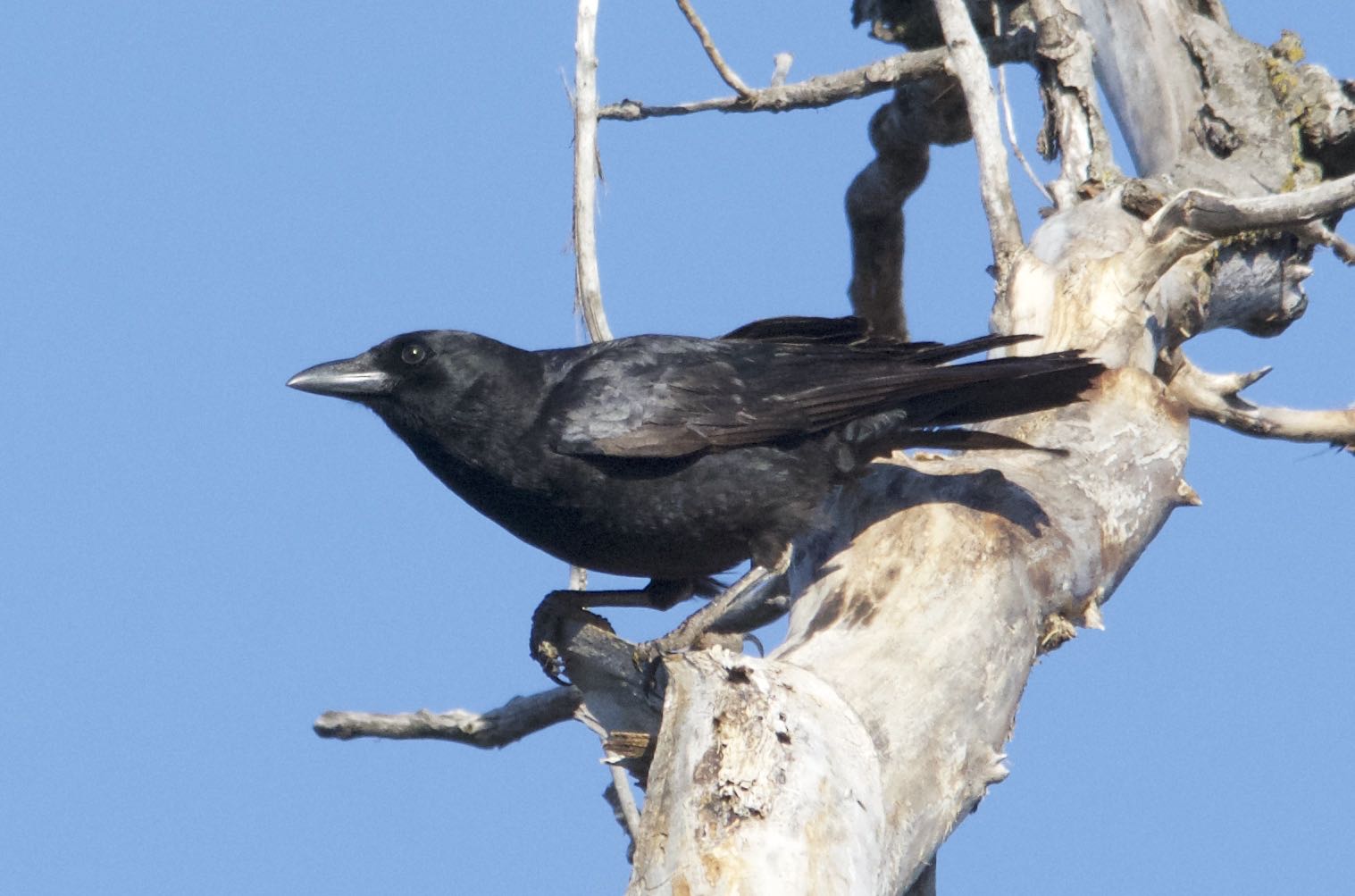
A coastal corvid that favors waterfronts on the eastern and southern coasts, the Fish Crow comes inland more often as the years pass. The only way to really know the difference between this crow and the American Crow, is the higher pitched voice, and it tends to vocalize what sounds like "nuh-uh." It is also a little smaller than the American Crow, but unless the two are next to one another, it is impossible to tell, unless the voice comes into play. Juvenile American Crows can be heard from late spring through August to September, and they can sound like an adult Fish Crow. They usually tend to be near a nesting site with adults in the area.
Less widespread than its larger cousin, who will summer in Canada, it doesn't fear humans and is frequently found in semisuburban regions. It is also more tolerant of being photographed. If actually compared between the two species the legs are shorter and the upper feathers have more pronounced body to them. There is also a distinctive hook to the bill. The tail is slightly longer and they seem to hover and soar more than the American Crow would. If observed in flight and on foot, it appears to have a boa around the neck through posturing of the body. Feathers also appear glossier, with a greenish or blue tinge.
Boomer Creek
March 2016
Expect them to be in areas where known heron rookeries are present, for they enjoy their eggs and nestlings, which is likely why they are found in Stillwater frequently during heron nesting season. They cluster around Meridian Technology, Sanborn Lake, and Boomer Lake Park.
They appear to be showing range expansion in both the north and east, and they tend to breed from April through June.
Late April to early May is the time of year to be hearing that classic call around the Kentucky coffeetree, ficus, and willow thickets of central Oklahoma, as long as we are near water and dense shrubby ground.
Male Bell's Vireo In Ficus Tree
The adult male is first in his territory, calling at the tops of trees. He will establish an acre to two acre territory, which he will share with a mate and his young. Song is constant over a two week period after spring arrival in mid-May, until female arrives and this is followed by a short courtship period, where song is still at a fairly high rate. Several nests are built, including dummy nests to detract the Brown-headed Cowbird, who lays in wait for the first month in order to locate and predate the chosen nest. Nests have been easy to find, as the songs continue and become faster in tempo at this location. When eggs have been laid, the song wanes and then occurs much less often.
Female Bell's Vireo with Nesting Material
This species boasts four subspecies, the Eastern, Western, Arizona, and the intermediate West Texas birds. The Eastern are brighter yellow and olive with a shorter tail than the western, and will bob the tail. The Westerns flip the slightly longer tail up and sideways, in the gnatcatcher fashion. Western populations are divided into the California, or Least Bell's Vireo, and the Arizona race.
These shy birds are uncommon and declining, and are generally solitary, unless breeding. The species is very territorial, and stays low within vegetation. They feed upon larvae and insects.
They have never been observed drinking water, which could be provided by their choice of food, as well as during the bathing process.
The species has an elaborate repertoire of calls ranging from about a second to nearly five seconds. Naturally this includes the alarm call, a threat-in-area notification, morning and approaching night songs, nestbuilding, intrusion, courtship, and several others. For the Female Songbird Project, the female has been heard to produce a short answer call. The purpose of this designation appears to be for male and female communication is the absence of either vireo. This is very similar to the same practice of the Northern Cardinal, which is well known to all birders.
Courtship is an interesting affair, as the male perches and calls for anywhere from a week or two, then suddenly, a female appears. This was the first time that it was learned that females have a singing voice, as she would answer from the nest spot. She would rarely show herself and even when young were fledging, a young bird was usually seen before she was.
Bell's Vireo with caterpillar
There is no sexual dimorphism in the species, and the female is clearly the submissive bird. It is always the male that initiates attack toward intruding birds. The Northern Cardinal is no threat, Mourning Doves are ignored, as are both Baltimore and Orchard Orioles, as well as the Red-winged Blackbird. Carolina Chickadees are chased and driven from the area.
Nests are well concealed by dense foliage, and are usually no more than three feet from the ground. They are never seen near the trunk, but are located upon the ends of lateral forks, which can easily be seen in the fall or winter.
In good years, two broods are possible. If there is any human disturbance, such as construction, birds will relocate and if early enough in the season, they will renest. Light pole construction was done in June of 2018, and the family relocated in a southerly direction, but it is uncertain if there was a new nest.