Monday, May 7, 2018

Sunday, May 6, 2018
Birding On a Shoestring: The American Southwest via Southeast Arizona part 2

Gambel's Quail

Magnificent (Rivoli's) Hummingbird

Pink Sided Dark-eyed Junco

Gray headed Dark-eyed Junco

Canyon Towhee

Wilson's Warbler

Acorn Woodpecker

Mexican Jay

Plumbeous Vireo

Cactus

Broad-billed Hummingbird

Violet-crowned Hummingbird

Western and Clark's Grebes

Western Grebe

Clark's Grebe

Black Phoebe

Male Lazuli Bunting


Cassin's Kingbird
Many of these were taken in Madera Canyon, as well as in Patagonia, both in Santa Cruz
County, southeast AZ. Most of the western and southwestern subspecies are clearly different,
very noticeably this grayer version of House Wren. The eastern subspecies is clearly more colorful,
but it will blend in better in this ecoregion.
Also observe how the Cassin's Kingbird differs from the Western Kingbird. It just has a white stripe
at the bottom of the tail, unlike the western, which has white on both sides of the tail.
Both the Clark's and the Western Grebes are much bigger than the ones that come from Central OK.
This is a lovely view of the breeding plumage for both. They can even interbreed, and the intergrade shows interesting characteristics, such as the black on the head. One side of the head can look like the western species and the other side can dominate with the headdress of the Clark's species.
There are also different towhees and juncos, all of whom are lumped into the sparrow family. Not all of them can be seen in spring, but there are more species in the winter.
Arizona is also the hummingbird capital of the world, but again, they all cannot be observed at the
same time of year OR the same elevation. For example, the Violet-crowned Hummingbird nests in
a very limited part of the southeast, and it is very rare and local in cottonwoods and sycamores.
As you can see, Gambel's Quail is much different than the Northern Bobwhit , and even less well known are the Montezuma and Scaled Quail, both of which are interested in different ecosystems.
Hopefully, you have enjoyed what some of Arizona has to offer in the winter, spring, and summer
even though it is spring now. Stay tuned for part 3.
Saturday, May 5, 2018
Birding On a Shoestring: The American Southwest Portrayed By Assorted Animals

Wilson's Warbler

Northern Rough-winged Swallow

Cinnamon Teal Pair, Male on L

White-faced Ibis Fishing
One in Front Has a Frog

Great-tailed Grackle

Male Vermilion Flycatcher

Female Vermilion Flycatcher
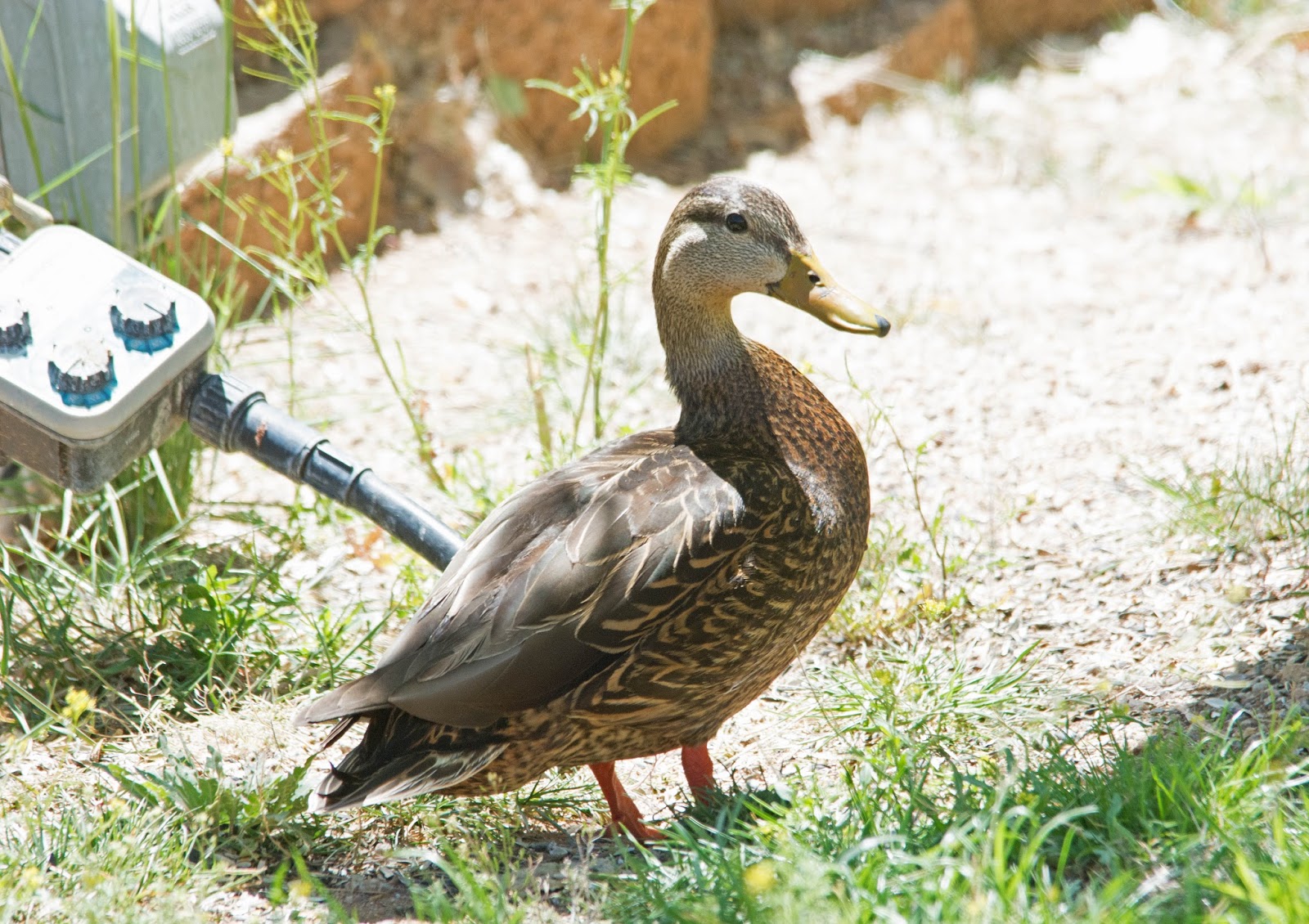
Female Mexican Mallard

Male Gila Woodpecker
Arriving in Tucson, AZ early in the day left a little time for birding, so we managed to
spend an afternoon at the Audubon Mason Center. Unfortunately, I was unable to get the Cactus
Wren there, but that came about a week later, which you'll see soon. This foray from April 19-May
3rd kept us on the run, sometimes rising as early as 0400 to get a jump on travel in order to be an
early birder for the early rising sun, which was at 0600 hrs. AZ does not use daylight saving time, which meant that we were usually awake two hours earlier than normal, and we were on Mountain
Time. Unfortunately, I was still on Oklahoma's daylight savings Central Time the entire trip.
The top photo of the Wilson's Warbler was at the Mason Center and the Gila Woodpecker was also seen there in the cactus scrublands.
The remaining photos were obtained on April 20th, when we drove nearly two hours south to Patagonia, which was in Santa Cruz County, where the remaining shots were taken.
There is much more to come, and I'll work on more photos tomorrow.
Birds and Zugunruhe, An Experience in Nature

Blue-gray Gnatcatcher

Carolina Wren

First Canada Goose Family of 2018

Male Brown-headed Cowbird

Scissor-tailed Flycatcher
First half of April 2018
Spring migration generally began at the appropriate time, but like everything else that is no
longer certain, the birds are playing a guessing game. Our avian friends have no choice is what
they do, for zugunruhe is a very strong urge. It is a great pull telling birds that they are going to
move and they have no control over this very strong call of nature. It is their call to move north, if
in our hemisphere, and there is nothing that they can do about it. The birds must go. Even birds that
are caged or trapped experience the same sensation, and they do try to fly away, even if they cannot.
Experiments have been done, even as far as turning their cages in directions that do not face north, south, east, or west. In the darkness in an inverted cone-shaped device with paper under them, birds still face the correct direction for their nonexistent flight.
Birds face many hazards during this flight. The Gulf of Mexico spans six hundred miles, and if the they have northern winds pushing them back, they must still fight the wind or land upon an oil rig if they run out of fat reserves in order the rest. Violent storms can force them down wherever they may be in transit, so they may or may not make it, possibly plunging into a watery grave. These animals have been known to hitch rides on boats or ships in order to complete their journey.
Nature is amazing, but it can be cruel. Juvenal birds survive this grueling journey about fifty percent of the time.
For the birds that do make it in one wave, this event is called a fallout and if any of you have been privy to this, birds will not move once they have landed, as they are so exhausted. They could land on South Padre Island, High Island or countless other places, even more inland.
The best thing to do is to let them rest so that they can refuel and continue their journey to their breeding grounds, as they only have a few short months to breed. Some birds travel from one end of the hemisphere to the other, so this is not a feat for the weak. Some of them sleep for a few seconds while their are still in flight, some do not even take the time to eat, even if they are able to stop.
For the young and old birds alike, one must congratulate them for their efforts. It is not an easy feat, and they do it twice a year.
Subscribe to:
Posts (Atom)