Translate

Saturday, May 14, 2016

Oklahoma's First Summer Birds Are Coming In


                                                                    Brown Thrasher


                                                                  Carolina Chickadee


                                                                     Eastern Phoebe


                                                                   Mourning Dove


                                                               Male Orchard Oriole
                                                                      1st Summer


                                                            Three-toed Box Turtle


These shots are a couple of days old.  The third wave of migratory birds is coming in, the
birds that were born last year.  They get the secondary territory, which goes in a general pecking order.  The top quality adult males, which are usually the oldest, come in from Central and South America first.  Most of them choose last year's territory if it provided what was needed last year.  A couple of weeks later, most of the adult females come into the area, and choose a mate, based on natural selection, as well as a choice territory.  Then last year's first year birds arrive to get what is left over.  The female Orchard Oriole pictured above is seeking a mate right now.  She was with another
female yesterday.

Oklahoma has two indigenous box turtles.  I have photographed both of them.  Besides the Three-
toed Box Turtle, we are also home to the Ornate Box Turtle.  There are also several other water
turtles, like the Red-eared Slider, the Snapping Turtle, and more that I'll try to locate.

Migration is still going strong, and once we get past this cold snap and the upcoming rain, we'll
see more of them.

Tuesday, May 10, 2016

The Birds of McCurtain County, Oklahoma, Including the Endangered Red-cockaded Woodpecker


                                                                         Tree Swallow


                                                                    Carolina Wren


                                                                  Great-tailed Grackle


                                                               Prothonotary Warbler


                                                                       King Rail


                                                              Brown-headed Nuthatch


                                                              Broad-winged Hawk


                                                             Yellow-breasted Chat


                                                                       White Ibis


                                                            Red-cockaded Woodpecker


                                                                American Alligator


                                                                      Tree Swallow


May 6 through May 10, 2016

These birds and the American alligator all hail from McCurtain County, Oklahoma, which is
in the southeast part of the state, just a hop, skip, and a jump from the Arkansas border.  This trip
had very strong possibilities for two of some of the rarest birds of the state, the Red-cockaded Woodpecker and Swainson's Warbler, both of which were seen.  However, I have no photo of the warbler.  I do hope to redeem myself with the Red-cockaded Woodpecker, which is rare all over the country, as well as an endangered species.

Also included in this package, is the King Rail, which is uncommon and local in the southern states.  Even more rarely, it will go quite far north, mostly in the central part of the country and the northeast
states.

McCurtain County also hosts a fairly sizable and diverse warbler population, though a good part of it is just temporary.  Most of these warblers were observed at Red Slough, as well as a few in Little River, most notably of course, the Swainson's Warbler.

The Red-cockaded Woodpecker was located in the McCurtain County Wilderness Area, and my knowledge on this bird was increased by being in the field with it as well as having excellent instruction through the Oklahoma Forestry Service, namely Clay Barnes, who I definitely hope to see
again, and gain additional knowledge through the state and the national wildlife refuges, all who do
a superb job in keeping our wildlife thriving.  I have seen naked nestling Red-cockaded Woodpeckers, as well as the eggs.

This is an experience that I will not soon forget, and I hope that you also enjoy what is here as seen through my eyes.

Thursday, May 5, 2016

Who Likes Baby Birds?


                                                            Fledgling Warbling Vireo


                                                               Yellow Warbler (Male)

                                                               
                                                                       Cedar Waxwing


                                                                        Green Heron


                                                            Fledgling Carolina Chickadee


                                                             Clay-colored Sparrows


50-72 degrees F/0700-1030 hrs./light and variable NW winds


As luck would have it, there were a couple of recently fledged(baby) birds that made it into my
viewfinder.  The first was the Warbling Vireo, and the other was the Carolina Chickadee.  Young birds
can be discerned by their yellow gape (bill area), so you can see that these were both youngsters.  They also have very short tails.

Green Heron was discovered bringing branches back to a nest site, so it was safe to say that the
herons are also having thought of procreating, too.  This will be the third year in this location for
the Green Herons, who don't normally colonize, but it certainly looks hopeful.

Cedar Waxwings are still in residence, and Boomer Lake has a large amount of mulberries, a favorite
of our neotropical migrants.  Until these birds have young, they will be eating fruit and returning to the nest with protein for the little ones, which makes them grow rapidly.

There are still plenty of Yellow Warblers and Yellow-rumped Warblers in the vicinity for your viewing pleasure, and there are more birds coming.

Wednesday, May 4, 2016

The World Through the Eyes of a Bird


                                                                  Great-tailed Grackle


                                                                  Western Kingbird


                                                               Yellow Warbler (Male)


                                                             Clay-colored Sparrow


                                                           Double-crested Cormorant


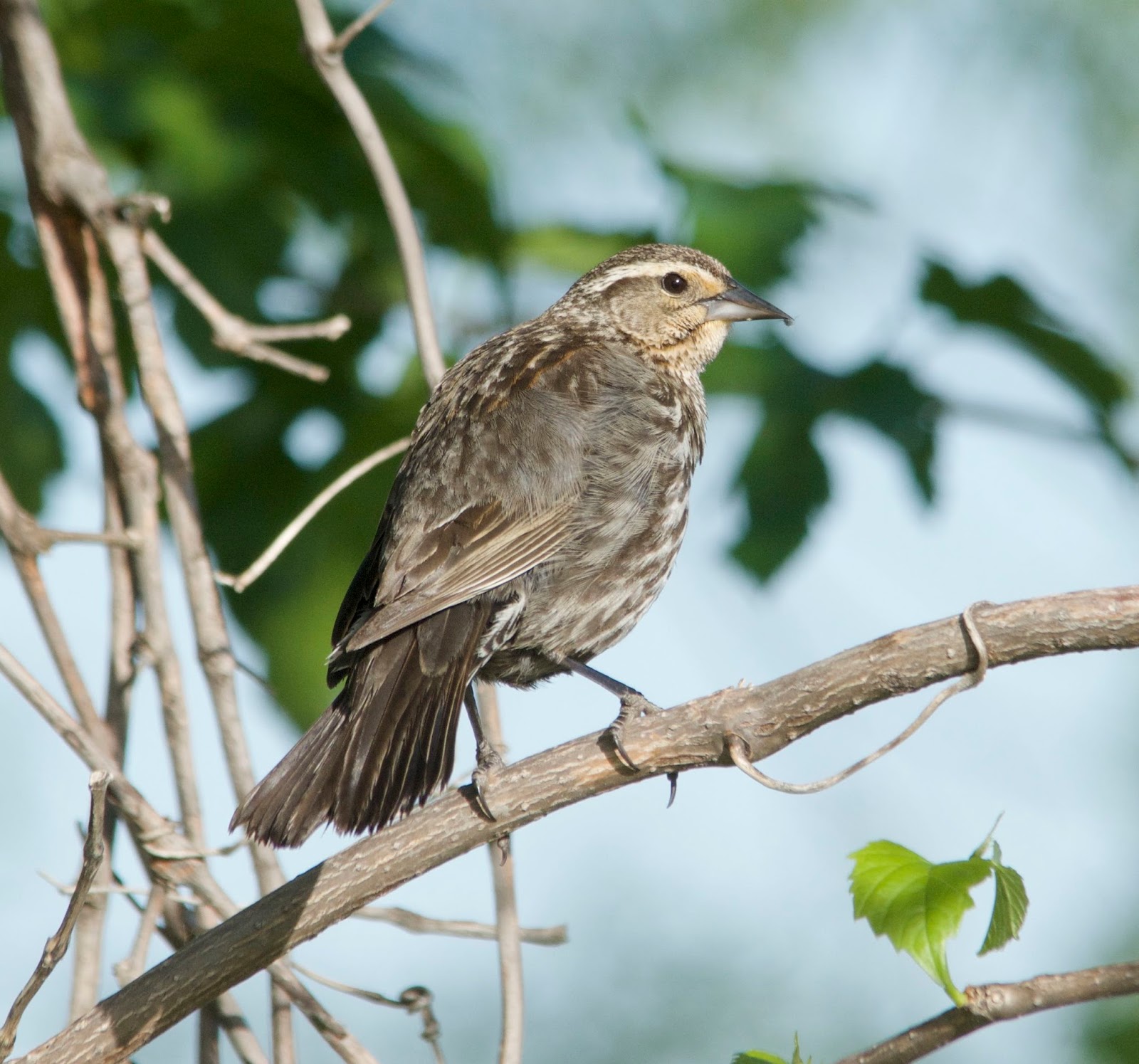
                                                        Red-winged Blackbird (Female)


                                                               Fledgling Eastern Phoebe


                                                                 Carolina Chickadee


05-03-16

0655-1030 hrs./46-67 degrees F/partly cloudy/15 mph winds

Yesterday was a most productive day, as there are babies both on Boomer Lake and Boomer Creek.
With the passage of time and good seasonal tailwinds, we have been very fortunate this year regarding what has been coming our way.  Every day that I go out for photographic opportunities, I thank the birds for giving me what they do, as being humble tends to keep humanity in check for the beautiful scenery in both flora and fauna.  As long as we help to protect it, we will have moments like these to enjoy, and I also thank you for allowing me to bring nature to you through my eyes.

The winds brought us wonderful things yesterday, like the Western Kingbird and Clay-colored Sparrow.  The Western Kingbird will stay here for the summer and bring us their young.  The Clay-colored Sparrow is a transient bird and breeds in the north central states and Canada.

The real surprise was out on Boomer Creek, where I found an entire family of Eastern Phoebes.  Both adults were actively feeding their three young, who had recently fledged.  Among this wonderful crop of nature's bounty were more Carolina Chickadees that I could count, also teaching their young ones the ways of their world and intruding them to their own little world.

This is the reason that we must make their world safe for them to continue their circle of life, and we must do our part to slow global warming as much as we can, and keep plastic and other trash away from their habitat.

Sunday, May 1, 2016

The Charge of the Boomer Brigade


                                                                   American Coot


                                                                Northern Cardinal


                                                                     Green Heron


                                                        Yellow-rumped Warbler(Myrtle)


                                                           Northern Cardinal(Female)


                                                            Painted Bunting (Male)


                                                               Yellow Warbler(Male)


                                                                    Cedar Waxwing


                                                           Yellow Warbler(Female)


                                                              Baltimore Oriole(Male)


                                                              Mallard Pair(Full Frame)


                                                             American Goldfinch
                                                        (Male- Breeding Plumage)


                                                                    Spotted Sandpiper


                                                                    White-faced Ibis


                                                            Northern Shoveler(Male)


0700-1140 hrs./49-59 degrees/15 mph to light and variable NW winds/partly cloudy

These photos were taken over the past couple of days, with weather conditions about the same.
The odd thing was, that when I was out early yesterday, it was mostly cloudy, then today it became
mostly cloudy when I was returning from my photo shoots.

Yesterday's shoot was the morning after a low pressure system, and with today still having a chill
and being the second day after the rain, subjects were still slightly extraordinary.  Females of the
species are now moving in, and last year's new birds will also be on their way after the females,
which is based on species hierarchy.

The first five photos were from yesterday.  It was good to see Green Heron again, and I now know
that the water snakes didn't pluck him from the grasp of the living.  Having keen vision for fishing,
he likely discovered either one or both snakes sunning near where one of the heron nests had been located last year and just took a few days to go elsewhere.

Most of the Yellow-rumped Warblers are in their breeding dress, which you will notice from the
earlier photos.  The yellow head patch is quite apparent and the rest of the yellow patches on the rump and on the flanks look just as bright.  The bird also has bright blue and black upon it, making
this a very striking spring bird, as the wood warblers are.

Today the Cedar Waxwings were coming through in large numbers, which I estimated at 225, which
is stable movement for just one species.  Our lake is very healthy with seeds, fruit, and protein, so
this will be another spectacular year.  Even though El Nino is bringing us cold fronts as well as a
great deal of unsettled weather, we will be the recipients of the more uncommon birds.  If I could only obtain photos of all the species that I see, it would be more helpful for you, but for various reasons, I cannot.  When in the deep woods, it is sometimes hard to have good movement in order
to quickly set up my gear.  Not only that warblers are fast, and many of them stay in the higher story
of a tree.

We are now in the presence of both Baltimore and Orchard Orioles, and I saw a female Baltimore
yesterday.  The beauty of the spring and summer birds is that they can go right to their nesting areas,
which isn't always in the same tree, but it is quite close.

A pin oak is located next to the restrooms on the east side of the lake, and several birds nest there
including the scissor-tail, both Baltimore and Orchard Orioles, and a Warbling Vireo has been
languishing there, as well.

The American Goldfinch has been around for the past couple of day in breeding finery, along with
two Cattle Egret today, one on the northernmost western jetty, and the other on Goose Island on the
east side.  Yellow Warblers are galore on the east side, three or four Spotted Sandpipers have been
doing their rocking rock in various locales, and there was a lone White-faced Ibis on the creek, as well as a couple of families of first born Mallard ducklings.  There are three Northern Shovelers in the vicinity, and this is an excellent area for many other beauties, too, like the buntings.

Take some time out to enjoy nature.  I promise you that you'll not be disappointed, unless you're
allergic to cottonwood fluff.  Perhaps I'll locate something new tomorrow.

050116 SNP Edition, Life at Boomer Lake

http://www.stwnewspress.com/news/lifestyles/life-at-boomer-lake-birds-and-snakes-never-get-along/article_5837960e-0f20-11e6-b532-ab2bf74f6279.html