Translate

Monday, August 20, 2018

Oklahoma Breeding Bird Species Profile: Prothonotary Warbler


Tsweet-tsweet-tsweet-tsweet-tsweet-tsweet-tsweet!

These sounds are familiar in wooded, tick infested swamps with a creek or standing water.  It is a clear, metallic song, and you should be able to observe this beauty, close to eye level once it gets to know you.

The male has a bright yellow head and breast with steel blue wings and black eyes and bill.  The species was named after Catholic clergy due to its primarily yellow attire.

A cavity nester, the pair will flit in and out of the old woodpecker hole that they have chosen, which is anywhere from seven to eighteen feet almost directly over the water.  When it is nearly May in Oklahoma, one waits with bated breath for this beautiful bird.

A New World Warbler, or wood warbler, the prothontary is an insectivore, and he will build several incomplete nests, while the female opts to build the real nest.  The birds favor insects and snails, which is why they are in favor of living by water, which tends to attract both of those food sources.  They will also eat seeds and rely on nectar, if necessary.


                                                          Male Prothonotary Warbler
                                                                  Red Slough, 2016

One of two cavity nesting warblers, it is often a victim of Brown-headed Cowbird parasitism.

These birds will use nest boxes, an old rural mailbox placed in or by the water, as well as old Downy Woodpecker cavities, and is often in the same area as other species of concern, namely the Yellow-billed Cuckoo and Red-headed Woodpecker.  They winter in mangrove swamps and lowland forests of creeks and streams in Central and northern South America.

This photograph was taken after trying to obtain one for a couple of years.  The bird was practically two feet away from my knees, perched over standing water in a swamp.  It had been calling to me, but due to the darkness, I was unable to see it at first.  It patiently waited while I got my shots, then returned to the nest cavity, not far from where I was standing.  It was worth the eight ticks to finally get this picture.


                                                        Male Prothonotary Warbler
                                                             Boomer Creek, 2017


Sunday, August 19, 2018

Oklahoma Breeding Bird Species Profile: Blue-gray Gnatcatcher


Very small and rarely standing still, the Blue-gray Gnatcatcher has two subspecies, the eastern and the western.  They also have a noticeable white eye ring, and a very defined blue-gray coloring.
The breathy and wheezing song can be heard before the bird can be seen, and that could be your only clue that they are in your presence.  However, during the fall, if they are still attending young, they will be a little more lenient to your view.

They glean small insects, usually from mid- to upper-story levels of trees.  In the east, they are riparian dwellers and foragers, and usually solitary.  The eastern birds nest in swampy woods and tend to favor broad-leafed, tall trees, especially oak which also is a favorite of most insects.  In the western regions, they tend to be located in mature brushy woods or thickets, as well as oak-juniper woods and chapparal.  Western nest in pinyon-juniper areas, open woods, or arid and dense brush.


                                                      Blue-gray Gnatcatcher, July 2016
                                                                      Boomer Creek
                                     
Once classed as an Old World Warbler, the male has a thin, black line over his eye and the long tail appears white from underneath.  The birds will often flutter while gleaning prey in foliage or around thin twigs.  Berries and fruit will be consumed in the winter.

Both sexes will build the nest, and the male often will show the female an assortment of sites on the territory, singing to her all the while as he perches during her inspection.  Both incubate fairly equally, as well as brood the young, who remain in the nest for close to two weeks.  The nests are usually made with spider silk and lichens.  They are attached either in small, high forks or on a horizontal branch.


                                                         Blue-gray Gnatcatcher Nest
                                                                           OK 2016

They are migratory, except in the extreme southern ranges.

081918 Muskogee Edition, Birding Today


http://www.muskogeephoenix.com/news/lifestyles/birding-today-bird-migration-begins/article_78d125d4-2292-5507-b016-17e82aef1023.html

Oklahoma Breeding Bird Species Profile: Western Kingbird


A bird of the western half of the US, the Western Kingbird is one of the tyrant flycatchers.  This flycatcher has white edges on both sides of the tail, a white throat and light gray breast, and has a high pitched and squeaky pidik-pik-pidik-pidik-PEEKado call.  It sounds like a sputtering car.

Many of these flycatchers nest upon manmade structures and have been comfortable for doing that for quite some time.  However, if they are in the countryside, they favor edge habitat like orchards, tree lined residential neighborhoods, hedgerows, grassland, desert scrub, fences, electrical or telephone wires, woodland or riparian edges, and many other venues.  They have adapted well to humanity and don't mind being in the close proximity of homo sapiens.


                                                                  Western Kingbird
                                                            Boomer Lake Park, 2016

This species is just as territorial as the Eastern Kingbird, Scissor-tailed Flycatcher and the rest of the kingbird clan.  When it is nesting season, they will drive any large bird out of the area, be it hawks or crows, yet several birds may share a single tree for nesting purposes.  They will many times repair a nest from the year before and reuse it.  The young fledge in about two weeks, but they still remain partially dependent.

Like the typical flycatcher, they will perch on branches and sally out after insects for both themselves and their young.  Oftentimes, they will return to the same branch and repeat the same activity after they have either eaten their insect or delivered it to a family member.


                                                         Black Mesa State Park, 2017

During courtship or while defending territory, they will display a reddish-orange crown, very similar to the Eastern Kingbird.

These birds are susceptible to pesticide problems, as they will easily encounter them while foraging around agricultural lands for insects.  They will dive for ground prey and search within foliage for protein matter.

They are a medium- to long-distance migrant, usually wintering in Central America.

081918 SNP Edition, Life at Boomer Lake


http://www.stwnewspress.com/news/lifestyles/life-at-boomer-lake-more-and-more-birds-drop-by/article_e09f35de-5da3-5b86-b987-aac65331350c.html

Saturday, August 18, 2018

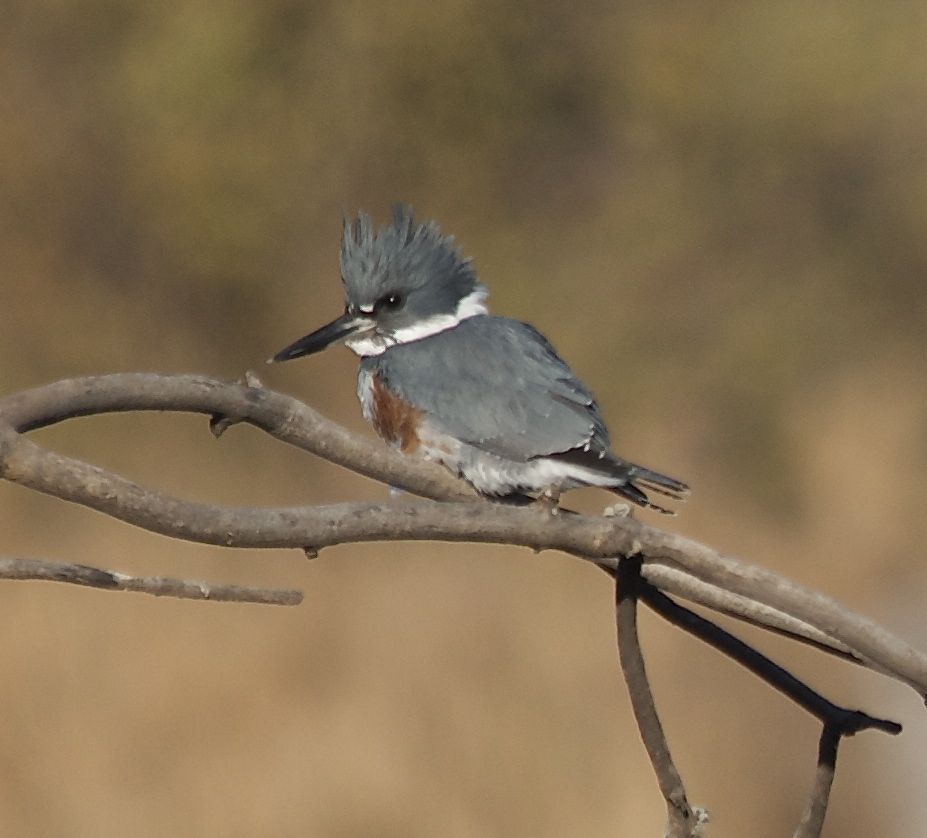
Oklahoma Breeding Bird Species Profile: Belted Kingfisher


Photographers can be birders, but not all birders are photographers, and not all photographers know the difference between a male and a female Belted Kingfisher, as can be seen in this video.  However, it was a good video to show how close one can get in a blind.

These uncommon but ubiquitous birds will fish for minnows on any exposed perch just a few feet over water.  They will hover, often like the American Kestrel to locate prey, and will even do the same for observers that they know mean them no harm.  They also will take lizard, insects, salamanders, frogs, and even mice.


                                                                Male Belted Kingfisher

Kingfishers dive headfirst to glean prey from the water and incorporate quick bursts of a couple of wing flaps with several slower ones in order for them to remain aloft and steady.

The only breeding kingfisher in Oklahoma, this pandemic breeder prefers to breed near water where they can set up nesting areas in sand- or mudbanks.  Sandy clay soil seems to be the preferred substrate and nesting is near a snag or a dying tree.  Nesting usually begins in late April or June.

Their preference for food lends to small fish, and the male will retire away from the nest site.  They have a large territory of a mile or better.  Young remain in the nest and under care for a good month.  They are taught to fish, then the parent will beat the fish almost to unconsciousness to provide good practice for their understudies.  Surprisingly, the young are fit to be on their own in about ten days to two weeks.


                                                         Female Belted Kingfisher


Their harsh, rattling call can often be heard before they make an appearance.

Most of the kingfishers that I have seen regularly are during the winter months where courtship is at a slow place.  Both sexes will appear shy for quite some time, then suddenly they see fit to pair.  After pairing, they show themselves occasionally, then get busy with nesting business. in the summer.


                                                              Male Belted Kingfisher

Fall Migration Is Appearing At Your Local Hotspots


                                                              Mississippi Kite


                                                                    Forster's Tern


                                                             Mallard Pair, Male on Right
                                                                        "The Guardian"


                                                          Mississippi Kite in a Stoop


                                                           First Year Great Blue Heron


                                                                           Ditto


                                                                           Ditto


August 2018

This is material from the first half of the month.  As you can see, the stars of the show are the Mississippi Kites, some of whom in Oklahoma lost fledglings out of various nests due to several violent storms over the past few weeks.  It is also believed that excessive heat was also a factor, perhaps causing some of the birds to vacate the nests whether or not they were ready.  A number of Blue Darters have been in the care of our local rehabilitator in Perkins.  To learn more about the Mississippi Kite, read the species profile here:

https://debhirt.blogspot.com/2018/07/oklahoma-breeding-bird-species-profile_21.html

A few days ago, after another round of storms, one also with sixty mph wind gusts, brought us seven
Forster's Terns.  The one above is a breeding adult.  Granted the photo is not the best, but you should note the trailing edges on the wings.  Not only is this beautiful, you can distinguish breeding terns by this characteristic.

The Mallard pair also struck me as a beautiful scene, so I also bring you that photo.  I shall later refer to it as The Guardian.  I believe it appears that the male is guarding the female.

The Great Blue Heron is a first year bird, hatched at our local rookery.  One can observe the dark blue coloring coming in, as well as dappled tan and white shoulder patches, or epaulets.  The chest and belly are also lightly streaked, and the legs are gray and green, also a juvenile characteristic.

Migration is upon us, so dust off those binoculars and share your migrants through eBird.