Translate
Tuesday, May 24, 2016
Babies and a Bird's Circle of Life
Juvenile(juvenal) American Robin
Recently Fledged Red-winged Blackbird
Immature Great-tailed Grackle
Bell's Vireo
Eastern Meadowlark
67-82 degrees F/0738-1018 hrs./12-15 mph wind gusts/partly cloudy
The weather has not been very co-operative over the past couple of weeks, for there has been
heavy cloud cover in the early morning or rain. The sun poked through the clouds relatively early,
so I ran out the door in hopes of getting a few photos.
As luck would have it, several of my first-seen of the day were young birds, which I have been
hoping for. For those of you that have never seen a young American Robin, this is a good example
of the spotted breast, which clearly shows that it is in the thrush family.
This recently fledged(not long out of the nest) Red-winged Blackbird was seen hiding in the weeds,
waiting for a parent to return with food.
This Great-tailed Grackle is an immature bird with feathers that denote it still as a young bird, but it still doesn't have the feathers of an adult. Note the bill, which is a good clue on the fact that this is
a bird in the grackle family. The tail is still a little short for an adult, the gape(mouth) still shows some yellow, and it is out in the open awaiting a parent to provide food. This bird is old enough not to draw attention to itself in order to attract a predator, like a hawk.
This lovely example of a Bell's Vireo is a singing male. Normally these birds remain in a dense shrub
or in the leaves of a tree, which tells me that this bird is actively seeking a mate or doesn't yet have
any offspring. This vireo was observed at the tops of trees at three different short-spaced occasions
on this morning.
This Eastern Meadowlark has been singing in the vicinity for quite some time. He had attracted a female several weeks ago, but the field where he and his mate had been trying to nest had been mowed once already. Either something happened to her, or she simply disappeared for whatever
reason, so he is still trying to find a female to mate with.
This is the time to be aware of young birds on the ground, so do watch where you step, even if on a
sidewalk. Also be aware that an adult bird is watching the young bird, so please don't take it away
thinking that it has been abandoned. Unless you are certain that this bird has been unattended for several hours, do NOT intervene. If you see the young bird covered with ants, DO take action and seek the help of a licensed rehabilitator. The ants will eat that bird alive.
For assistance in locating a rehabilitation, contact your local veterinarian or a warden.
Sunday, May 22, 2016
More Rare Neotropic Cormorants Are on the Homefront
Adult Female Orchard Oriole
Neotropic Cormorant
Breeding Plumage
Juvenile Neotropic Cormorant
Juvenile Neotropic Cormorants
Canada Goose
"King of the Hill"
Willow Flycatcher
05-21-16
80-86 degrees F/1500-1820 hrs./partly cloudy/15 mph SE wind gusts
A couple of us had been wondering about some of the cormorants that we'd been observing,
and both came to the same conclusion, but didn't dare to speak up that these were all Neotropic
Cormorants. I last photographed them together six days prior, but hadn't had the opportunity to
look at the photographs.
They were all observed again, yesterday, and I got better shots than on that cloudy day, and am
confident enough to say that they all ARE Neotropic Cormorants. The breeding adult is easy to
identify, but the juveniles are a little tougher. However, the clincher is the bill and surrounding area.
The juvenile nootropics also possess dark lores, whereas the more common Double-crested Cormorant has orange lores. All juveniles described are first year birds. Juvenile nootropics also have a dark breast, and the Double-crested variety has a light breast. Unless one looks quite hard for this, they will be missed, so from now on, look closely at your cormorants, or you could miss a real
find like these.
The Orchard Orioles have moved in, including the young birds from last year. There is one that
has been calling in a tree that belongs to some Eastern Kingbirds, who don't chase the oriole away.
They will remove other birds expediently, like the Northern Mockingbird, who is not a neotropical
migrant.
Another welcome guest that will be staying a while is the Willow Flycatcher, the above photo. We
also host the Least, Alder, Great-crested, and Scissor-tailed Flycatchers at Boomer Lake.
There are still plenty of young Canada Geese with more on the way. Both parents have been off the nests on warm days, so it is easy to observe the large, white eggs while they procure food for themselves.
Thursday, May 19, 2016
Monday, May 16, 2016
Rare Birds Are Still Gracing Payne County in Oklahoma
Red-bellied Woodpecker
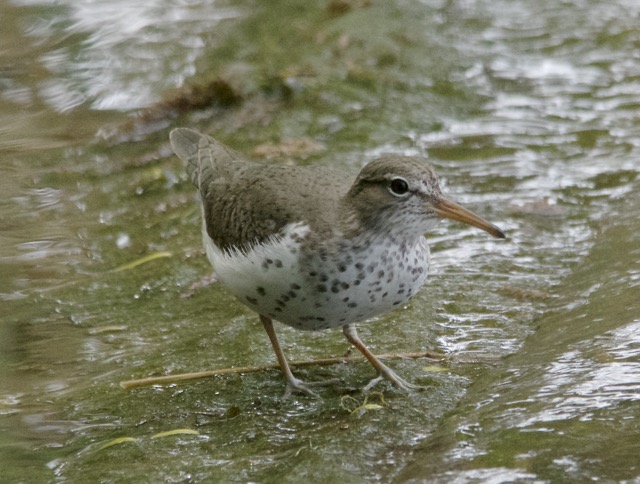
Spotted Sandpiper
Great Blue Heron
First Spring Hooded Merganser
Swainson's Thrush
Eastern Kingbird
Neotropic Cormorant
05-15-16
0900-1300 hrs./58-68 degrees F/partly to mostly cloudy/15 mph wind gusts
The day before the rain provided a good showing at Boomer Lake, namely the Neotropic Cormorant
who visited me between the northern jetty and Goose Island on the east side of the lake. This bird
arrived approximately a month ago, and has been with us ever since, which has been the first spring
it has ever been at the lake. Also, two first spring Hooded Mergansers dropped right in front of me
on the north side of the lake closer to the shore near the northern part of Goose Island. Nonetheless,
even though the Hooded Merganser can be in the area this time of year, they will most likely be resident birds. Normally, these birds are in the area only during the winter, so it is quite exceptional.
The remainder of the birds were photographed off Boomer Creek in the deeply wooded area. The
Swainson's Thrush was heard calling prior to the sighting, and there were also several warblers seen
and heard in the area, including the Prothonotary and Blackpoll Warblers. If you look hard at the Red-bellied Woodpecker, you'll see its long tongue protruding from its bill, which is how it gets all those delicious ants and termites.
It is expected to be good weather on Wednesday, so it is likely that more birds could be arriving in the
area, but until then, the current visitors are probably not going anywhere.
The Spotted Sandpiper, the Red-bellied Woodpecker and the Red-headed Woodpecker are all at home in the Boomer Creek area, as well as the stately Pileated Woodpecker. There is no question that these
birds are all raising youngsters. Hopefully, I might be able to spot a nest cavity tree, even in the thick woods. Time will tell.
Sunday, May 15, 2016
Subscribe to:
Posts (Atom)